
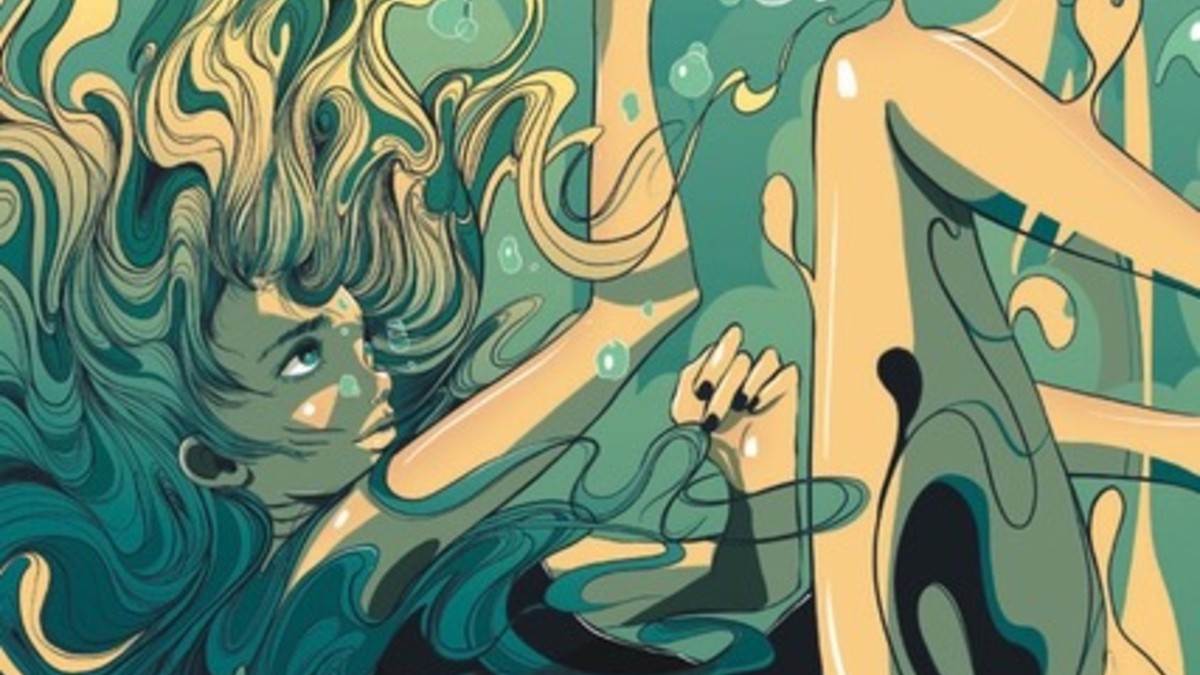
We’re all for fairy-tale retellings in general, but we admit we were immediately intrigued by the idea of a futuristic sci-fi spin on The Little Mermaid. How does that even work? Where did the idea come from? Author Susan Fletcher talked about all these pressing issues with Fangirlish, as well as sharing her sci-fi references and how she adjusted to writing for a younger crowd.
“The idea evolved over years and years!” Fletcher shared. “A long time ago, before I even knew about climate change and for reasons I can’t entirely remember, I began collecting stories about flooded cities. Old legends about drowned Welsh villages. Atlantis. True accounts of small towns and settlements inundated when dams were built to provide electricity. News stories about ancient cities swallowed up by the sea and newly discovered by modern explorers. Over time, I piled up pages and pages of notes.”
For a writer, all those things are leading somewhere. Even if it’s not immediately obvious. “I was hoping to find a story in there. I was thinking of something light and magical. But nothing really sparked until after my daughter grew up and got her PhD in engineering and microbiology. She told me that amazing stuff was going on in the field of genetics. So, I started to read about that.”
And then the story took a turn. “I can’t remember when I stumbled on CRISPR, the gene-editing technique. But the more I read, the more interesting it got. With CRISPR, we’ll be able to eradicate terrible diseases…and in time, we might also be able to create people who are stronger, faster, and smarter than anyone on the planet today. People with superhuman abilities, people who can smell as well as bloodhounds, maybe, or see as well as hawks. I’m not saying that’s a good idea. I’m just saying it might be possible.” And that it would probably make a good story.

“I remembered a story I used to love—The Little Mermaid–about a mermaid who changes herself to be with the human guy she adores. My old “flooded cities” fascination resurfaced and flowed into my new obsession with genetics and CRISPR. And I thought: Hey, what if I retold that old story using science, not magic? And at last, I was ready to write.”
And Sea Change borrows from “lots of science fiction novels that take an emerging bit of technology and imagine how it might evolve and affect the future,” Fletcher told us. “ Two books like this that I love are Ender’s Game, by Orson Scott Card, and Feed, by M.T. Anderson.”
But, even though Fletcher wasn’t trying to send a specific message, the book does explore “what might happen with human gene editing and sea level rise.” However, like all good stories, “on a deeper level, Sea Change explores ideas about being human. Being accepted for who you are. Accepting yourself for who you are. Reconnecting with people you care about, people who are different in some ways from you. Choosing to hope, no matter how dodgy and uncertain the future looks right now.”
This book is geared toward a YA crowd, and writing for younger readers is always different than writing for adults, just as writing for the YA crowd is different than writing middle grade. For Fletcher, “the idea told me who the audience should be,” she shared. “First of all, it’s a love story. Though it’s true that love stories work on a fairytale level with younger readers, I wanted this story to feel, I don’t know, more realistic and sophisticated in its treatment of romance. Secondly, the technology of human gene-editing is complicated, and the implications are not simple. I wanted to write for readers who were ready—and maybe even eager—to think about all of that. So I was hoping that the baked-in elements of the story would automatically appeal to young adult readers more than to, say, readers in elementary school. Beyond that, I tried to transport myself back to when I was a teenager and write from that perspective. Granted, that was really long ago, but those young adult years are thrilling and life-altering; you’d be amazed how long and how clearly you can remember them!”
Fletcher has been a professor for many years, something she says “Taught her to be a better writer.” But as often happens with the stories that really grab you, a little bit of it is about how well they’re written, and a great deal of it is about how much the story just speaks to you. And this one doesn’t just do that; it might just make you think about a lot of things differently.

Susan Fletcher is the author of fourteen books for young readers, including Sea Change, Shadow Spinner, Journey of the Pale Bear, and the fantasy series, The Dragon Chronicles. Her novels have been translated into ten languages and have received a Golden Kite Honor from the Society of Children’s Book Writers and Illustrators, as well as acclaim from the American Library Association, the Children’s Book Council, Bookriot.com, Natural History Magazine, Western Writers of America, Women Writing in the West, and more. Susan taught for many years in the M.F.A. in Writing for Children program at Vermont College. Reach her at www.susanfletcher.com.
