
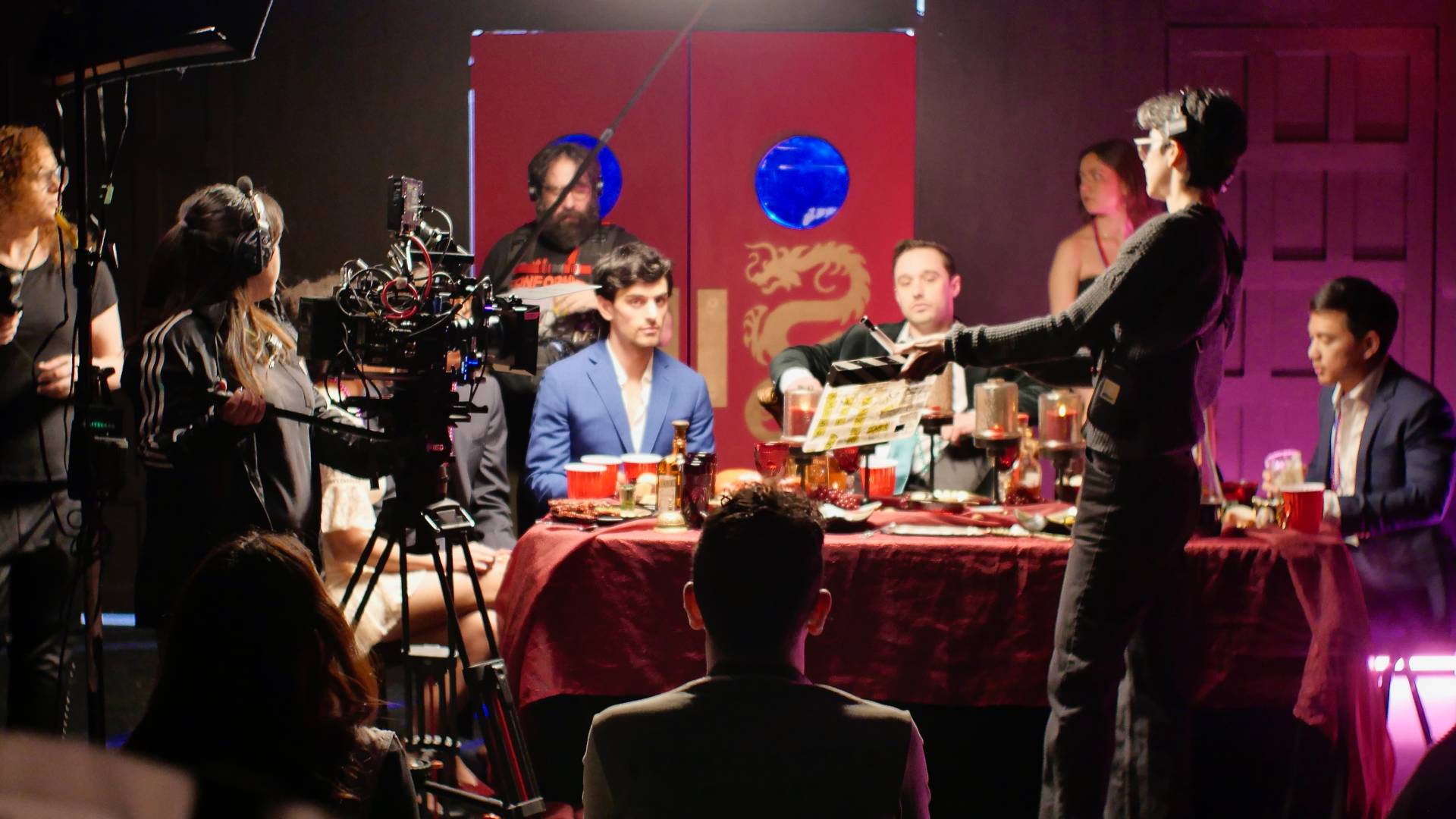
The creative process is always a combination of magic and determination. For Juancho Rodriguez and Zack Shaw, the two men behind the new dystopian short Just Die, the combination of a good idea and a desire to say something that has brought them to where we are now, with a finished product that they hope can resonate with others.
We sat down with the pair to talk about the idea behind Just Die, how this short is truly about mental health, and how they went from idea to script to actually making the short.
“I was always intrigued by taking a concept or idea and flipping it on its head,” Shaw told us. “Take The Last Supper. The image with Jesus and his disciples and everyone kind of looks up to it. But instead of being all elegant and pretty, it’s young people, eating grotesquely with their hands. And maybe not at a wooden table, but like at a fancy 3-star Michelin restaurant.”
What’s going on behind that? That’s where the story came to be. And you need a story behind it, a real story, to make it work.

“I started putting the idea and the concept to paper,” Shaw said, “I let the idea and the story breathe, and I was like: there’s got to be a real reason why these kids would be doing this, and it’s got to come back down to mental health.”
The why is simple—we live in a post-COVID world. And everything is different.
“It was such a big event that affected everyone in some sort of way, some more than others, right? But it affected young people the most. Some of these Gen Z kids who just graduated college, who graduated high school during that time or even just graduated recently, they’re a little broken, and it’s not their fault. They were stunted mentally, development-wise.”
It comes back to mental health, once again. And for Rodriguez, the idea behind Just Die is to be able to create conversation. “A normal Gen Z kid watches this, and they’ll get it.” Someone older might not. “I want to create that conversation, bridge that gap, because that’s what art is about, creating conversation, telling stories.”

And for both Rodriguez and Shaw, part of the process of creation is separating themselves from the final product. “If you try to make art, be it film, music, anything, and you’re thinking through the process of creating: ‘oh, will people get it? Will people like it?’ If you create art around that, you’re going to tie yourself into a knot because it’s impossible to create something that everybody likes.”
“We just have to make sure that we tell the best possible story, and whatever people get from it we just have to let that be.”
The best story possible, for them, involves a very diverse team—starting with an Asian man and a Latino man at the center. And that’s something the two of them were both very aware of, and didn’t really set out to do.
“It’s kind of not a thing to have a Latino creative with an Asian creative,” Rodriguez told us. “I mean, we’re both American. We have that in common. But we have completely different backgrounds. And what brought us together was the story. And then from that point forward, we just kept hiring the best people. And the best people just happened to be diverse.”

Sounds simple, but it often isn’t. “I would say, 90% of the crew was Latino. It wasn’t by design, but the movie was better because of it. And all our department heads were women. Every single department was led by a woman, also not by design. It just happened. They just all happened to be the best at what they did.”
“I love the diversity question because it starts with the directors in this case, with Zack and myself. And then it just naturally went down to the crew. But I would say that it wasn’t forced, and because it wasn’t forced, it was so wonderful.”
Just Die isn’t trying to be polarizing. That’s not what Rodriguez and Shaw were going for. But they’re aware that there are various interpretations of the story and the message, and they’re not just okay with that; they’re eager to see it. This is a labor of love, yes, but it’s also a very cool short with great visuals, an important message, and a very strong, diverse team behind it. All of those are possible.
