
Catriona McKenzie is the kind of director that should need no introduction, not for television fans. She has, after all, directed many huge projects, from Disney+’s Echo, to Outer Range, to Gen V, and the most recent episode of the Prime Video hit series The Boys, titled “The Insider,” which was released on July 11. But directors don’t always get the credit they rightfully deserve, and Fangirlish had a chance to talk to McKenzie about her latest directing endeavor, her independent film Satellite Boy, her general approach to directing action sequences, and how groundbreaking it is to see an Indigenous woman in her position have the success she’s had, and perhaps the most important thing we learned is that McKenzie is very, very aware of her position, and of trying to pay it forward.
“Everything I am is just who I am,” she told us. “I have a history that’s given me a way of looking at the world in a certain way, but at the end of the day, I’m a curious person who is interested in what it is to be human. And I carry my history with me. I’m proud of who I am.”
There’s also the importance of these stories having a platform to be told. “Working on Echo I developed friendships with various creatives. What a privilege to work with Tantoo Cardinal, Chaske Spencer, and Alaqua Cox, for example,” McKenzie shared. “Boundless native stories are waiting to be told and infinite ways for them to be told. The most important thing is that we have many voices telling them and there is access to a platform.”

But there’s also intentionality. “I’ve had the privilege to work on several American shows with Indigenous characters and storylines and all my history as an Indigenous filmmaker in Australia has allowed me to bring a fresh perspective on the story and a way to work with actors,” she shared. “When I started directing, I worked with lots of non-actors so I developed a process for that. In The Boys I’m working with consummate actors like Karl Urban, Anthony Starr, Claudia Doumit, Jack Quaid …they are all spectacular actors.” However, McKenzie believes that her “background working in remote parts of Australia gave me a very sharp eye for what’s important. You don’t f*** around when you are out in the bush. So, I like to get the work done efficiently.”
For her part, McKenzie tries to always “have a shadow with me on a production.” It all goes back to the fact that “the next generation of filmmakers and creatives need access. That’s important to me. It’s about having a wide, more expansive view of both the industry and the pure power of giving people access to platforms where their stories can resonate.”
McKenzie’s talents have taken her to many different projects “comedy, genre, drama. I believe doing comedy makes me better at drama and vice versa.” And her process starts with reading the script in a quiet place, “where I can sit with the material uninterrupted. I never get that opportunity again, so the first read is very important.” Then comes the character work, and after that, the story.
“I start with character. Who is this person and what do they want within the constraints of this world? Then what’s the story? Where do I place the audience? What are surprising ways to visually tell it? I like to have fun with it. My background is as a writer and I love the visual language of images. A picture is a thousand words and I love working out the quest of how to best visually bring character and story alive in an exciting way.”
But it’s different for every project. “For example, making Satellite Boy we were in a very remote part of Australia. The house I was staying in had a nest of Taipan snakes living under the house. There were saltwater crocodiles in the area. It’s a spectacular place and culturally strong but there are these wildlife considerations when you film there. I was working with non-actors. It was all on location. No studio work at all. So, the process is different but you still have to ‘play the ball’, tell the story, navigate the constraints of locations, and get it done. Seeing a call sheet with ‘keep a look out from crocodiles’ is no joke!”

The Boys, however, was very different. “We film in Canada. There’s lots of studio work on expansive sets. It’s a completely different world, and tone.” Plus, she wasn’t alone in the process. “Eric Kripke, amazing showrunner extraordinaire, absolutely knows the show. He knows what he wants. Paul Grellong, who wrote the episode I directed, is an extraordinary writer. We went through the process shoulder to shoulder.”
“I watched every season so I knew the world and where the characters were going in the story,” McKenzie told us, though she very fairly did ask if one can ever really know where The Boys is going and what the characters will do. The answer is no.
“The first time I read the script I saw it was a Christmas Special and I knew I was in for a ride. It was an amazing script with outrageous set pieces. A combination of stunts and emotional turns for the characters. John Koyama is the stunt coordinator. He’s an amazing force on the show. It takes weeks to build and train everyone up for the stunts. Stefan Fleet is the VFX guy. So much of the show is touched by VFX. The script had more stunts and outrageous moments than I’d read in a single script before.”

All in all, for McKenzie, it was quite the experience. And it helps that she’s always willing to try anything. “I don’t have the fear gene. I was more curious about how I could make it. How to make it the coolest episode.”
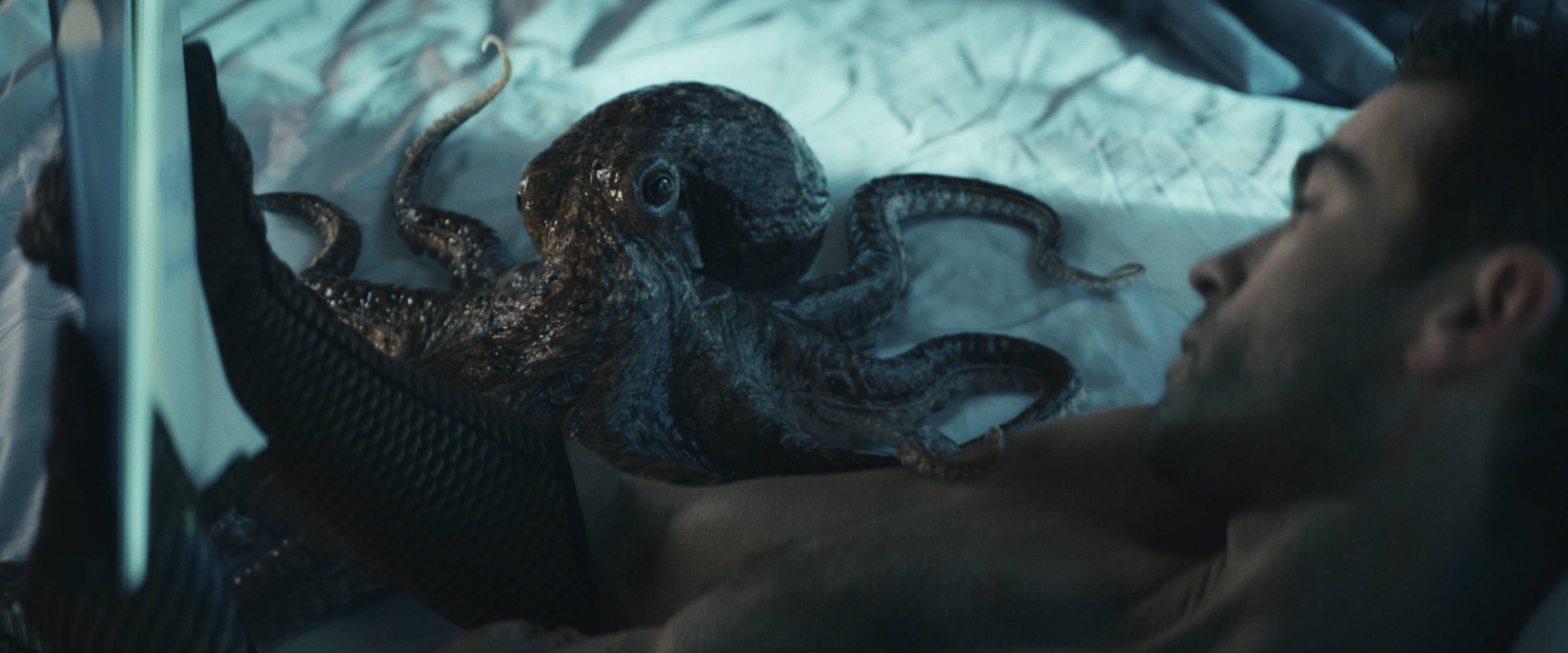
She has, of course, directed many iconic fight sequences before. But “whether it’s a huge stunt sequence or an emotional scene, it’s all about character. Action without heart is a schmeer of visual noise,” she shared. “The Deep and Ambrosia scenes are the perfect example of a technical scene and also a very emotional scene. The moment The Deep smashes the tank was technically very difficult to achieve. We rehearsed that one moment about 25 times before we shot it, and got it right on take 1”
“There was actor action, with physical water effects, with visual effects that all had to come together perfectly. One of the great pleasures of a shot like that is having a group of 80 people all absolutely focused on one singular moment. When I call “cut” and everyone is high-fiveing each other because it was perfect and awesome is a great feeling. And Chace Crawford who plays The Deep has hit it out of the ballpark with his performance. It really is a team sport.”
And the next step, for McKenzie, would be to continue to tell more stories. “Satellite Boy was a love letter to my father. It was a heart project. I was directing TV in Australia but I wanted to do a more personal side project. Making TV I’d met a lot of creative collaborators so I was able to bring them into the process and bring the crew together to make it happen.”
“In my few years in Los Angeles, I’m in a similar position and I am ready to bring people together and make projects. That’s the goal. Moving to a new country is an invigorating process and I have stories to tell about America. I love being here. I have stories to tell about this place. I’m taking all these experiences into my bag of tricks and preparing for my next steps.”
We’ll be paying attention.
