
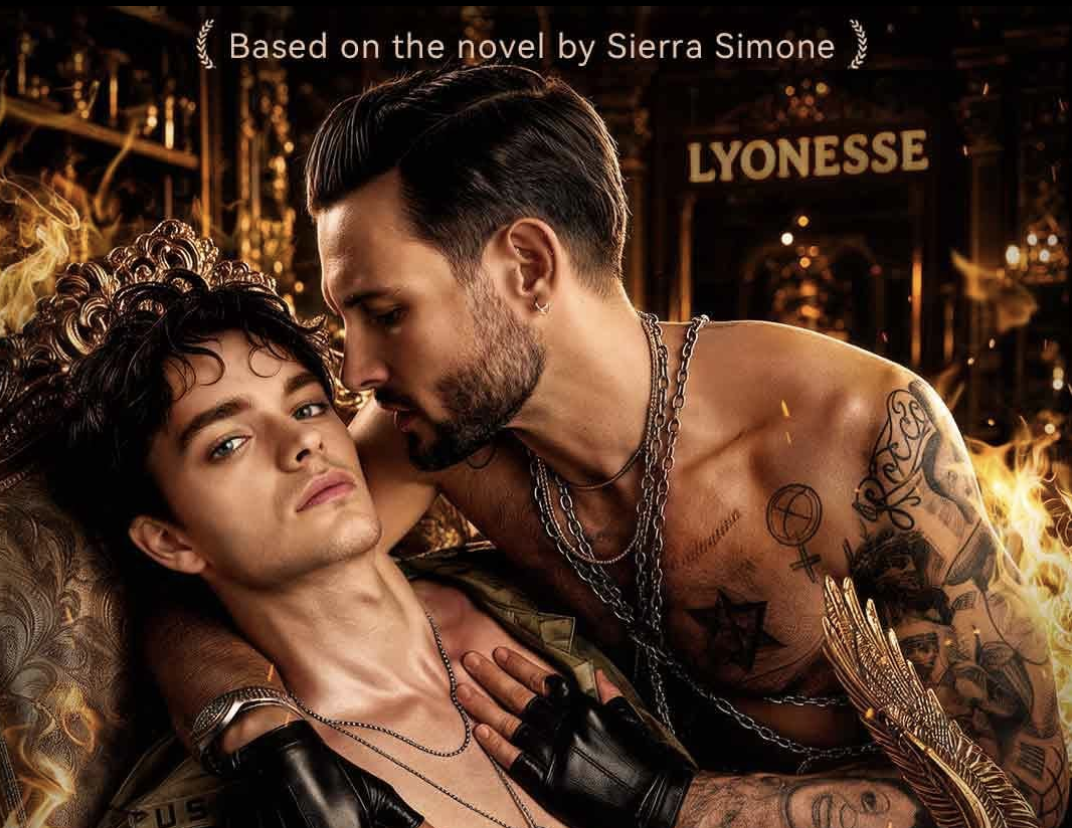
Well, this is something I truly did not see coming. Not even a little bit—and yes, I read the books.
SALT KISS, based on Sierra Simone’s dark-romance series, has all the elements readers expect from her work: intense dynamics, morally questionable men, complicated trauma, power imbalances, and enough spice to make you wonder whether anyone involved has ever heard of a healthy coping mechanism. Spoiler alert: they don’t.
Simone undeniably has a loyal audience, and there are readers who connect deeply with the heightened, erotic, emotionally messy worlds she creates. I can respect that, even if her books have never fully worked for me. Well, they have NEVER worked for me. I have found her books filled with plot holes or a lack of plot completely.
THE WHY
For me, the novels often felt like they prioritized sex over character development. The heat was there, but the emotional depth was not always enough to make me care about the people involved. I wanted more growth and more dimension so characters that could be relatable. It didn’t feel like the characters choices mattered beyond the bedroom.
I have never found that, ever. Her books have always fallen short.
Honestly, I never found that connection while reading Salt Kiss. I turned the pages, but I was never truly invested, not feeling protective of anyone. Ships be damned, I did not find myself rooting for a couple. I did not have that “just one more chapter” feeling because I needed to know what happened next. Instead, I kept waiting for someone—especially Tristan—to be given more room to exist as a fully realized person.
Her books have always made me want my time back. I just have this weird thing where I always finish a book I start, because I keep thinking it will get better.
TRISTAN
Tristan is a character who should have had me in a chokehold. He is carrying the fallout of war, trying to understand who he is outside of the life his family has demanded from him, and searching for any possible way to escape the expectations that have shaped him. His father, an army general and genuinely one of the worst kinds of men, looms over so much of Tristan’s emotional life. The damage and the anger is there. The potential is absolutely there.
I wanted more consequences for the people who hurt him and I wanted him to receive the help that he needed for his PTSD. The people in Tristan’s life needed to recognize what had been done to him. I wanted him to have support, accountability around him, and space to confront the ways he has been forced to suppress himself just to survive his family’s expectations. His story is about more than romance. It is about identity, abuse, legacy, trauma, and the cost of being raised to believe that love is conditional.
That is why Jake Lively’s performance surprised me.
LIVELY
Lively has been steadily growing and impressing me, showing his versatility as an actor. Early on, some of his roles felt safe—which is not necessarily a bad thing. There is nothing wrong with taking roles that let you find your footing, especially when you are building a career. And regardless of his family name, Lively is clearly putting in the work to stand on his own. If he were simply relying on connections, I do not think vertical dramas would be where he was proving himself.
But Lively has shown real range. One project, he is the fresh-faced football star. Next, he is playing the stepbrother who is way too obsessed with his stepsister. He has found a lane playing the bad boy, the athlete, or the guy everyone wants a piece of—and he does it well. But Tristan feels different.

COMPLICATIONS
Here, Lively gets to play someone more emotionally complicated. Tristan is not just a brooding guy with a tragic past. He is a person desperately searching for stability, affection, and a version of love that does not come with manipulation or cruelty attached to it. He has spent so much of his life suppressing who he is to make his family happy, and the consequences of that repression have shaped every part of him.
Lively understands that Tristan’s vulnerability should not make him weak. He lets the pain live underneath the character’s choices, even in the moments when Tristan is defensive, angry, or making decisions that are not exactly easy to support. There is a sadness to him that makes you want to reach through the screen and remind him that he deserves more than the life he has been given.
Then there is Mark Trevana, played by Nico Tortorella.
TORTORELLA
Mark Trevana is a very specific kind of awful. He’s genuinely got issues and needs to be knocked down a few pegs.
I would love to say that I like him because I love Nico Tortorella, but that would be a lie. Tortorella, I have always found them talented, intriguing, and able to bring something unpredictable to a role. But Mark Trevana? Absolutely not. I do not like him, did not trust him. I do not want to be within a five-mile radius of his attitude. He’s a miserable human being who acts as though he’s a god, when really he seems to be the devil in disguise.
Trevana owns a sex club, and to be clear, that is not the issue. Make your money, sir. Do your thing. I am not here to kink shame anyone. What makes Mark unbearable is not his profession or the world he operates in—it is his belief that he is above everyone else. He has this deeply frustrating need to control every situation, every person, and every outcome around him. It’s impossible to deal with. His trauma is obvious, and yes, there is clearly something broken beneath all of that arrogance. Trauma can explain behavior; it does not excuse treating everyone else as if their needs, feelings, and boundaries do not matter.
THE PERFORMANCE
That is what makes Tortorella’s performance so effective. They make Mark so irritating, so controlling, and so emotionally exhausting that you cannot look away. You may hate him, but you are invested in him—and that matters.
I have always believed that one of the best signs of a strong performance is emotional investment. If you love a character, the actor has made you feel something. If you hate a character, but you are yelling at the screen, throwing your phone onto the couch, and desperately waiting for someone to finally call them out? The actor has still made you feel something. That reaction means you care about what happens, even if the only thing you want is for that character to be knocked down several notches.
WHAT I WANTED
Tortorella has always been a compelling screen presence, even in projects where the character did not fully work for me. But with Mark Trevana, they make the character impossible to ignore. I hated him and wanted him to suffer. He needed to feel even a fraction of the pain he causes other people. I wanted someone to tell him that he is not the smartest person in every room.
And yes, I screamed at the screen. Yes, I threw my phone a few times.
That is not because the performance failed.
That is because Tortorella made me care enough to be furious.
STEALS THE SHOW
Lively, though, is the one who truly steals the show. He makes Tristan’s journey feel bigger than the romance at the center of it. Watching him, I found myself thinking about who Tristan was before everything happened to him, what he has had to bury to survive, and what he actually needs in order to become the man he wants to be.
That is the part of the story that worked for me most. Tristan is searching for love, yes, but he is also searching for safety, acceptance, and the freedom to exist without constantly performing the version of himself his family expects. Tristan is also searching for himself. Lively gives him an emotional openness that makes the character easy to root for, even when the story around him gets messy. You want Tristan to find something steady. You want him to learn that he deserves care without having to earn it through obedience, pain, or sacrifice.
STRUGGLE
I still struggled with understanding how Tristan fell in love with Mark Trevana. To be completely honest, Trevana is miserable. He is controlling, emotionally unavailable, and so determined to stay in charge that he often seems incapable of recognizing how much damage he is causing. There were plenty of moments where I was looking at Tristan and thinking, “Please stand up. You deserve better than this man’s terrible attitude.”
But even when I did not fully understand the feelings developing between them, I found myself wondering whether they could bring out something better in each other. Could Tristan’s tenderness challenge Trevana’s need for control? Could Trevana, beneath all of his deeply frustrating issues, offer Tristan a kind of protection or stability he has never had before? Those questions gave their relationship more tension than I expected—and, importantly, they were questions I never found myself asking while reading the books.
THE FEELS
The adaptation finds more emotional texture in their connection, even when the relationship remains complicated and sometimes incredibly hard to support. It does not make Trevana easier to like, but it makes Tristan’s perspective easier to understand. There is a difference between saying a relationship is healthy and recognizing why two damaged people might be drawn to each other. The series is more successful when it lets that exist.
What I did genuinely love was the language around kissing. Kissing can be one of the most intimate things two people do together. Sex can be physical, passionate, impulsive, and complicated—but a kiss, especially a meaningful one, often requires a different kind of emotional surrender. And do not even get me started on forehead kisses, because that is an entirely separate category of romance and I will not be taking questions at this time.
RESISTANCE
Trevana’s resistance to kissing Tristan says so much about him. He can handle desire when it is controlled, detached, or on his terms. But kissing requires vulnerability. It is harder to pretend that a kiss means nothing, especially when it comes from someone who is slowly becoming important to you. So when Trevana finally kisses Tristan and follows it by breaking his heart? I was furious.
It felt like a slap in the face—not just for Tristan, but for the person he is trying so hard to become. Tristan is beginning to let himself want more. He is beginning to trust. He is beginning to believe that maybe he could have a life beyond his family’s abuse, expectations, and emotional neglect. Then Trevana gives him this moment of intimacy and immediately turns it into another wound. I hated it. I hated it for Tristan. And I hated it because, in that moment, Trevana proves exactly why he is so difficult to root for.
THE WHY
I still find myself wondering what made ReelShort want to adapt this particular series. There are so many dark romances and queer romance novels with stronger characterization, deeper emotional arcs, and stories that might have translated more naturally to the screen. On paper, Salt Kiss would not have been my first choice.
But I will say this: the adaptation is better than the books.
That comes down largely to Lively and Tortorella. They bring enough emotional investment, chemistry, and character work to make the story more compelling than it was on the page. The way they are will make you curious about Tristan’s future. They make you react to Trevana, even when your main reaction is wanting someone to shake him until he realizes he is the problem.
IN CONCLUSION
Are there plot holes? Absolutely.
Are there moments that made me pause and say, “What in the actual hell is happening?” Also yes.
But if you can separate the drama from the source material—and let go of the expectation that it needs to be a perfect adaptation—it is not bad. It is messy, dramatic, occasionally ridiculous, and emotionally uneven, but it is still watchable. It is still a story that gives you something to react to.
And honestly, there are much worse things you could be watching.
