“People need stories,” Larry Lamb (Jack O’Connell) says at one point in Ink, and that feels like the entire thesis of the movie. And in so many ways, of the current political climate. We’ve gone far beyond telling facts and into telling stories, and stories have a lot of power in shaping people’s opinions. If you’re going to believe anyone, believe the man who made the British tabloid The Sun what it is today.
The movie, directed by Danny Boyle and adapted from playwright James Graham’s recounting of how The Sun basically launched tabloid culture in the UK, is a fast-paced, intriguing look at the behind-the-scenes of journalism. It’s also a very obvious warning about the dangers of pushing ethics out of the profession, and choosing to take a side in the stories you’re supposed to be reporting on without bias.
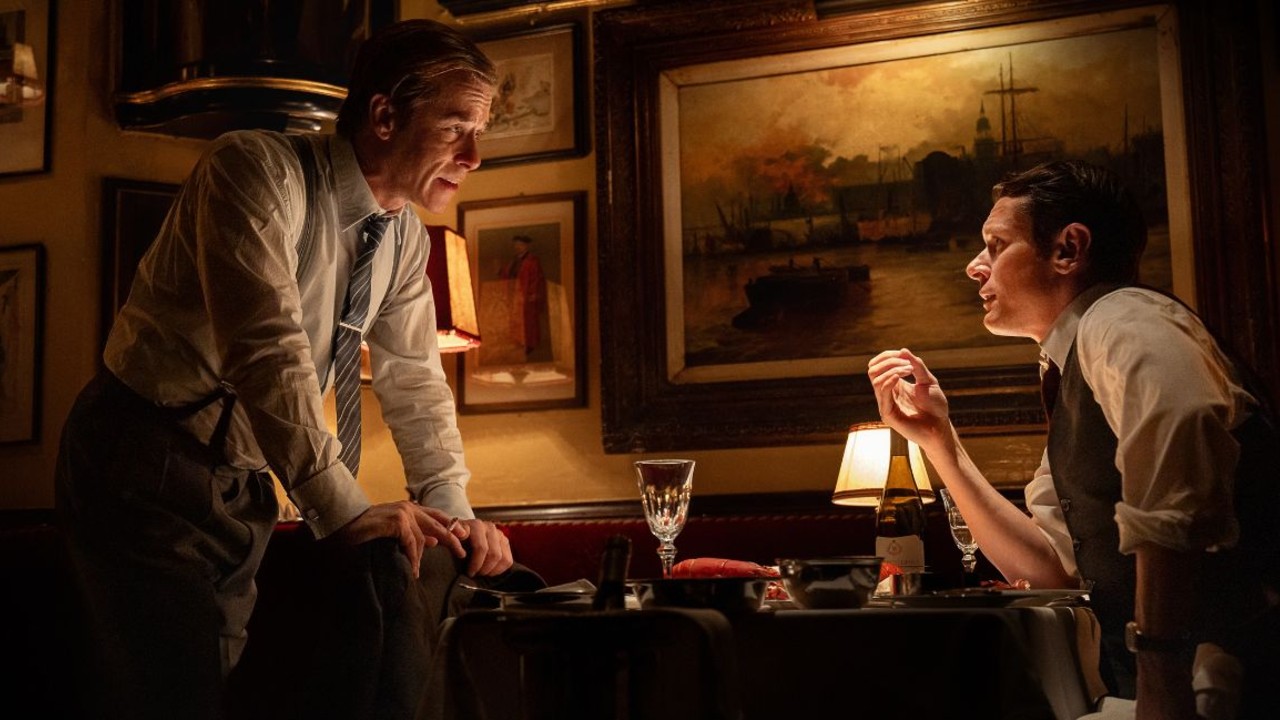
It all starts when Rupert Murdoch (Guy Pearce) convinces newspaper editor Larry Lamb to oversee his newly acquired daily, The Sun. Murdoch wants to sell more, and Lamb wants to be respected. Lamb’s solution? Cover topics no one else is covering, in ways no one else dares to. It works, almost too well.
The mechanics of how The Sun becomes so popular are really well told, and the movie never flags, but there’s a distinct lack of interest on Ink‘s part in attaching too much of a moral component to the story it’s telling. Is it a good thing, what Lamb did? The movie takes a little too long to take a side, instead choosing to let viewers decide. For some, it might work well. Others, however, would likely appreciate more of a message.
MORE: La Bola Negra TIFF Review: This is Why It’s Important to Preserve LGBTQ+ Stories

Murdoch’s character, in particular, suffers from the decision to be somewhat morally ambiguous. It’s easy to track Lamb’s descent, and the decisions he makes that take him not just over the line but way past it. The movie even has one character, Joy (Claire Foy), who is basically there to be Larry’s conscience. It’s a very shallow role, one that Foy makes almost more interesting than it should be.
But since she doesn’t serve the same purpose for Murdoch, we’re left with a characterization that at times makes him seem like a pretty decent guy who just wants to sell newspapers. He, in fact, at one point warns Lamb about going too far. Yes, Rupert Murdoch. The character we see onscreen is so wholly inconsistent with what we know of the man that it is, at times, shocking. But considering this starts in the 70s, we have no choice but to give the movie the benefit of the doubt that, at some point, we’ll understand the story it’s trying to tell with Murdoch.
MORE: In Waves TIFF Review: Bring Tissues
We never really get there, however. By the time we get the final conversation between Murdoch and Lamb, the roles have reversed. Murdoch is the bad guy, Lamb the victim. It’s just very hard to trace how they got to that place considering what we’ve seen. The movie then uses its final minutes to try to cram in the message it never effectively conveys during its runtime.
It still somewhat works, because the message is strong. But like most of the movie (AI mice and all that), it never works as well as Boyle wants it to. Instead, this ends up being just another movie about journalistic ethics and the hold stories have on us, one that ends with a moral teaching, just like fables do, but that forgets to imbue that into the story from the beginning.
Ink screened at the Toronto International Film Festival. The movie will be released in select theatres in the United States on 11 December 2026, before releasing on Netflix on January 8, 2027.
