
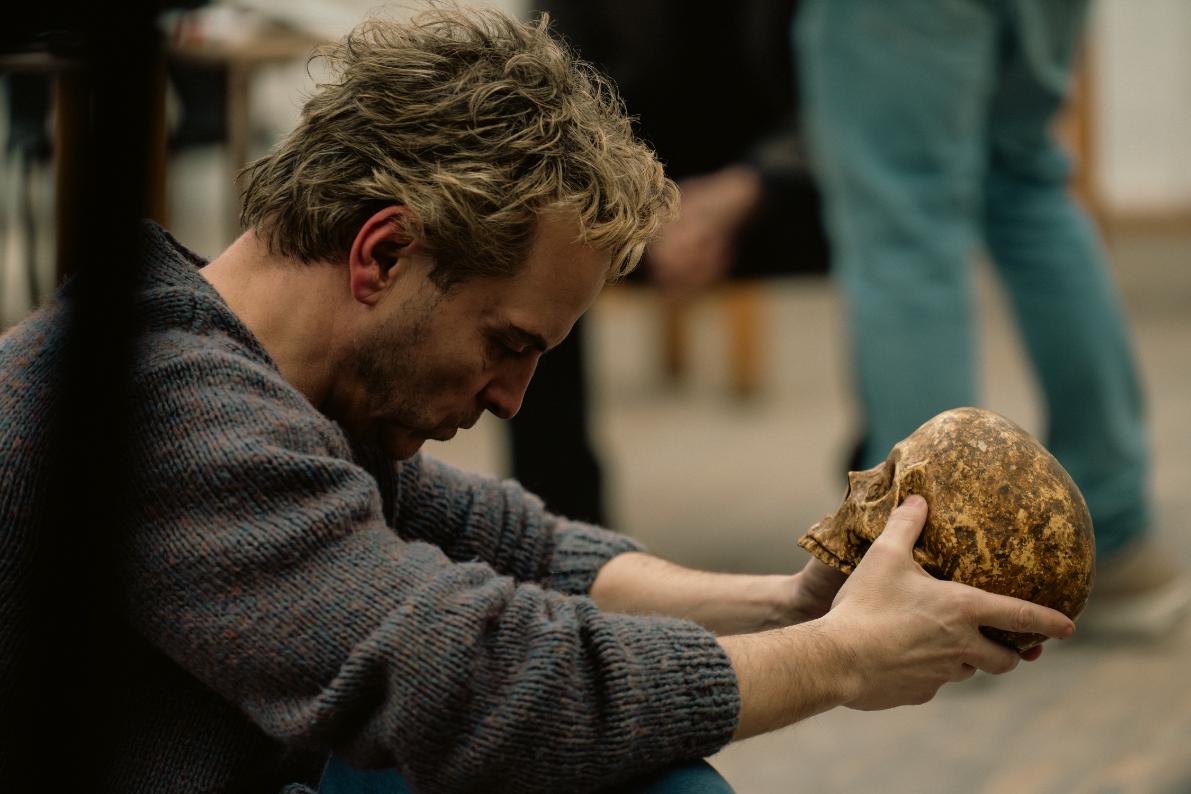
If you know Andrew Scott, then you know he’s no stranger to disappearing into a role. It’s like when he dedicates himself to a character, you don’t know where he starts and the character ends. And even though I know it’s his face, I feel like I’m meeting a new person every single time he’s on screen. He did that when he played Jim Moriarty on Sherlock, my first experience with Scott, and he’s continued to do that with every single series or film of his that I’ve watched. And he did that again in Simon Stone’s Elsinore.
The biopic Elsinore tells the story of Ian Charleson and the incredible odds that he faced while preparing to give “the performance of his life in Hamlet at the National Theater in London.” As someone who didn’t know who Ian was before this film, I felt like I was learning important queer history that didn’t shy away from the reality that he faced, the stigma surrounding AIDS, and his unfaltering love for theater and the performing arts. And Elsinore ended up being a film about art that was masterfully woven together with hope, kindness, and a community that has kept LGBTQ+ strong since the dawn of time.
MORE: La Bola Negra TIFF Review: This is Why It’s Important to Preserve LGBTQ+ Stories

Back to what I was saying about Scott disappearing into his characters. Throughout the film, Ian is giving himself over to the craft because this is what he loves. And it doesn’t matter if there’s a diagnosis that’s making his dream harder, he’s still going to do the thing he loves. Because he wants to create an experience for the audience where everything else fades away and they’re going through this epic with him. And I think that’s what Scott did himself in Elsinore. I stepped into the movie with him. I experienced everything through his eyes and his character. And I forgot where Scott started and Ian ended. But I also forgot where I ended and this movie started.
The strength of Scott’s performance was also due to his co-stars. Because, like I said, it takes a community when you’re part of the LGBTQ+ family. And it’s not just those you share blood with. It’s those who choose you and that you choose in return. One of Ian’s biggest supporters was his real life friend Patsy Pollock. For the biopic she was played by the talented Billie Piper. And I felt like through her I saw people that I’ve known in my life, who would go to the literal ends of the Earth, while cleaning up my vomit, and/or cooking me dinner because they chose me.
MORE: Bedford Park TIFF Review: Inmigrant Families Are Not All Alike

Then there’s the rest of the characters in Elsinore. Because a lot of times when it comes to queer films on the big screen, there’s usually only one queer person. Elsinore had plenty. There were queer people in all stages of this movie. And even better, Elsinore didn’t have these queer people in a continuous cycle of suffering and pain. This movie is about pursuing your dreams, doing what you love, and loving openly while facing those insurmountable challenges of life.
Elsinore is about the beauty of the LGBTQ+ community’s perseverance. Because we have so many things working against us. But we still create, flourish in unexpected and wondrous ways, falter and get back up, and so many other achingly human things. And we do that all in the face of continued pressures to stop us, ignore us, or just completely erase us from every facet of existence. Ian didn’t let anything erase him. Not his disease, not expectations, and not what others thought he should be or could be.
MORE: Love Is the Monster TIFF Review: Haunting, but Real

And if there’s anything that you should walk out of Elsinore with, it’s a renewed vigor for the things that you are passionate about. Because as cheesy as this sounds, this is your life now. You might as well live it the way you want, with who you want, and doing the thing that makes every cell in your body light up.
Elsinore hits theaters November 20, 2026.
