
SPOILER ALERT: The following contains spoilers for Chicago Med Season 12, Episode 6.
Tomorrow came quickly on Chicago Med. Season 12, Episode 6 pays off a lot of the potential that the NBC series set up in “Tomorrow, and Tomorrow, and Tomorrow,” as the show prepares to wrap up the first part of its cycle. And aside from one incredibly obvious subplot, “Lessons in Chemistry” weaves all the material together well, leaving the actors to once again prove that this ensemble cast is underrated.
Deanna Shumaker—whose other credits include last season’s superlative “Altered States”—not only pulls together all the plot threads, but does so with the right character combinations. The main case of the week involves suspected murderer Lance Carpenter (played by The Americans‘ Kelly AuCoin), who turns up after having a seizure while penning his memoir with a writer who doesn’t know she’s his daughter. At first blush, this potential-killer reveal and father angst feels like Med already did this with Dr. Sarah Reese and her dad. But Shumaker takes a different tone than that, keeping the creepy factor to a minimum and revealing that Lance’s other secret is a brain tumor he waited too long to treat. The case also teams up Dr. Mitch Ripley and Dr. Daniel Charles, both of whom know about complicated pasts, both together and separately. It’s always a pleasure to see Ripley and Charles together because it’s a way to chart the evolution of their dynamic, but in this instance, it also quietly serves as character development for them both. Charles, who begins and ends the episode with settling his mother’s affairs, can understand learning more about a parent. And his presence is an opportunity for him to give an overstressed Ripley some advice on being the involuntary Chief of Emergency Medicine.
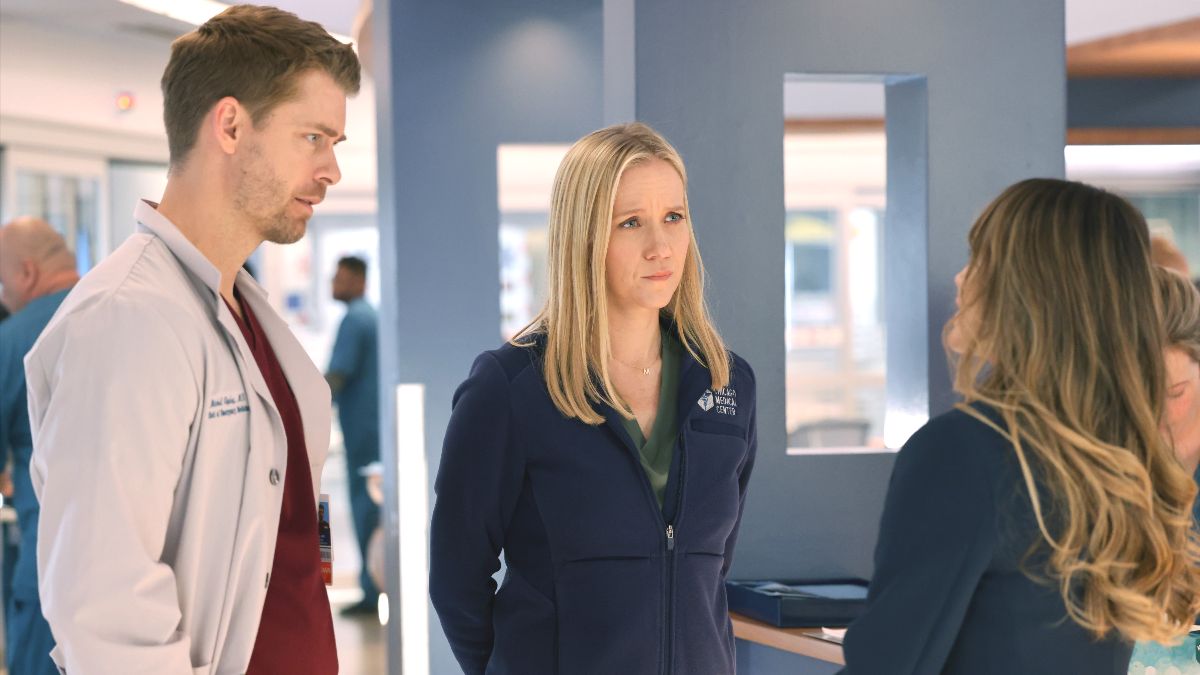
Ripley has almost too much to do in this episode, serving as a sort of connective figure, with a presence in the two biggest stories and having the biggest personal subplot. That demands that actor Luke Mitchell shift gears quite a bit—as Ripley goes from sympathetic in one story, to angry in the next, to relieved in another—and Mitchell carries it all off well. It feels like one continuous arc for Ripley, rather than three separate beats, as if fans can see how all that stress is kind of messing with him. It’s a nice subtlety to Mitchell’s performance, because TV dramas can talk about how under pressure a character is, but the audience doesn’t always get a chance to feel that. Ripley Watch is at an all-time high this week, as he tries to help Lance’s daughter Melody, then has to interject when the unhoused couple from Episode 3 get kicked out of the hospital, and then is surprised by the welcome return of Dr. Caitlin Lenox. Ripley does what he should (and what everyone wants to do) in standing up for Harper and her unborn baby, not holding back at all when he tells Mallory Sloan that she’s “doing the job wrong” and she ought to “stay in your lane.” Chicago Med‘s doctors have blown up on ill-informed bureaucrats before, but this time is one of the most memorable because of that not mincing words, and because it’s Ripley fully stepping into the role as ED Chief. It’s also more entertaining when viewers remember that Mallory is played by Luke Mitchell’s wife Rebecca Breeds. Not only is Chicago Med giving them significant screen time together, it’s giving them great material.
But surprisingly, it’s not Ripley who has the episode’s massive explosion. That honor goes to Dr. Hannah Asher as Jessy Schram has possibly one of her best moments in the entire series. As soon as Harper leaves, One Chicago viewers know she’ll be back and it won’t be good. Shumaker stops short of full tragedy, but Hannah has to perform an emergency C-section that ends in an involuntary hysterectomy and a baby who may or may not survive. She then storms upstairs and spells all of that out for Mallory and Meredith, and Schram is positively riveting. This is one of the scenes that’s going to define Hannah’s character. It’s impressive not only from an acting point of view, but to pause (after the emotional gut punch) and look at how far Hannah has come since she was first introduced. It’s appreciated that Shumaker even went back to Harper’s storyline—a lesser show would’ve just never mentioned the character again, out of sight and out of mind—yet she doesn’t simply wrap it up, she uses it as a flashpoint for the season’s biggest battle and a heroic moment for Hannah. With Episode 7 poised to be Hannah-centric, one wonders if this scene will reverberate into the future.

Elsewhere, Chicago Med finally brings back Lenox and while Sarah Ramos has limited screen time, it’s good to see her again. Lenox has already been largely off-screen for five episodes—which could wind up being a whole quarter of the season, depending on how many hours are in Season 12—so it’s time. She also arrives when the hospital needs Lenox’s no-holds-barred personality; if anyone can help take the fight to Meredith, it’s Lenox. The only disappointment here is one that just can’t be avoided, which is that it truncates Ripley’s arc as ED chief. There’s a reminder early in “Lessons in Chemistry” that it’s been three weeks, but this is the first episode to dig extensively into what that means for him. The medical dilemma he faced in “Baptism by Fire” was a good moment, but Episode 6 is a broader examination, and it has to come to an end because it wouldn’t be fair to have Lenox return only to sit on the sidelines. On that note, it would’ve been great for Lenox and Ripley to have a longer and more serious conversation, instead of a brief storage-room fling. They have so much to talk about and yet their reunion scene barely scratches the surface. Hopefully the next episode doesn’t reset the status quo and allows the show to explore what they’ve had to go through while they were apart.
The only part of “Lessons in Chemistry” that falls flat is the third plot, which gives the episode its title. Dr. John Frost and Dr. Annie Wu treat a pair of bickering chemistry students, and this story doesn’t work because it’s very obvious throughout that the medical case is a construct to draw attention to Frost and Annie’s own thawing conflict. The guest characters aren’t as well-developed as they are in the other plots, and when the two students admit they don’t actually hate each other, it’s almost like they’re stand-ins for Frost and Annie. One wonders if Chicago Med is pushing the two of them toward an eventual pairing—and that isn’t necessary for either one to be an interesting character. Plus, the memory of how abruptly the writers pulled the plug on Frost and Naomi is still relatively fresh.
Yet that’s the only sizeable complaint in an episode that hits almost all of its other marks. Shumaker even makes Mallory into an actual three-dimensional character, as she’s visibly affected by Hannah’s speech and later expresses her regrets to her predecessor Sharon Goodwin. This may feel minor compared to everything going on with the main characters, but it’s actually pretty brilliant on multiple levels. Firstly, Breeds and S. Epatha Merkerson are wonderful in their scene together. But now the audience sees Mallory as a human being and not just the walking embodiment of the hospital’s latest bureaucratic edict. The question early on was what would make the Meredith arc different from all the other times Chicago Med has played its anti-establishment card—and now the audience knows. Mallory feels like a person, instead of the usual archetype where the bureaucrat either is just a flat-out antagonist (see: Meredith) or maybe does a nice thing at the end before disappearing. She’s going to have her own mini-character arc, and it’s going to be interesting to see how that develops, because rarely do fans get that kind of insight into the people on the other side of the table. That means more screen time for Breeds, who’s been a great addition. And that also makes Mallory a weapon in the heroes’ arsenal, because Goodwin and Doris definitively uncover Meredith’s plan: she’s using the overflow room for uninsured and underinsured patients, discriminating against those who are less profitable. Viewers probably guessed this early on (that overflow room wasn’t here for a good reason), but it’s good to have it spelled out. And Mallory brings a perspective to that conflict that’s different from everybody else but Goodwin. It gives fans even more of a reason to be excited for the inevitable showdown.
“Lessons in Chemistry” takes all the ideas that Chicago Med Season 12 has been playing with, and gathers them up into one coherent basket. But it’s not just checking off plot boxes: Shumaker uses this as an opportunity to grow characters and pairings, whether it’s Ripley with Charles, Hannah, Mallory and Goodwin, or even Charles and his mom. In that sense, the episode serves as a temperature check to see how not only this season is a little bit different, but how far a lot of these characters have grown since fans initially met them. 12 seasons in, there’s a lot about this show that feels fresh and new, and this episode captures that feeling.
Chicago Med airs Wednesdays at 8:00 p.m. ET/PT on NBC. Photo Credit: Courtesy of NBC.
