
The Batman universe has long captivated audiences with its brooding, atmospheric take on Gotham City. Each iteration, from Tim Burton’s fantastical sets to Christopher Nolan’s gritty realism, has brought its own flavor to the iconic city. The Penguin, a series set in Matt Reeves’ reimagined Batman universe, continues this tradition. We had the opportunity to speak with Kalina Ivanov, the series’ production designer, about the creative challenges and opportunities in crafting a fresh perspective on Gotham and how her designs bring depth to each character, highlighting their journeys through carefully crafted spaces. Ready?
Here we go!
Exploring a New Gotham with Vision and Depth in The Penguin

When asked about how she managed to bring something new to the world of Gotham while working within such a defined aesthetic, Ivanov began by emphasizing the differences in filming locations. “The very first thing for the audience to understand is that the movie was shot in London and Liverpool. So, by the nature of the fact that they were abroad and we were shooting in New York City, the architecture is already different, and the architectural vernacular is different. That was the very first question I asked Matt Reeves and Lauren LeFranc, our showrunner: how do we handle the difference between these cities, and how should we proceed?”
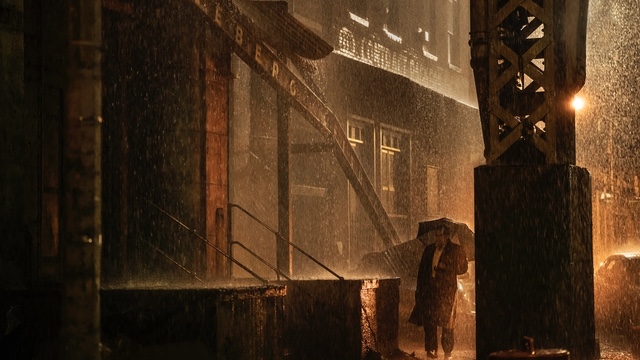
Reeves and LeFranc provided a fresh angle for Ivanov’s design work, telling her that only a few iconic Gotham elements, such as Arkham and the opening sequence, needed to be carried over from the film. The rest, however, was open to Ivanov’s creative touch. “They told me that we only have to carry over a few things from the movie, like we need to look at Arkham and the very opening sequence,” she explains, “but we’re going to create an original neighborhood called Crown Point that wasn’t in the movie. We’ll be on the streets, under bridges and overpasses, underneath train trestles. We’ll always be with the Penguin at the lower levels and in his environment. And that was very freeing because it allowed us to expand on the Gotham they hinted at in the movie but to do it with new neighborhoods that hadn’t been explored. In that sense, it was liberating.”
Kalina’s approach is all about grounding Gotham in gritty, unseen corners of the city that echo the Penguin’s rise through the criminal underworld. This focus on Crown Point and the layers of city infrastructure highlights a more “lived-in” Gotham—a place where power shifts in hidden, shadowed spaces rather than towering skyscrapers.
MORE: Discover what we think about The Penguin trailer!
Crafting Unique Auras for Gotham’s Characters

When asked how she tailored the right tone for each character and how this evolved throughout their journey, Ivanov explained that designing for new characters in unexplored parts of Gotham provided a unique opportunity. “The show is introducing new characters in new worlds that we have not seen and that is very helpful. First of all, I spoke with the production designer of The Batman, James Chinlan, who is a friend and a colleague, and he did a brilliant job. And so we talked about his and Matt Reeves’ approach to Gotham and how that was rooted in the actual 1930s history of New York City. And that was a big tell—we’re rooted in New York history, and we’re shooting in that city. I can definitely expand on that,” Ivanov shared.
Ivanov’s work expands Gotham’s streets to include vibrant new characters, especially strong female roles. “We have a lot of new female characters that were not in the movie,” she noted. “We have Sophia, we have Oz’s mother, and we have his lover, Eve, the madam. And those are very strong and very different female characters. Our world is much more 50% male and 50% female, if you actually look at screen time. And that alone allows me to take the design in different directions.”
While her approach allowed room for distinct spaces, she maintained a consistent tone across all sets by adhering to a muted palette inspired by the film. “The one thing I try to do is keep the overall tonality of the palette similar to the film,” she said. “It’s on the darker scale, it’s more muted.” However, Ivanov adds splashes of contrast—such as the pink, almost retro feel of Oz’s mother’s house, which she designed to convey a false sense of innocence, giving viewers clues to deeper layers in her character.
Exploring Oz’s World in The Penguin: The Diamond District

For the character of Oz, Ivanov wanted to create a grounded space that reflects his character’s ambitions and taste—or lack thereof. “Oz is a new character for us in terms of environments,” she explained. “We only see him at the club and outside in a few scenes and a very memorable car chase in the movie. So where does he live? Where does he go home? Who are his friends? Does he have friends? And so those are the questions that our show answers.”
After researching New York’s Diamond District, Ivanov had an idea: “I pitched the idea that Oz lives in the Diamond District, but in a jewelry repair shop, and that his bedroom is actually the safe box where all the jewels are kept at night so they don’t get stolen.” This setting—gritty, functional, and slightly absurd—was a hit. “Colin loved the idea. The creatives loved the idea,” Ivanov recalled. The set even includes a subtle nod to Oz’s background; an old advertisement for the jewelry store, perfectly framed, subtly reflects his past.
In working with Colin Farrell, who plays the Penguin, Ivanov designed a space that reflects Oz’s attempt at sophistication, albeit with questionable taste. “Colin and I talked a lot about his level of lack of taste,” Ivanov laughed. “There’s a big purplish painting by the door of his bedroom that we created in the style of a reference Colin sent us. It’s abstract, it wasn’t bad, but it wasn’t great either. For him, he thinks, ‘I’m like Carmine; I have to collect art.’ Most probably he picks up these pieces from a flea market or a store that he walks by and goes, ‘Oh, that’s purple. I love that.’”
The female characters in The Penguin received equally distinct design treatments, unified by a symbolic theme. “With the women, I worked very hard to make them very different but connected by a theme of flowers. All three women have a different version of flowers in their wallpaper,” Ivanov shared. Each design captures a unique essence: Eve’s bohemian, eclectic look; Oz’s mother’s 60s and 70s-inspired pink, conveying an innocent facade; and Sophia’s art deco-styled “murder bedroom,” a design in keeping with her father Carmine’s taste. “They’re very stylized flowers with very geometric, strong shapes,” she explained. “That’s the way I approach the design, and then I expanded it and took it in a different direction.”
MORE: Do you remember The Penguin first look and key art? We got your back!
The Designer’s Dilemma: Vision Versus Budget

When asked about her creative process and how she balances her vision with budget and technical limitations, Ivanov spoke candidly about the inherent challenges. “The real difficulty for a designer is exactly that,” she explained. “The real challenge is that your vision, no matter what the budget is…is always going to be bigger than the budget. Particularly when you have something very exciting.” Ivanov noted that, whether working with a substantial budget or a more modest one, there’s always a point where creativity outpaces financial resources.
Her approach involves making smart compromises without compromising her core vision. “The real skill for a designer becomes, ‘How do I figure out to take the same vision and now fit it into the budget that I have been given?’” she said. Ivanov emphasized the importance of collaboration, explaining, “I have a lot of helpers. I don’t do it alone. I have a supervising art director that works with me. I have my construction and paint people. I have the decorating people.”
Ivanov recalled a specific example from her work on Lovecraft Country to illustrate the compromises necessary to balance creativity and budget. In that project, she had designed a set called “The White Room” with an initial budget estimate of $400,000. The producers, however, only allotted $120,000—a stark difference. “I said, ‘That’s impossible. It’s a futuristic room. I really want it twisted. I really want it this way,’” she remembered. But instead of giving up, Ivanov and her team brainstormed solutions.
The breakthrough came from her art director, who suggested using fabric instead of plaster for the walls. “We thought, ‘Why not? It’s a round room. If you light it from the front, it will look like a thick wall. You’d never know it’s fabric.’ It’s an old technique from theater,” Ivanov explained. By employing this approach, they managed to reduce the budget to $180,000, which the producers approved. “We did not get it to $120,000, but we got it to $180,000,” Ivanov said. The experience, she shared, is a reminder of the “complicated dance” between vision, budget, and collaboration with producers to reach a mutually agreeable solution.
Ivanov highlighted that navigating budgets is an essential skill for production designers, one that requires experience and a degree of negotiation. “There’s a lot of negotiating basically going on,” she explained. “It’s complicated, and you learn that from experience.”
While Ivanov’s favorite part of the job is the creative process—“to dream and to create interesting things”—she acknowledges the necessity of balancing these dreams with financial constraints. “It’s an important part of the job,” she added. “And sometimes the limitations of the budget force you to come up with another way of doing things, so the budget journey, it’s a very interesting one.”
MORE: We can’t forget the first teaser trailer for The Penguin. Discover why!
Kalina Ivanov’s Favorite Sets from The Penguin

When asked about her favorite scenes in The Penguin, Ivanov found it hard to choose, expressing pride in the cohesiveness of the entire show. “I would say the entire show, because there’s a cohesiveness in it. But of course, I have my favorite sets,” she admitted. Among those that stand out are Carmine’s mansion, both interior and exterior, which Ivanov said she loved designing. “Oz’s Loft, too,” she added, noting the uniqueness of each space.
A particularly ambitious aspect of the production was Crown Point, the neighborhood Ivanov helped build specifically for the show. “The street that we did for Crown Point, the two blocks of street that we did, was pretty amazing,” she explained. This area not only gave a more grounded view of Gotham but also connects narratively to Oz’s past, including the carefully constructed apartments from his childhood. Ivanov appreciated how these spaces narratively flowed into each other, building Oz’s story visually and emotionally.
Some of her other standout sets include the Trolley Depot, the Jazz Club, and Oz’s final penthouse. “They’re my favorite children, they’re my A++ students,” she laughed, describing the sets as a “very different” mix that captures the scale and range of the project. “It’s hard to choose!” she said. But the beauty of the project, according to Ivanov, lies in the distinctive, immersive worlds each set offers, which helped her shape Gotham into a multidimensional space on screen.
Kalina Ivanov’s Dream Projects: Period Drama and Social Reflection

Looking to the future, Ivanov shared her passion for period drama, specifically a project set in the late 19th century. “If I wanted to pick a project, I would love to do an Age of Innocence-kind of film,” she revealed, expressing a desire to explore the years between 1880 and 1890. For Ivanov, this period speaks to the present day, highlighting the stark social contrasts between wealth and poverty, themes she sees mirrored in contemporary society.
“The reason I’ve been thinking a lot about that period…it’s out of the 1920s, but both of these periods really relate to what is happening today in the world,” she reflected. Ivanov pointed to the concentration of wealth in a small elite class, while the rest of society struggled—a situation she finds strikingly relevant. “And then the 20s were like that, and both of these periods, one led to World War I, one led to World War II,” she noted, suggesting that the cycles of history offer valuable insights into today’s issues. Ivanov often draws on this inspiration, calling on her understanding of historical inequality to subtly comment on wealth and power in her design work. “The robber barons of America,” she joked, “I know who you are.”
Through her distinctive style and sensitivity, Ivanov has helped shape the evolving aesthetic of Gotham in The Penguin, creating a cityscape that speaks to character, story, and the layered world it inhabits. And we love it!
The Penguin is available to stream on HBO.
