
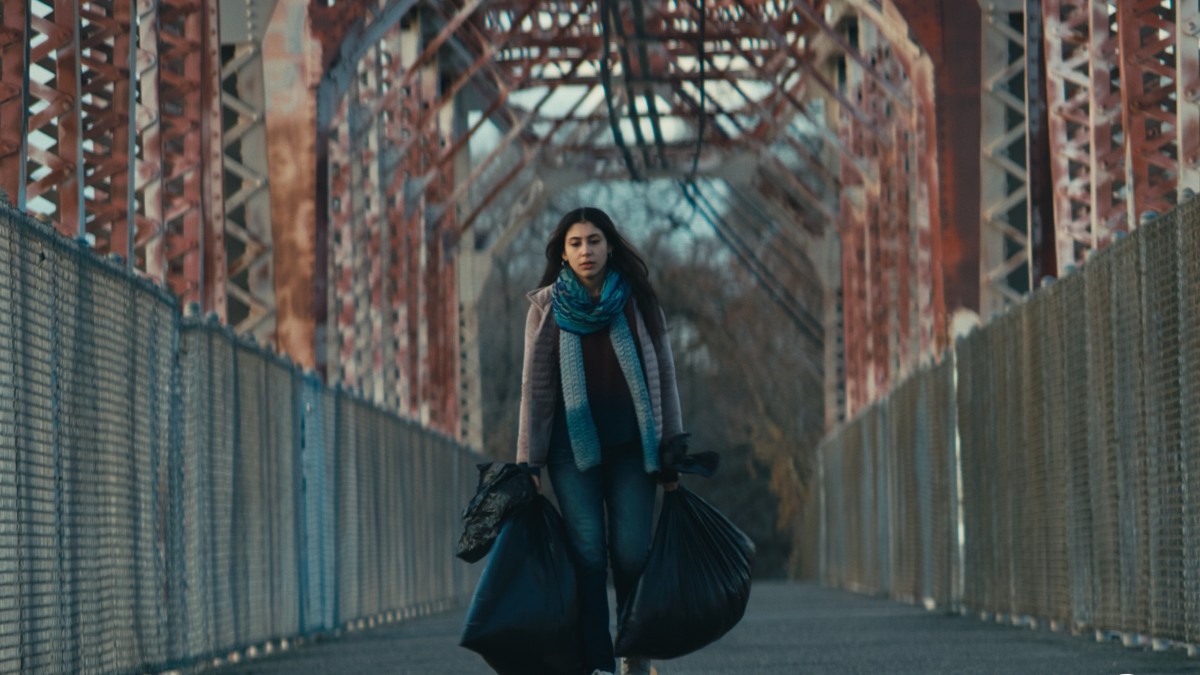
Some things don’t need to be said. Or, things you hope don’t need to be said. No Address, starring Beverly D’Angelo, Patricia Velasquez, Kristanna Loken, Lucas Jade Zumann, and Isabella Ferrerira, among others, very unequivocally says those things, but it does so in a way that makes you feel like the lesson you’re learning is the kind of lesson you should have already learned. The kind of lesson that isn’t a lesson, it’s just the way things should be.
In No Address, we get to not just explore homelessness, we get to really dive deep into what people suffering from homelessness are thinking and feeling. But homelessness is the kind of topic that feels in many ways, obvious. You know how you should feel about it, sad. You know that it’s bad. No one should be homeless!
Often, however, we think of homelessness as a problem about policies and not a problem about people. No Address is, however, about the human side of the issue.
Not just that, it’s about how so many of us are just one misfortune away from ending up without a place to call home.

The human side of the problem is what makes No Adress so thought-provoking, and in the same way, so relatable. Zumann, who has grown so much since his time in Anne With An E, is mesmerizing as Jimmy. There are a lot of great performances in No Adress—in fact, it’s hard to find a bad one, but perhaps because we’ve seen Zuman as the romantic love interest before, as the Gilbert Blythe to our Anne Shirley, there’s something about seeing him as Jimmy now that tugs at our heartstrings even more.
Ferreira is especially illuminating in the movie. It’s like you can’t take your eyes away from her, even if every second of watching her hurts, because what she’s going through hurts. Velasquez too, is captivating, not just because she’s convincing, because all of these actors are, but because she’s so wholly human. The humanity in a problem that we are so used to dehumanizing just so we don’t feel it in the day-to-day—because that is the only way we can keep going—turns out to be the movie’s biggest strength.
No Address makes us feel for every one of the characters in a way that allows us to feel for the issue, and that is the best thing we can say about art.
It’s not just about making us feel, it’s about allowing us to. And in that way, it’s raw, it’s painful, sometimes it’s uncomfortable. It’s perhaps, supposed to be all those things. You are not always supposed to get answers. If you do, they’re not always going to make you feel good. But that’s okay. Change doesn’t come from feeling good.

Not that long ago, the devastating LA wildfires left many people displaced. These days homelessness affects more than 1.2 million adults and 1.5 million children, with street-level homelessness increasing by 12% nationwide between 2022 and 2023. At the current rate, the number is set to double in the next 5 years. A movie might not change the full story, but it’s a start. It’s a tool.
Particularly considering Robert Craig Films has pledged to donate 50% of the net profits of the film No Address to a diverse range of organizations and churches nationwide that are working to combat the homelessness crisis within their communities.
Good intentions are not the only reason to watch a movie. But there are worse reasons too.
And, hey, I enjoyed it for that and for what the movie was, as well.
No Address is in theaters now.
