
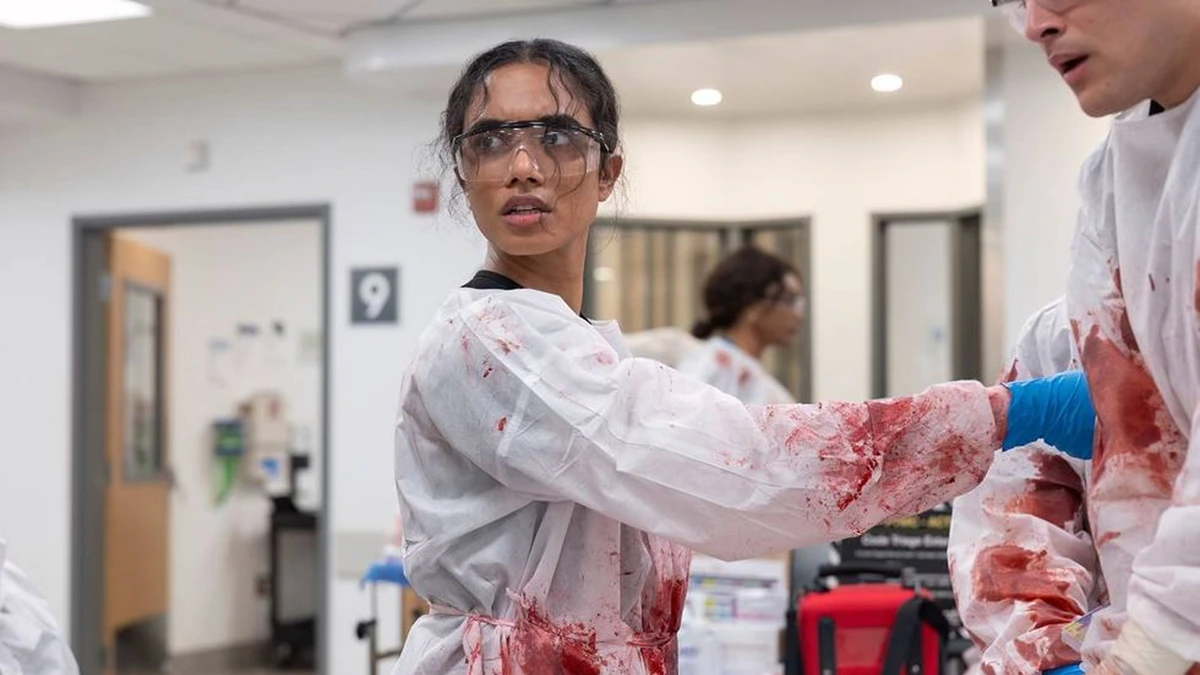
Dr. Mohan (Supriya Ganesh) spends most of The Pitt Season 1 refusing to sacrifice patient care in favor of getting them out the door quickly. She takes her time with all of her patients, building a relationship, earning their trust, and meticulously checking (and double-checking) everything. In fact, she’s the type of doctor many of us wish we had — the one who listens, the one who cares about quality of treatment, not quantity of people treated. (“I really feel like she was written as a response to, I mean, the F—ed up system that is healthcare,” Ganesh told us at one point.) But instead of praise, Mohan’s reward for her approach to patient care comes in the form of repeated lectures from Dr. Robby and being referred to as “Slow Mo.”
That changes in Episode 12, when Robby puts Mohan in the Red Zone — for the most critical patients, who the doctors need to stabilize within five minutes — as the ER treats patients following a mass shooting at Pitt Fest. In those tense hours, Dr. Mohan zips from patient to patient, thinking on her feet and making quick decisions that save lives. To kick off our interview with Ganesh, we asked her what she thought this ability to adapt during the crisis says about Samira as a doctor and what it could mean going forward. “I think what’s really interesting about this character is that there was no question about whether she was a good doctor. It was more a question of whether she could fit into this environment. And I think the mass casualty incident really shows that…she does belong here.”
But Dr. Mohan “needs to get out of her own head, really. I do think that is her biggest problem.” Sometimes, the resident “is so anxious about making a mistake…because of her own trauma, that she just really feels like she can’t lose a patient because of something she does.” That causes her to believe “she can’t leave any stone uncovered or unturned.” Additionally, it “leads her to create, like, this little web of her own making as to why she might spend some time with a patient.” So, even though “that allows her to be a great patient advocate, and she is the kind of doctor, as a patient, that you want to meet in the ER,” Ganesh told us she believes her character “is that way because of a lot of anxiety.”
When the Pitt Fest shooting happens, though, “there’s just no time for anxiety because you’re just getting patient, after patient, after patient. There’s no way you can really go slow if you want to make sure you’re saving people.” Because “she cares about saving people,” Dr. Mohan knows she has to treat patients more quickly. And, “if she really felt like her going slow would be detrimental to a patient…I think she’s able to get out of herself.” But there are still moments, even during the mass casualty episodes, when she hesitates, most notably in The Pitt Season 1 Episode 14 when Dr. Abbot has her try a medical procedure that “at least the way I understood it…has only been done once in the world.”
Here, Supriya Ganesh makes a clear distinction between this procedure and the one her character used to relieve intracranial pressure in The Pitt Season 1 Episode 13. “It’s so tricky because you do see her doing unconventional things, but I think they aren’t…unconventional in the [same] sense.” That’s because “at the end of the day, when I was trying to relieve intracranial pressure with the hematoma…I’m making a hole. And that is, essentially, what you need to do to relieve that pressure.” On the other hand, with the embolism patient, not only is Dr. Abbot walking her through a procedure she, personally, hasn’t read about, “it’s also just not something you would ever use a catheter for…You would not pull air out of a heart that way…And so, I think some of that hesitation comes back because she’s realizing that this is crazy.”
There’s an important takeaway from that scene in Episode 14, though. “I love that scene for her because it shows her stepping up to the plate of being an ER doctor in a different way than the mass casualty incident. Because, I mean, to be an ER doctor, you kind of need to be a renegade a little bit, right?” Using Dr. Langdon’s “somewhat unconventional ways” of handling traumas as an example, Ganesh reminded us that, as an ER doctor, “you have to improvise, and you have to make sure you’re okay with…random things being thrown at you. That’s kind of what [Mohan’s] being asked to do in this moment. And…I just love that she steps up to the plate.”
MORE: Don’t miss our Shabana Azeez interview on how these episodes affect student doctor Javadi and how she hopes The Pitt Season 1 affects viewers.
More from Supriya Ganesh on how the mass casualty incident affects. Dr. Mohan

Asked about preparing for The Pitt Season 1’s mass shooting episodes, Supriya Ganesh told us “the show really wanted to show what experiencing something like this is for doctors.” Explaining that “of course, the victims of the mass casualty incident are the people who are the most affected [because] they are the ones going through it,” she said that “the next level of…who ends up getting affected are the people treating them. Because that’s immediately where you go when you have an injury.” So, although “we were really specific about what we wanted to show, and we wanted to be realistic about…the protocols that we are showing that doctors have to put in place to deal with a mass casualty incident,” the effect of treating all those patients has on healthcare workers needed to be clear.
“I think it was really important for us to also show that this takes a toll” Ganesh said before stating the obvious: “This isn’t really something that [healthcare workers] should have to deal with.” Admitting she was “getting angry” just thinking about it (same), she continued, “it’s…absurd that this is already an overwhelmed system. And you’re essentially saying, ‘oh, this thing’s adding to it.'” Not only that, “but we’re not really going to do anything to stop it. And it’s already hard enough being an ER doctor.”
(Insert that one “no way to prevent this” post from The Onion here.)
Just like during the early days of the COVID-19 pandemic, when “we didn’t want to overwhelm the hospital system,” we should see gun violence as “a public health crisis” that we want to alleviate. But that’s not how our society, or at least enough of the decision-makers in it, treats gun violence. Instead, we’re overloading an already-overloaded system. “I think we see that with [The Pitt], where this hospital is already overwhelmed, and now we’re dealing with this. And it is — it is so hard for the doctors to deal with” getting slammed with shooting victims.
So, we can relate that back to how Dr. Mohan adapts and shows she’s a great ER doctor during these last few episodes. Because sure, the experience is “great for my character in the sense of…her career. But what does it mean if — if the career high you’re having is, like, as a result of this incredibly traumatic event?” And Mohan can’t be sure “this is the last time [she’s] ever going to experience something like this.” For all she knows, it could happen again in a couple of years (or less). That means these last few episodes of The Pitt Season 1 mark “a very complicated moment, I think, for Dr. Mohan. And I think the show just does such a good job of showing how much this affects healthcare workers.”
We’ll see a little bit of the direct effect on Dr. Mohan in the season finale. Without spoiling anything, Ganesh told us the experience was “just such a intense thing…for anyone to go through. We’re very realistic about what firearms do to the human body. I was in the Red Zone. I saw some of the worst of it. And I think there’s a part of Samira that doesn’t really know how to process it, and I don’t know who she would really go to for help with that.” So, “I think that’s also what the show plays with in, in looking at her response to it. I don’t really know if she has the support system to deal with something as traumatic as what she just went through in the past two hours.”
MORE: Read our Taylor Dearden interview for some insight into Mel’s unexpected support from Dr. Langdon.
On how Samira’s loss affects her as a doctor

Part of the reason Dr. Mohan doesn’t have that support system Ganesh referred to is because she lost her father at a young age. But how much of that trauma does she bury, and how much of it stays more on a surface level for Samira? “I think she does bury it, but I do think it affects everything she does,” Ganesh told us. Even choosing emergency medicine as her specialty can be seen as a way of “reworking some of that” trauma, but “I don’t know if she really knows that.” Instead, “in her head she thinks, ‘I want to change the system,'” and that’s what’s “front and center.”
On the other hand, “the thing that’s buried is just the amount of hurt and…the loss.” Deep down, Samira is “hoping she can feel like she can save herself or her dad in, in doing this [job]…I do believe that’s — that’s the thing she maybe isn’t honest with herself about.” Realistically, even if she tells herself she can change the system, Dr. Mohan is “probably not going to” because she’s just “one person. This is a big system that chews you up and spits you out, right? So like, what — what is it that you’re trying to fix for yourself? And I think that is really the question she’s not answering for herself.”
MORE: Learn a little bit about how some of Dr. Santos’ past might affect who she is, as both a doctor and a person, in our Isa Briones interview.
On the patients from The Pitt Season 1 that will stick with her

Since The Pitt Season 1 is almost over, we decided to ask Supriya Ganesh which patient story will stick with her as an actress. And, if they’re different, who will Dr. Mohan not be able to forget after this difficult 15-hour shift? Ganesh picked Joyce, who we met way back in The Pitt Season 1 Episode 2. “I was pre-med in school,” she told us, “we learned about sickle cell — and I can tell you about sickle cell right now. I can tell you the point mutation it is. I can tell you the amino acid that gets switched out in order to change the shape of the hemoglobin…why that’s bad, and how that affects oxygen delivery.” Professors also “mentioned, ‘and this affects the Black population the most.’ And that was it.”
But, even knowing the biological realities of sickle cell and its effect on Black people, “even in that moment, I did not put two and two together of: These people are in pain. What do you think is going to happen when they show up to an ER and they are in pain?” Ganesh saw that as her own “background coming…into play…I mean, of course, I’m like racialized in a certain way when I get to the ER, but I’m not a Black person. And I cannot imagine what it must be like to be seen as if you’re drug seeking when you’re actually in pain.”
So, Ganesh remembers, “when I got the script…I was like, ‘oh my God, that — that makes so much sense.'” But prior to being a part of this series, no matter how much she learned, or how often she was tested on the disease, “never — never once have they delved into…the sociopolitical implications of it. And so, that’s something that’s absolutely going to stay with me as a person forever.” The actress also told us she’s going to try looking into outreach opportunities, and she’s “so grateful to be on a show that’s…exposing the realities of being a Black person in healthcare, a Black patient in healthcare, a Black woman in healthcare.”
Next up: Samira’s most memorable patient “might be Nandi,” the influencer we met in The Pitt Season 1 Episode 7, who Dr. Mohan discovered was experiencing the effects of mercury poisoning. Oh, and Dr. Robby wanted her to just send to Psych. “It was such a win for her to show that [her] my approach actually does work. This person would have been sent to Psych, and she’s someone who cares about racial justice. I could go on and on about how, you know, when patients are sent to Psychiatry, there’s — there’s an overwhelming skew towards POC populations for that…Even though there’s no — technically no higher rate of incidents for POC populations for psychiatric illnesses.” (POC being people of color, for those who don’t know.)
Come to think of it, Nandi will stick with Supriya Ganesh herself — not just her character — too. “As a South Asian woman, just the idea that someone’s…lightening their skin with mercury (unknowingly), it’s just, it’s such a problem in our community where there’s so much colorism. And so, I just love that that was something that was implicitly discussed…with that patient. So, I think for Samira and me, that — that was a really lovely moment.”
And then, she basically summed up everyone’s feelings on The Pitt: “I just love…everything that the show is doing, really. So, a lot of it probably is just going to stay with me.”
MORE: We also spoke to Gerran Howell about student doctor Whitaker surviving his first day.
You can watch our full interview with Supriya Ganesh here
Don’t miss Supriya Ganesh as Dr. Mohan in The Pitt. The Season 1 finale streams Thursday, April 10 at 9/8c on Max.
