
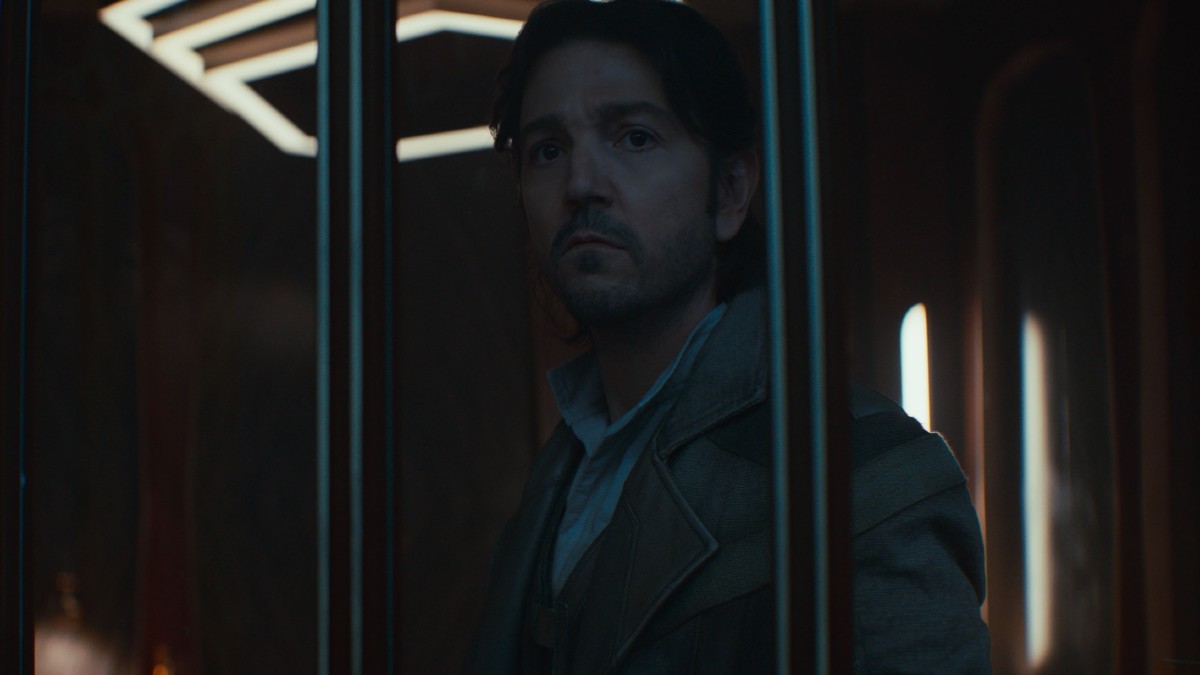
Andor Season 2, Episodes 7-9 “Messenger,” “Who Are You?” and “Welcome to the Rebellion” are not the end of this story, certainly not of the rebellion, but they are in many ways the pinnacle of this moment in Andor. It’s almost hard to ask more of Andor, of storytelling in general, than what the show delivers in this three-episode block. Because these episodes are brutal, emotional, thrilling, and yet inspiring. It’s hard not to watch them without feeling not just the desire, but the need for rebellion.
It’s not just about Ghorman, either, though “Who Are You?” in particular is a masterpiece not in defeat, but in dignity, even in loss. Ghorman was massacred, yes—but it didn’t surrender. Does that make it better? Some might argue it doesn’t, you lost anyway. But if the options are lose/lose, then there’s something to be said about remaining yourself, even while a faceless Empire tries to rob you of the last of your humanity.
MORE: Where does Andor fall on the timeline? Here’s the answer.
REBELLIONS ARE BUILT ON HOPE

Jyn Erso’s catchphrase is found in Ghorman first, in a very surprising place, perhaps, because it feels like there’s no hope. Although, perhaps, the truth is that hope is found in the most hopeless places sometimes. Hope is about the belief that there is something better out there, even when all seems bleak. And that is worth fighting for. That is worth sacrificing. Because what Ghorman is doing is just that… It’s a sacrifice. And they want everyone to know it.
And it’s a journey for them, too. First, there was defiance. The defiance of those who stand there singing. Then there was fear and shock. “We are being slaughtered.” But in the end, the people of Ghorman didn’t, wouldn’t go out without the world knowing what was happening to them. “This is murder. They made this fire and led us to slaughter. Now they expect us to die without knowing why.”
Ironically, in the background of the Ghorman Massacre, there’s also one of the people responsible for it—Syril Karn, trying to pretend like this isn’t what he wanted. And perhaps, deep down, it isn’t. Maybe he’s believed in the propaganda enough that he doesn’t see himself as one of the bad guys. But that makes not one iota of difference. He’s still one of the villains of this story, and worst of all, he’s a faceless villain, not anyone’s archnemesis. And he died the way he deserved to, without glory, on the street, and without anyone remembering his name.
MORE: Our review of the first three episodes of Andor is here. And episodes 4-6 here!
THE DEATH OF TRUTH IS THE ULTIMATE VICTORY OF EVIL

Mon Mothma’s speech hits very hard in the context of the world we live in, but it also works perfectly in the context of the moment she’s living in the Star Wars timeline. “The loss of an objective reality is, perhaps, the most dangerous,” she says, and it feels like she’s speaking both to a Senate that will ignore her and to us as she calls what happened in Ghorman an unprovoked genocide. We, of course, understand that what she’s doing is suicide. Calling Palpatine a monster in the middle of the Senate is a surefire way to get yourself killed. And yet, someone had to do it.
“Welcome to the Rebellion,” Cassian tells her, as he whisks her away. But Mon Mothma has been in the Rebellion all this time. She has, arguably, been playing the hardest and most complicated role of all, that of straddling the line. But there’s only so long we can smile and pretend that autocrats and dictators are anything but what they are, and Mon Mothma is proof that at some point, we must all stand for what we believe in. Otherwise, we become part of a corrupt system.
Either we speak up, or at some point, we are the system. She refused to become part of it and instead became the face of the Rebellion. Ghorman didn’t die for that, but Ghorman surely thanks her, and so does the rest of the galaxy.
MORE: We broke down the Ghorman massacre here.
MAKE IT WORTH IT

Cassian asks Mon Mothma something near the end, something that also ties to Bix’s decision to leave Cassian. “Make it worth it.” Because everyone’s making sacrifices, and the sacrifices have to lead to something. They have to mean something. What’s the point of the Rebellion? What’s the point of all the fighting if it doesn’t lead to something big? Bix said, a few episodes ago, “I want to win,” and she wasn’t just saying that to say it. That feels like an absurd thing to pick above everything else, but is it? Is it when the fate of everything, of everyone, hangs in the balance?
“I’m choosing for the both of us,” Bix says, and she chooses the Rebellion. Can we imagine that choice? Can we conceptualize it? Bix’s choice, in the end, is the thing that saved the galaxy. Would Cassian have gone on the mission that procured the Death Star plans had she been waiting for him? Would he have made the decision to go to Scariff in Rogue One if he knew Bix was on Yavin? The answer is likely no. So, it might be easy to judge Bix now, but the galaxy far, far away owes her a debt of gratitude, one they might never really know about or be able to repay.
Agree? Disagree? What did you think of Andor Season 2, Episode 7-9? Share with us in the comments below!
The first 9 episodes of Andor Season 2 are now available to stream on Disney+.
