
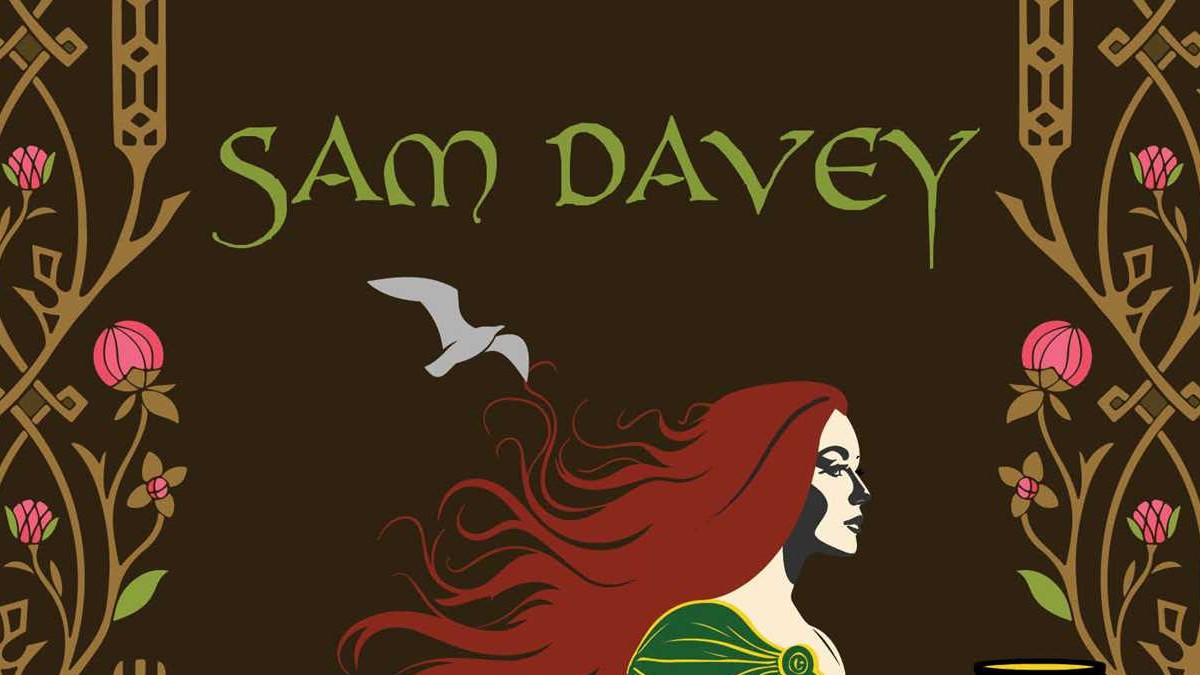
Sam Davey’s new historical fantasy, The Chosen Queen, is releasing soon. The book, sort of a Game of Thrones meets The Mists of Avalon mixture of political intrigue, war, coercion, and the battle between old faith and new, is based on Arthurian legend. But this is a different look at the legends we know.
Instead of focusing on the men—on the kings and knights—The Chosen Queen instead focuses on the women whose strength, leadership, and sacrifice laid the true foundation for Camelot and the stories we know. Now that’s something we want to read.
To prepare for the book, author Sam Davey joins us with a list of the best retellings of myths and legends to shed contemporary light on classic stories.
Myths and legends are humanity’s oldest stories. They provide a narrative that explains how the world works, giving us a cast-list of often super-human individuals whose deeds and actions frequently become touchstones by which we measure our own morality. The books I’m going to recommend here are those where the author has taken those age-old tales and given them a modern twist – with strong female characters at heart and centre.
***************
The first of these is Stone Blind, Natalie Haynes’ re-telling of the story of Medusa – a girl cursed with the power of turning anyone she looks at into stone.
One of the things I love about the book is the reason why the author wrote it. As a child, she had just accepted that Medusa the Gorgon, with her wreath of snakes for hair and evil powers, was nothing but a monster. Later, she questioned how this had happened to her and why, and the result is a fast-moving and moving story of a young girl who is only a monster because the world has made her so.
The real message of the book is that our notion of what is monstrous is very much driven by our conditioning, and that the system that punishes Medusa simply because she is in the wrong place at the wrong time, is really far more gruesome than the Gorgon.
***************
I love all of Elif Shafak’s books, but I was particularly drawn to The Island of Missing Trees. The story is told through the eyes of Ada, the quirky, free-spirited, and angry 16-year-old daughter of a modern-day Romeo and Juliet called Kostas and Defne – one Greek and Christian, the other Turkish and Muslim.
The book draws upon the myths and legends of the fig-trees of Cyprus, and also takes inspiration from classical mythology, particularly the story of Persephone, the pomegranate, and her enforced entrapment in the underworld. It is a story about falling in love with someone you shouldn’t, about sacrificing all for the truth of that relationship, and about coming to terms with the consequences.
***************
One of the books I held most dear when I was growing up, and which had a strong influence on my own desire to write fantasy and speculative fiction, was Marion Zimmer Bradley’s The Mists of Avalon.
The book tells the story of Morgaine, half-sister to King Arthur, and high priestess of Avalon. Morgaine’s narrative is utterly compelling and sheds a very different light on the stories of Camelot as it is viewed not through the lens of Arthur and his knights, but from the perspective of a woman, torn between her love for Avalon and her relationships with others.
***************
Growing up by the sea, I have long been fascinated by the stories of the Selkie folk – creatures who can be human on the land, and a selkie (seal) when in the water – often using this power to enchant their human lovers and to entrap them in the dark worlds beneath the waves.
I was particularly drawn to Sealskin by Su Bristow, an interesting re-telling of the classic tale, in which a selkie comes ashore only to have her skin stolen by a human, and thus being unable to return to the sea.
The story is beautifully told, but does have its dark elements featuring both rape and domestic violence, which sometimes make it difficult to read, but it has love and redemption at its heart.
***************
My final choice is Madeline Miller’s Circe, a retelling of the Greek legend that is as beguiling and enchanting as Circe herself.
I loved this book because of its irreverence, its wit, and because of the author’s determination to tell the story from an unabashedly female perspective.
Like Igraine, the heroine of my novel The Chosen Queen, Circe is only vouchsafed a few lines in the original Greek telling of the tale. Here she has a whole book in which to tell her tale, and Miller does so wonderfully, with such energy and invention that it is hard to put down.
Sam Davey’s The Chosen Queen will be available wherever books are sold on June 3.
