INTERVIEW: Transplant Star Ayisha Issa Talks Pivotal Moments
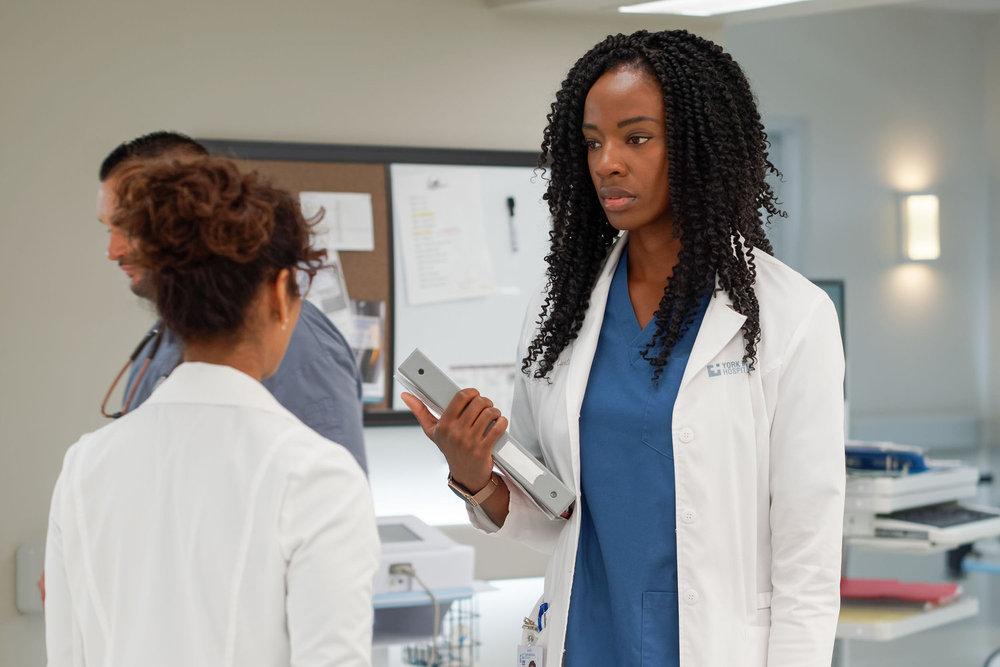
With three episodes left to go, Transplant is coming to a close – and they are pulling out all the stops. With changes for all the characters, it’ll be interesting to see how the relationships and dynamics shift. Ayisha Issa, also known as Dr. June Curtis, spoke to Fangirlish about the upcoming episode and what fans can expect from her character in the final episodes.
Issa, a Canadian native, has played roles in Dark Matter and Shadowhunters before her role as June Curtis in Transplant. Alongside her career as an actress, she is also a model and practitioner of Brazilian Jiu-Jitsu. Issa, a powerful, strong woman, is no stranger to playing strong female characters and is only just getting started.
Read our interview below!
Crumbling
We asked Issa to tease the upcoming episode of Transplant and what it means for her character.
“This is a pivotal moment for June. I think that she’s finally become comfortable with the dynamics that she has with her best friend and with her colleagues. And I think that she had really become on board with the idea of moving forward and becoming a mom. I think that she really felt like she had a footing on where she was and become comfortable in this new expanded version of herself. And all of that is going to crumble. It’s really one of those moments where life just does the thing that life does. That’s the best way to put it. Life is going to do what life does.”
TRANSPLANT — “All I Have Is How I Feel” Episode 408 — Pictured: (l-r) Laurence Leboeuf as Dr. Magalie Leblanc, Ayisha Issa as June Curtis — (Photo by: Yan Turcotte/Sphere Media/CTV)
Strong Female Characters
To me, June has always been one of the strongest female characters on TV. She also started with fortified walls and hyper-independence in Season 1. Issa talks with us about the process of allowing her character to open up throughout the 4 seasons, and what female strength means to her.
“Yeah, that’s a great way of putting it. I think that when I got picked to play this role, I was at a point in my life where I was starting to reimagine what it meant to be a strong woman. I think I had developed a version of that and was living a version that didn’t feel 100% comfortable, but it felt like what it was supposed to be. And I think that when I saw how June was written in season one, I was able to identify with that version of a strong woman.
And I think that precisely what I was hoping to happen, happened, which is that Joe had the character evolving. And he was doing it in what I perceived as a very realistic way. It’s not an overnight thing. It’s not that she now has a friend who’s vulnerable and soft and comfortable in being vulnerable and strong in her vulnerability. Now, June will also be strong. It wasn’t going to be that clear.
TRANSPLANT — “All I Have Is How I Feel” Episode 408 — Pictured: Ayisha Issa as June Curtis — (Photo by: Sphere Media/CTV)
And I do remember that there was some friction with the production team because they were unsure that I would be capable of showing the necessary vulnerability. Whereas my perception of it was, no, I understand what it means to open up to people, and I know that this is a difficult process, and it happens small and it happens incrementally and it happens a little bit, and then it comes backwards.
And I feel really grateful that I had Joe’s support in that. I always felt that he understood what I was doing. I understood what he was doing. And it allowed me to explore a very real process that I was having myself and to bring that out through the character in a realistic way and in my own way.
And so what we see over the four seasons is really my reinterpretation or reimagining or what I’ve learned about what strength really means. You know what I mean? And it doesn’t mean having rigid boundaries all the time or being able to keep distance and being able to do everything by yourself all the time. It means being able to feel comfortable asking for help. It means being able to feel comfortable and safe and confident in your ability to be okay when you’re sharing your needs and your feelings vulnerably. It means being able to communicate how you feel without having to go through judging the world around you or blaming somebody else for your experience.
This is what strength really means, I think. And it’s something that us women tend to do very, very well when we allow ourselves to. So it was about demonstrating that arc. And then, of course, Mags being the catalyst for that and really kind of tapping into Laurence’s performance as Mags and what she brought to that to allow that to be the catalyst for that form of the evolution. And then to have Novak be the constant testing of that evolution, right? If the strength is still there. Is the strength still there? It’s still there.”
Comfort Zone
With some significant changes and decisions headed June’s way, it’ll be interesting to see how she responds and how they impact her relationships. Specifically, June and Novak, as they’ve always had a work-wife, work-husband relationship, albeit a highly frictional one, and it’ll be interesting to see that dynamic shift. Issa mentioned the ups and downs of how June will cope with those upcoming shifts.
“Well, I think going with the theme that you started with, which I think is a really good one, is the idea of the constant testing of June’s character and her ability to adapt and learn from her situations and apply what she’s learning. So I think that she’s being faced with an opportunity to kind of revert in some ways to some more familiar, more comfortable patterns. Right now, she has almost everything she wants in the trauma OR scenario; she’s worked so hard at this, and she’s constantly being challenged by Novak and by the environment.
TRANSPLANT — “Torn” Episode 407 — Pictured: (l-r) Ayisha Issa as June Curtis, Gord Rand as Mark Novak — (Photo by: Sphere Media/CTV)
The challenges are only going to get more intense for her type of personality and the things that are challenging for her. Personally, she’s just going to be hit really, really intensely with a lot of things that she is not necessarily prepared to or equipped to deal with. She’s still learning about the emotional intelligence that she needs and getting comfortable with processing emotion, and she relies heavily on Mags for those things and everything.
So I think that there’s an opportunity for her to kind of fall back into her comfort zone, kind of go, okay, I tried this thing and we got to a certain point and it’s great. And now this has opened this new door, which is actually what I’ve been working towards. And this is the culmination of all my work. Nobody would question anything if I kind of moved forward in this direction. But I think it’s also an opportunity for her to continue to run and to avoid and to kind of just walk away from a situation that she hasn’t really fully figured out how to deal with.
And so, how she’s going to go about it. And the thing is that I don’t think there’s a wrong answer in how she answers and how she deals with it either. I think that there are valid reasons for her to go in either direction.”
Endings
Issa also characterized the final three episodes in three words: 1. Heartbreaking, 2. Sobering, 3. Respectable.
When asked what’s next for her, she mentioned some personal endeavours that shed light on health, travelling, and happiness. Having graduated from college during the final season of filming and obtained her degree in interior design, she discussed expanding her career and branching into new areas.
“So, for me, I have been dealing with some health stuff, some female health stuff that has come up. And I’m considering doing a podcast about it, just to explore the process of how I found out about it. I think it’s important stuff. People look at me and they see a very healthy, active person, which I am, but there are a lot of struggles that I have been dealing with. Struggles that I have been dealing with, which I didn’t fully understand until now. And a lot of work that I have to do to truly be healthy, so that my inside and, you know, what’s happening is matching what I’m putting out there. So I thought it might be an interesting opportunity to explore some of those themes.
And so I was thinking of exploring, you know, maybe a docuseries about not really changing careers because I’m always going to be an actor, but just like what it looks like, you know, as a woman in your 40s or as a person in your 40s who decides to like take a left turn and try something different. It’s so common these days for us to have more than one career in our lives. So like, what would it look like for me to pick up something completely different and run with that and watch the kind of ups and downs of trying to join a completely different industry?
So those are some of the things that were on my kind of bucket list of things I want to do.
And then, of course, acting-wise, whatever comes up looks interesting and challenging. I’ll be happy for.”