
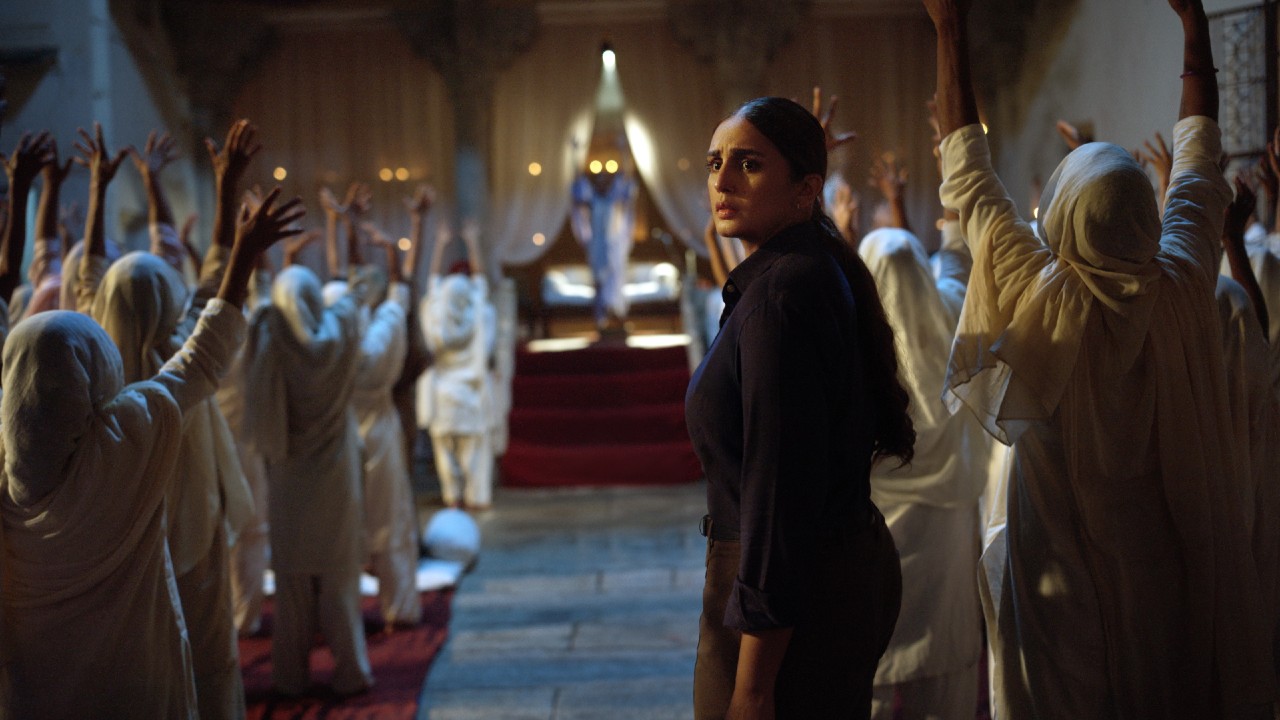
Watching a movie like Bayaan from the outside, from a basic level of understanding what it is about, the circumstances it depicts, and the story it’s trying to tell, is very different than watching it with knowledge. The movie, although straightforward and largely predictable, offers a very interesting glimpse into India’s Godman culture, particularly if this is your first exposure to the narrative.
I can’t claim my experience is broad, but I have seen other films that touch upon the subject—and know very well that this is far from the first to attempt it, or to attempt to deconstruct the systemic complicity required to keep these Godmen in check. Even the female police officer who takes on the case just to realize her privileged life is still very much conditioned by laws put in place by men has, in some ways, been done before. But I still very much enjoyed the journey and the idea behind Bayaan.
MORE: Hamnet won TIFF’s People’s Choice Award, and we think it deserved it. Our review!
The story takes place in a small Rajasthan town after a powerful cult-leader (Chandrachur Singh) is accused of sexual abuse. Officer Roohi (Huma Qureshi) is assigned to the case and must confront her desire for justice with the realities of a community where the specific power dynamics are very much established in a way that doesn’t exactly invite outsiders.
As stated before, Bayaan doesn’t exactly reinvent the wheel, but it does do a pretty good job of navigating a world where crime isn’t an outlier and the system itself will do everything it can to maintain the status quo. If anything, the biggest problem with Bayaan is that it focuses a bit too much on the dynamics of that system and the guardrails set up to protect it, and less on the characters, mainly Roohi, who are trying to put an end to the abuse the system perpetuates.
MORE: Excited for Guillermo del Toro’s new movie? Read our Frankenstein review!
If Bayaan feels a little hopeless at times, it’s because systems of oppression are so well built and so ingrained into our societies. That this is a very specific look at a culture and a set of circumstances doesn’t mean we can’t understand how they could have gotten where they are and how hard it is to break out. No, the worst part is we understand all too well.
Bayaan is not an easy watch, because the subject matter won’t ever be, but it’s also not a challenging one. The message the movie is trying to send is clear, and though the characters are sometimes sacrificed for the sake of that message, it’s a pretty important message to send. The issue, of course, is that we remember characters more than we remember big-picture messages, and the decision to make Roohi more of a stereotype than a real woman fighting against injustice makes it so; even if you enjoy the film, it probably won’t stay with you. It might interest you, it will probably entertain you, but it likely won’t touch you, not the way it wants to.
Bayaan screened at the Toronto International Film Festival.
