
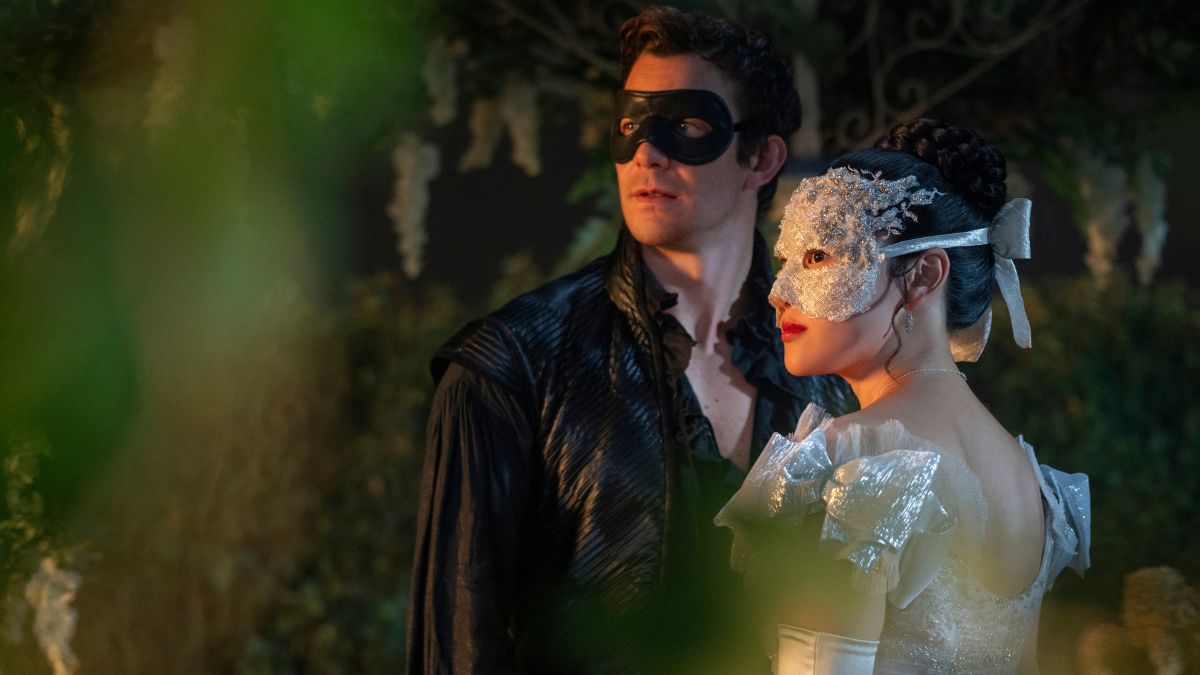
Dearest Gentle Reader, it is good to be back! In a dreamy reintroduction to the romance series, Bridgerton Season 4, Episode 1, “The Waltz,” does far more than simply stage the highly anticipated masquerade-set meet-cute of Benedict Bridgerton and the Lady in Silver. Rightfully so, the show makes a device of its most ambitious (and Shakespearean) set piece yet. Whether it’s Violet taking a new place in society or Penelope finding a new footing as Lady Whistledown, the ball becomes the perfect backdrop for the characters’ next chapters.
Mostly, the season premiere, written by Jess Brownell and directed by Tom Verica, quiets concerns that Bridgerton is past its prime. In truth, “The Waltz” sees the beloved romance series blossom into a more grounded and mature version of itself. As it welcomes a new cast of characters and evolves with familiar favorites, Bridgerton finds a renewed confidence as “The Waltz” quite literally dances into a new social season. As Lady Whistledown puts it, this social season “might look a little different from what our fair ton has come to expect.” This episode is a definitive start to a season that is entirely in touch with its heart and humor.

Upstairs/Downstairs
This season premiere serves its function of setting up what will follow. Of course, the largest portion of that pertains to the romance, but the show has other characters to concern itself with, too. More specifically, Bridgerton Season 4 has a specific interest in the working class, given its leading lady. That new lens allows the series to explore Bridgerton through the eyes of familiar yet peripheral characters, like Mrs. Wilson, Celia, (Footman) John, and Varley.
“The Waltz” impressively incorporates the happenings downstairs. That first tracking shot, leaving Violet to follow Mrs. Wilson, is seamless. Switching to a handheld camera once downstairs encapsulates the more active energy there, opposing the calm of the upstairs. The well-choreographed sequence immediately expands the world. That beginning creates a bookend with Sophie unmasking the Lady in Silver to reveal she is a maid.
Even so, it is through the characters that hug Bridgerton House’s walls that “The Waltz” delivers some of its key exposition. Kate and Anthony are still in India, having welcomed their firstborn child; Gregory is at Eton; Eloise still has no interest in marrying; Hyacinth is eager as ever. While that expository conversation is essential in placing the characters in time after Season 3, it serves a grander purpose.
It shows how well the Bridgerton staff keep up with their work for the family, and the line delivery expresses a genuine fondness from the staff for the family. Not to mention, Celia, John, and Mrs. Wilson’s personalities shine through the quick exchanges – how they all look to John when Violet questions Benedict’s whereabouts. There are choices on the page and from the cast that give the characters more depth than past seasons permit.
MORE: Everything We Know About 12 Days of Bridgerton


The Start of a New Season
“The Waltz” also brings Eloise, Francesca, and John back without much mention of their time in Scotland. That choice works best for Francesca. Hannah Dodd’s performance, even with a mask, says that there’s still so much to learn there. Alternatively, Eloise returns with a definitive choice to be a spinster, which isn’t far from where she stands at the end of Season 3. To its credit, “The Waltz” raises plenty of questions about what Eloise will do with her time. Francesca and Eloise’s arcs are particularly intriguing since it’s more than likely that one of them will lead the already-renewed fifth season.
Meanwhile (and wonderfully), Hyacinth is antsy to debut. So much so, she takes her most active approach yet to be at the ton’s balls. It’s already such a delight to see Florence Hunt have more to do. Even so, Francesca’s reaction to learning that her mother has lowered her baby sister’s hem mirrors that of the audience. Hyacinth’s literal growth, as well as the news that Gregory is at Eton, reflects the time that has passed since Bridgerton’s debut in 2020.
That development is also present in one of the season premiere’s more interesting angles – Queen Charlotte’s influence on what Penelope does as Lady Whistledown. Their “great friendship” is dependent on Penelope delivering “great gossip.” However, such like that about Lord Harley and Lady Luton’s affair jeopardizes the social standing of Lady Luton’s daughters. As Bridgerton’s world expands and the characters mature, there’s no better time for Whistledown to evolve.
MORE: Bridgerton Season 4 Won’t Work Without Viscountess Kate Bridgerton

Benedict, the Second Son
As a season premiere, this episode must – and does – understand Benedict Bridgerton. His internal conflict with being the second son could come off as entirely shallow, given his immense privilege. However, the script and Luke Thompson approach it with balance and curiosity to get to the core of him. Early on, Benedict practically begs Violet for his current self to be enough. Thompson’s performance (His eyes and voice when he says, “Please!”) taps into Benedict’s desperation to be seen, to be known. Therefore, Benedict plainly articulates why he goes outside of society; it’s a place where he is seen as more than “Number Two.”
Benedict says, “I am charting a more venturesome course outside good society. In doing so, I am being true to myself. Is not that the point?” That feels like him trying to tell his mother that he may find a relationship that isn’t as she imagined. It may not be as tradition and society deem acceptable because it may not be with a woman. The third season sees Benedict explore his sexuality. The show takes place in a time without the language of present-day labels, but it’s made clear that Benedict’s sexuality is fluid. While this season is about his love story with Sophie Baek, that romance doesn’t negate his sexuality. That part of him exists, full stop.
“The Waltz” also improves on Season 3, which never really shows Benedict doing Anthony’s Viscount work. While he does not know copper’s investment level, Benedict enthusiastically supports tenants, no matter their financial standing. That distinction alone cleverly sharpens Benedict’s characterization. After all, he has been a vocal supporter of those who work for a living since Season 1. Overall, “The Waltz” does an exceptional job of defining Benedict and then unraveling, in the most complementary way, him a bit.
MORE: Bridgerton Season 4 Trailer Takes Benophie Beyond the Masquerade Ball


The Masquerade Ball
The ball’s theme insinuates that Benedict’s costume will allow him to disguise himself as something other than “Number Two.” However, “The Waltz” quickly deconstructs how being “anyone” else isn’t so simple. Even after stepping away from the wall last season, Bridgerton makes a case for why Penelope may want the persona of Lady Whistledown to stay near it. Her role as Whistledown is forever changed, and learning how Penelope will navigate that awareness and responsibility is one of the more intriguing hooks for the season. Moreover, the dynamic between Penelope and Charlotte is powerful and playful – definitely one to watch.
The same is true of Lady Danbury and Charlotte’s friendship. Agatha’s mask feels like a bit of a barrier as she tells her dear friend the truth – that Agatha wants to leave the ton. Golda Rosheuvel, Adjoa Andoh, and Hugh Sachs as Brimsley play that scene so well. The edit leans into Rosheuvel’s wonderful pause, leaving one, like Agatha, to believe Charlotte will agree. It’s so good! There’s a comfortable chemistry among that trio that speaks to the history between their characters.
It’s also such a functional setting to relay exposition in reintroducing Lady Araminta (Katie Leung), Rosamund (Michelle Mao), and Posy (Isabella Wei) to the ton and introduce them to the audience. The masquerade ball and all its secrecy are also the ideal setting for Violet and March to have stolen moments. The blocking of their intimate yet fleeting exchange highlights how extravagant this set piece is for Bridgerton. It’s no wonder that “The Waltz” spends half of its runtime there. The set design and the intricate costumes are spectacular. It’s all enveloping and grand and magical. Bridgerton’s teams deserve their flowers for their energy, time, and hard work.
MORE: Who do we think is Bridgerton‘s most underrated duo? Find out here!

Benedict and the Lady in Silver
When a beloved character has this much anticipation around their arrival, it’s like waiting with bated breath to see how they’re adapted for the screen. That all fades when Yerin Ha holds up her arm to John before taking Sophie’s dance card from him. Ha completely embodies Sophie’s energy from the book while making the character her own. For non-book readers, her introduction to the masquerade ball also provides some imperative details about where Sophie may exist in society – or outside of it. Whether she’s bumping into a table of bonbons or standing in awe of the “glorious” details, Sophie comes to life after years of waiting for her.
As if it’s fate, that same sentiment of relief plays out when Benedict sees Sophie for the first time. Benedict and Sophie’s – or the Lady in Silver’s – meet-cute is enchanting. The distance between them in that ballroom fades away. Benedict finds the response to what he says at the end of Season 3: “It feels right now that the next thing I might learn may change me entirely.” That recognition plays out throughout the rest of the night, but it’s in Thompson’s eyes in that moment. The scene that follows is similar to the book – a phrase that may appear often throughout these reviews, to my delight.
Thompson and Ha’s chemistry is instantaneous. As an instrumental version of Usher’s “DJ Got Us Fallin’ In Love” plays in the background, Sophie and Benedict feel like they’re in their own world. That is, until the pressures of their subjective realities – Violet’s intentions for Benedict to dance with marriage-minded debutantes; an undefined tension between Sophie and Lady Araminta – inch closer.
MORE: It’s Benophie’s Time: Bridgerton Finally Unmasks Benedict as S4’s Lead


Dance Lessons with Benophie
Watching them escape from it all – to an instrumental version of Third Eye Blind’s “Never Let You Go” – stirs butterflies. This sequence suspends time as it spans nearly the episode’s remaining runtime. Thompson and Ha’s chemistry has a mesmerizing buzz that lends itself to Benedict and the Lady in Silver’s sharp banter. It’s incredible to watch Sophie defend the ladies who pursue Benedict, pushing him to “wade out deeper” to a new perspective.
Brownell’s tight script shines in Benedict and Sophie dancing around her identity. Their back-and-forth gives the scene a rhythm long before Benedict teaches Sophie to dance. There’s a softness to Benedict’s tone that reflects the genuine curiosity in his questions. He doesn’t expect Sophie to see through the “Number Two” to Benedict, tugging at the truth to illuminate Benedict’s belief that he, too, is an imposter.
There aren’t enough words to describe Benedict’s expression when Sophie replies, “But this is your family home.” Benedict saying, “Even more so here,” is a standout breakthrough – in Thompson’s eyes and incredulous laugh. The truth can’t hide under Benedict’s mask. Vulnerable revelations like that are what one expects when Thompson’s skill set is exercised in a leading role.
Ha is excellent when the Lady in Silver puts the scene – the dance, Benedict kissing her bare hand – to memory. Verica’s choice to push the camera in never breaches the terrace’s (A nod to A Cinderella Story’s gazebo?) privacy. Verica’s direction preserves that intimate space as Sophie has one foot in it and the other out until the bell tolls for midnight. Beautifully, Bridgerton freezes Benedict and the Lady in Silver’s first (and only) kiss in the natural magic of that terrace. “The Waltz” is everything that Bridgerton needs as it heads into Benedict and Sophie’s season of love.
MORE: Bridgerton: Eloise Bridgerton Is the Logical Lead for Season 5
—
