
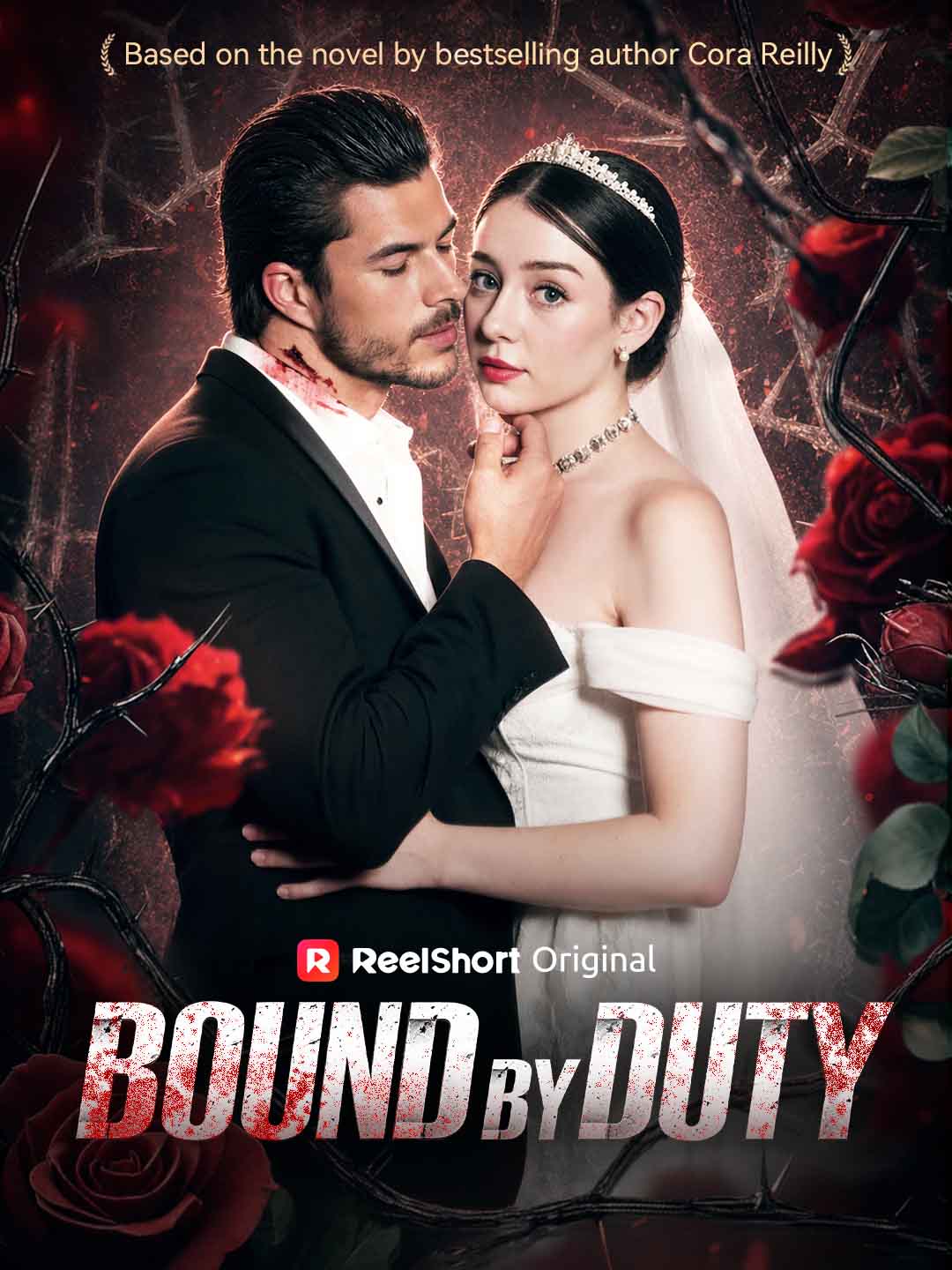
“You really think I wanna be fucked by a loaded gun,” Val says in the ReelShort adaptation of Bound by Duty.
If that doesn’t tell you where we’re headed, let me be clearer about where we’re starting from: a dark place. A genuinely dark place. And by episode 13, I was seriously questioning my choices — right around the time I decided to invent a drinking game where you take a shot every time someone says “capo.” Lordy. They say it a lot. I would not survive.
None of which means I hated it. And I want to be precise about that, because there are a lot of episodes after 13, and what happens in them is the reason I’m writing this at all.
The setup
Bound by Duty stars Casey Schryer and Chase Mattson, and it’s an adaptation of the book of the same name — part of ReelShort’s ongoing run at Cora Reilly’s catalog.
Val and Dante enter a second marriage, and both of them arrive carrying their first ones. Dante’s wife died of cancer. Val’s husband died too — and nobody knows he was gay.
They marry out of duty, whatever that’s supposed to mean in practice. She doesn’t want to be a traditional mafia wife. He doesn’t want to move on at all, because moving on feels like a betrayal of the woman he buried.

The secret, and what it costs her to keep it
Val won’t tell him the truth about her first husband, because in their world that truth is shame — not his shame, hers by association, and his posthumously. So she carries it.
And the thing that makes it ache is that she’s protecting a dead man’s reputation while it actively damages her own life. She wants to spare him the shame. She’s also terrified that if Dante learns the truth, the truth underneath it comes out too: that she’s a virgin. Four years in a loveless marriage and she was never touched.
Sit with that for a second, because it’s the emotional engine of the whole series. She spent four years being a wife in name, performing intimacy she never received, keeping a secret that isolated her completely — and she came out of it convinced that the fact of her inexperience makes her less wantable, rather than evidence of how much she gave up for someone else’s protection.
That’s not a plot device. That’s a woman who has never once been allowed to want something out loud.
And him
Dante, meanwhile, is trying to honor his late wife by keeping his distance — and failing, because he wants Val. That’s the trap he’s built for himself. Every time he feels something for his new wife, he reads it as the deepest betrayal of the old one, so the wanting itself becomes evidence of his own dishonor.
Which means Val gets the whiplash. He pulls Valentina close and then shoves her away as hard as he possibly can. He makes her believe she’s everything, and then tells her with his actions that she’s nothing. He swears he’ll always protect her and then lets his childhood best friend harass and bully her without consequence.
It’s a lot. It’s honestly a lot.
And here’s the pattern I couldn’t stop clocking: Dante is always a few steps behind. Always. He cannot protect her because he isn’t paying close enough attention to notice she needs protecting. His grief has taken up all the available bandwidth, so the person standing in front of him keeps getting processed late — the harm registers after it’s already landed.
I don’t think he’s a bad man. I think he’s genuinely trying to be a good one, which is somehow more frustrating to watch than if he weren’t. But being haunted is a full-time occupation. It’s very hard to move forward when a significant part of you believes forward is a form of theft.
The detail that tells you everything: he won’t even wake up with her in the morning. Not the wedding night, not the big declarations — the morning. The ordinary, undramatic intimacy of letting someone see you before you’ve assembled yourself for the day. That’s the thing he can’t give her. And in a marriage built on duty, that small daily refusal is the loudest sentence in the whole series.
The pregnancy and the infertility
Then Val gets pregnant — and learns that Dante is infertile. Or has been told he is, which amounts to the same thing until suddenly it doesn’t.
What follows is the moment the whole marriage hinges on, because he could very easily have gone the other way with it. He doesn’t. When he finds out she’s pregnant, he’s happy. He believes her. He wants to protect her. In a genre that runs on suspicion and paternity accusations and men who assume the worst about their wives on principle, Dante simply takes her at her word, and it’s the first genuinely unguarded thing he does all series.
But before that lands, I have to say: Val doesn’t understand that she doesn’t have to prove anything to him. She keeps operating like her worth in this marriage is a case she has to argue. And I get where it comes from — four years of being a wife nobody wanted will do that — but it means she keeps auditioning for a role she already has.
Where I’m put off by both of them
Honestly, Carla brings out the worst in both of these people (and she is a ghost), and I’m a little put off across the board.
Val doesn’t get that grief isn’t linear. That he can love her and still fall apart on a Tuesday for no reason he can name. That needing time isn’t the same as withholding. She wants a schedule for something that doesn’t run on one.
And yes, there’s jealousy. Of course there’s jealousy. Anyone would be jealous of a woman who gets to be perfect forever because she’s not here to be human. That’s the cruelest thing about competing with a memory — the memory never has a bad day, never says the wrong thing, never fails to wake up in the morning. Val is being measured against someone who has been edited into an ideal by loss. It would make anyone jealous.
But recognizing why she feels it doesn’t make how she wields it fair.

The cemetery
So he goes to the cemetery, and he tells Carla the truth: he’s fallen in love with someone. He’s moved on. He tried to deny his feelings for Val and he can’t do it anymore.
That scene is where the series earns everything it spent thirteen episodes making me endure. Because he doesn’t ask permission and he doesn’t ask forgiveness — he just tells her, the way you’d tell someone you loved, because she was the person he told things to. Moving on isn’t presented as replacing Carla. It’s presented as the last conversation he owes her.
He knows he’s made mistakes. He knows he should have shown Val more love, much earlier, and that knowing it isn’t the same as having done it. And when the time comes to actually do it, he understands the assignment: he’s going to have to prove to her that the love is real. Not say it. Prove it. Because he’s the one who taught her not to trust it.
She’s going to be the last woman he ever loves. And after everything, I believe him.
The accident
Val has an accident at home and ends up in the hospital. Dante is at the cemetery when it happens — which is almost too neat, and I mean that as a compliment. The exact moment he finally chooses the living is the moment the living nearly gets taken from him.
He about loses his mind. Runs straight to the hospital. And she pushes him away.
Which is devastating and completely coherent. She’s terrified of being hurt, so she’s protecting herself from the one person who has actually shown up — because she’s learned that his showing up is temporary, and the pull-close-then-shove-away pattern has trained her to brace instead of reach. He built that reflex in her. Now he has to watch it work on him.
The impossible choice that isn’t
And then the floor drops out: her ex-husband, the one she believed dead, is alive. He finds her and gives her terms. He’ll kill the baby unless she kills Dante.
Is that an impossible choice? No. It isn’t. Protecting your child comes first. Family comes first. That’s the arithmetic, and it’s not even close.
But she doesn’t seem to remember that in the moment, and she puts the poison in his tea. Which I think says less about her love for Dante than it does about how thoroughly her first marriage rewired her. She was conditioned for four years to obey a man who owned her, to keep his secrets, to make herself small around his demands. He shows up alive and the old programming boots right back up. She isn’t choosing him over her child. She’s reverting to the version of herself that never got to choose anything.
The nursery
And then she finds him building a nursery for his daughter.
That’s what stops her. Not a speech, not a confession — evidence. The man who couldn’t wake up beside her is on the floor assembling furniture for a child, and every claim he’d made about moving forward is suddenly load-bearing and real.
She basically slaps the tea out of his hands. Immediate, physical, no hesitation.
Then she does the harder thing: she tells him everything. The truth about her ex, the truth about the choice, the truth about what she almost did. She gives him honesty, and he recognizes exactly what that costs her — because honesty has never once been safe for Val. Every truth she’s ever held has been a liability, something to bury for someone else’s protection. Handing him this one is the first time she’s ever gambled on being met instead of punished.
And he recognizes that her giving it to him at all means they’re finally standing in the same place. He proved the love was real by building something. She proved it by telling him the worst thing about herself and staying in the room.
That’s the whole series. Two people who were each protecting a ghost — his by grieving, hers by lying — finally putting them down at the same time.
They find peace in the love they can actually give each other, and in the far rarer thing underneath it: knowing they can be trusted with the truth. For two people who married out of duty, that’s not a small landing. That’s everything.

The to-be-continued
There’s a kidnapping. He saves her. Of course there is, and of course he does — it’s a mafia story, and I’m not going to pretend I wanted it any other way.
What I genuinely loved is that they gave us a to be continued. That was a smart call. Sixty-eight episodes is a lot of real estate and they still packed it to the seams, with clearly more story sitting on the other side of that card. Better to leave the door open than compress the rest into a rushed finale that services plot instead of people. This is a series that works because it slows down for the small stuff — the mornings, the nursery, the honesty — and you can’t do that if you’re sprinting to tie off every thread.
Why book adaptations work so well here
I want to sit with the adaptation question, because Bound by Duty is the best argument I’ve seen for it, and I don’t think it’s a coincidence that ReelShort keeps going back to the shelves.
Start with the structural fit. A vertical gives you sixty to ninety seconds per episode and demands a hook at the end of every one. That’s a brutal ask if you’re building a story from scratch — you end up manufacturing cliffhangers, which is how you get twists that exist purely to end an episode and get resolved in eight seconds. Short chapters, alternating POVs, a reveal or a reversal every few pages, an emotional escalation you can feel coming. Cora Reilly’s books were engineered for the read-one-more-chapter compulsion, which is the same instinct as unlock-one-more-episode. The pacing translates because the pacing was already there.
Then there’s the interiority problem, which is the real one. The weakest verticals fail because nobody has an inside. Characters announce their feelings, or they don’t have any, because there’s no time to build them. An adapted novel arrives with the interiority pre-loaded — Val’s shame, Dante’s guilt, the specific architecture of why he can’t wake up next to her. The actors aren’t inventing a psychology on a fast set. They’re playing one that’s already been worked out over four hundred pages, and that’s exactly why Schryer can convey so much in the margins of a scene. The subtext exists because someone wrote it down first.
It also solves the trope problem, or at least reframes it. Verticals live on trope density, and originals tend to stack tropes as a substitute for story — arranged marriage plus secret baby plus fake death plus amnesia, deployed as content rather than consequence. A book uses the same tropes but has to justify them, because a reader will close the cover otherwise. So the second marriage isn’t a premise, it’s a pressure system. The dead husband coming back isn’t a shock, it’s the return of the thing that made Val who she is. Same ingredients, load-bearing instead of decorative.
Vertical dramas have a stigma problem — the assumption that nothing shot for a phone can be emotionally serious. An adaptation borrows credibility. It says, out loud, this came from somewhere. And once a project believes it’s allowed to be about something, everyone involved starts making better choices. That’s the difference between the first thirteen episodes of Bound by Duty and everything after: the source material gave it somewhere to go, and it went.
The performances
The real star of this drama is Chase Mattson. We already knew he could play a mafia don better than most people working in this space. What we didn’t know — or at least what I hadn’t fully seen until now — is how much room he has underneath it.
Because the range is the story here. He had to convince you, inside a single performance, that Dante was a man who loved deeply and a man who could kill without flinching. Those two things usually cancel each other out on screen. One always wins, and you end up with either a teddy bear in an expensive suit or a brick wall who frowns meaningfully at his wife twice an episode. Mattson refused to pick. He played them as the same muscle — the capacity for absolute devotion and the capacity for absolute violence coming from one place, which is exactly right for this genre and almost never executed this cleanly.
And he made the tenderness the more frightening of the two. That’s the choice I keep thinking about. The ruthlessness is just his job; it costs him nothing. The love is the exposure. So every soft moment carries a little dread underneath it, because you can see him calculating what it would do to him to lose this, and you understand precisely why he spent thirteen episodes trying not to feel it.
He also did the thing that’s hardest in vertical drama: he let the character be wrong. He played a man actively hurting his wife without ever letting him off the hook or asking you to excuse it, and still kept him worth rooting for. Play it too sympathetic and the cruelty stops mattering; play it too cold and you lose the audience for good. He kept Dante culpable and human at the same time, which is what made the cemetery and the nursery land as earned rather than convenient.
But none of that works without Casey Schryer, and I want to be clear about why. Mattson had the showier assignment — grief, violence, the big cemetery monologue. Schryer had the quieter and frankly harder one: play a woman whose entire inner life is made of things she isn’t allowed to say. Val’s secret, her shame, her inexperience, her fear that the truth makes her unlovable — almost none of it can be spoken out loud, in a format that gives you ninety seconds and then yanks the floor out.

So Schryer had to leak it. And she did, constantly, in the margins of scenes that were technically about something else. She played four years of being untouched as a kind of physical wariness, a woman braced for a hand that never comes. She let you see Val calculating how much of herself to reveal in real time. And when the poison and the nursery arrive back to back, she plays the reversal without a single line of explanation — you just watch a lifetime of conditioning break, on her face, in seconds.
The two of them together are why the thing holds. He’s playing a man who can’t let himself be loved and she’s playing a woman who doesn’t believe she’s lovable. Two people running opposite versions of the same defense, and both actors trusting the other to catch it.
That’s not mafia-drama acting. That’s just acting, and it happens to be wearing a very good suit.
Whatever happens next, we’ll be waiting.
