
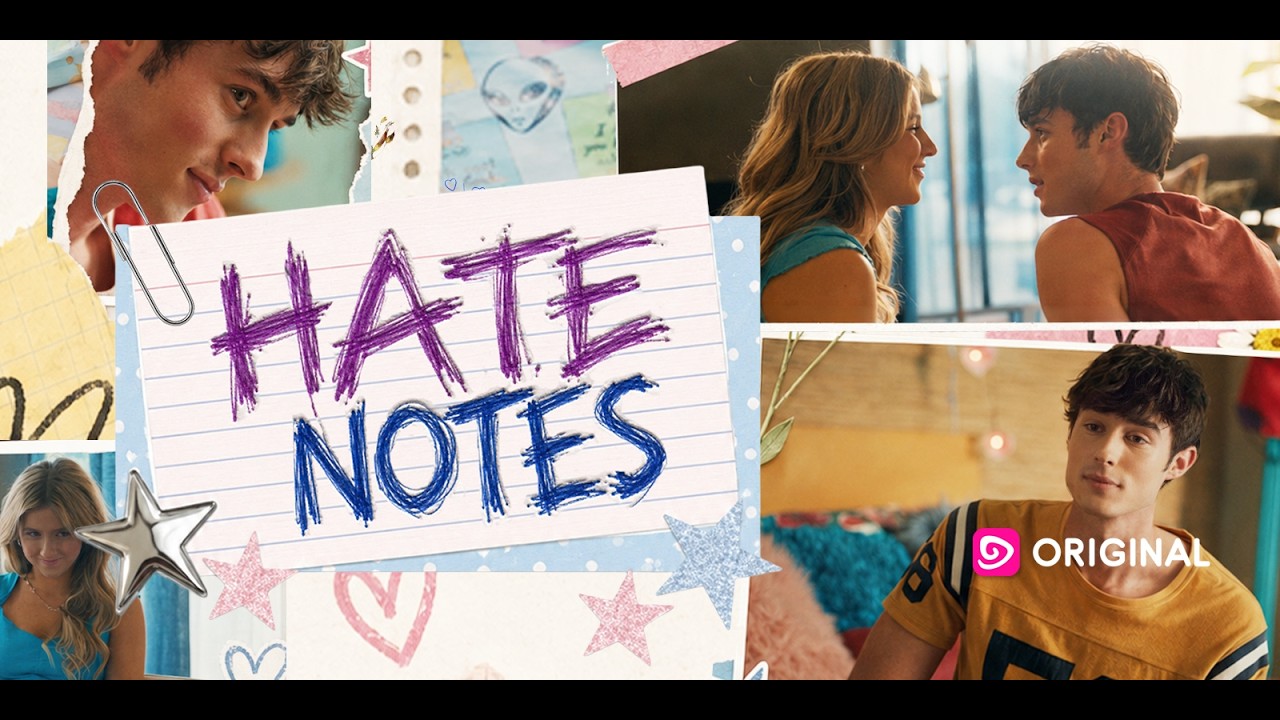
Shouting into the void is easier than talking to those you know. The void doesn’t judge you out loud. You get to avoid the confrontation and let it disappear into a place where nobody has to respond to it.
In Hate Notes, Iris Davis understands that completely. And that’s what makes this whole premise work — because writing something down anonymously isn’t really about hiding. It’s about needing somewhere to put a feeling that you can’t put anywhere else. Iris doesn’t start a secret blog because she’s cruel. She starts it because there’s something inside her with no acceptable outlet, and the void is the only place that’ll take it.
Every previous generation of teenage girls had a diary with a lock on it. Iris has a blog. Same instinct, completely different physics — because a diary can only betray you if someone finds it in your room, and a blog can betray you from anywhere, to everyone, forever. She’s doing the oldest thing in the world in the one place where it can’t stay private. That’s just what privacy means now.
She “hates” him
She hates her brother’s best friend, Jesse.
He’s annoying. He calls her crybaby and frustrates her constantly.
And it’s obvious she likes him. Obvious to me, anyway. She tries so hard to push him away, to perform nothing but irritation whenever he’s in the room.
But he gets to her.
So she takes all that annoyance and puts it online, in a private blog — sticky notes listing every reason she hates Jesse.
Nobody makes a list about someone they’re indifferent to. Every note is a small monument to how he’s living rent free in her mind. The blog is a receipt for wanting to be noticed, obsession, and feeling something that one may not want to admit to.
The word she chooses matters, too. “Hate” is the only socially acceptable strong feeling a girl is allowed to have about her brother’s best friend. Anything softer would be a confession. So she picks the one intense emotion that doesn’t expose her, and she commits to it so thoroughly that she starts documenting it — because a feeling that big needs somewhere to live, and she’s already decided which name it’s allowed to have.
She can’t win that exchange out loud, so she wins it in writing, where he can’t interrupt.
Okay, the premise
I should probably tell you what it’s actually about.
“Iris Davis is horrified when her anonymous blog trashing her brother’s cocky best friend Jesse Ellison gets leaked to the entire school. She agrees to help him track down the mystery author, not exactly eager to point the finger at herself. Their fake investigation sparks real chemistry, but Iris’s secret threatens to cost her the only guy she’s ever truly wanted.”
Structurally, that’s a smart setup, because the investigation forces exactly the proximity neither of them would ever choose. The genius of it is that Iris has to spend hours pretending to look for herself, which means every conversation about the author is secretly a conversation about her feelings, in code, out loud, with him. She’s confessing constantly. He just can’t hear it.
The Davis house
Jesse spends a lot of time at the Davis household. This family was there for him when nobody else was.
Like Iris’s brother, he’s extremely protective of her — he doesn’t want to see her get involved with anyone. Iris and Jesse seem to enjoy the push and pull of it, even while she’s determined to convince Jesse she wants nothing to do with him.
There’s something quietly sad underneath that setup, and it’s the most interesting thing about Jesse on paper. He’s a boy who found a family that isn’t his and can’t risk it. Wanting Iris would mean gambling the only stable thing in his life. So he does the thing people do when the stakes are that high — he converts it into teasing. He gets to be close to her every single day without ever having to name what he’s doing.
His protectiveness is telling, too. He’s guarding her from other guys while positioning himself as categorically not an option. That’s not brotherly. That’s a boy standing in a doorway pretending he doesn’t want to walk through it.
And the brother is the load-bearing obstacle in all of this, even though the drama treats him as furniture. Jesse’s entire sense of belonging runs through that friendship. If he wants Iris and it goes badly, he doesn’t just lose a girl — he loses his chosen family. That’s an enormous amount of risk for a teenager to carry. He’s protecting his only safe place, badly.
The internet is forever
This drama is genuinely about what putting something online can do to you. At the exact moment Jesse gets awarded a scholarship to his dream school, the hate notes drop. Iris had nothing to do with the release and she’s as confused as anyone else — very few people even knew the diary existed.
Jesse is shocked that someone could despise him enough to write these. The bigger problem is that his scholarship has a morals clause, and the notes can absolutely wreck his future.
That’s the piece that gives this story real teeth, because it’s the most contemporary thing in it. Iris wrote private words in a private place, and the consequence lands on someone else’s college fund. That’s not a teen drama contrivance — that’s just how the internet works now. Something written for an audience of nobody gets read by everybody, and the harm has no relationship to the intent.
It also flips who’s actually vulnerable here. Jesse looks like the one with power at this school. But he’s the one whose future is conditional. A rich kid survives a leaked document. He can’t.
The morals clause detail is genuinely the sharpest thing in the script, and I wish more people talked about it. Because notice what it actually does: it makes Jesse’s future dependent not on his behavior, but on other people’s opinion of him. He didn’t do anything. Somebody wrote something. And an institution decided that other people’s words about him constitute evidence about his character. That’s a real and specific injustice, and it’s the exact mechanism by which the internet ruins actual people. Not truth. Reputation.
There’s a certain amount of classism baked into that too, whether the drama meant it or not. Morals clauses only threaten the people who need the money. Jesse’s whole life is subject to review because he can’t afford tuition, and nobody with a trust fund has ever had their future evaluated for tone.
Jesse and where I don’t buy it
At first you think Jesse is the quintessential jock. Self-serving, god complex, all-around douche.
But if you stop for a second you can see that he genuinely does care.
Blake Manning, who plays him, doesn’t manage to convince me — it’s an opinion, back off me — that Jesse actually goes through much change. I understand it’s supposed to be subtle. For the life of me I don’t see it.
And I want to be fair about why, because subtle is a legitimate choice and I’m not asking for a big speech. The problem is that subtle only reads if the audience can identify the starting point. Manning plays Jesse as fundamentally decent from about the third episode on, which means there’s no distance for him to travel. You can’t watch a man soften if he was never hard. His arc requires an earlier version of himself that we’re mostly told about rather than shown.
There’s a format issue in this as well. Vertical dramas are built to hook you fast, which means likability gets front-loaded — you can’t risk an audience swiping away from a lead they dislike in the first ninety seconds. So performers get pushed toward sympathetic almost immediately, and the cost is that nobody has anywhere to grow. Manning may not have had the room to play a genuinely unpleasant Jesse even if he wanted to. But it feels like the script promised us that guy, a redemption arc, and the drama keeps referring back to a version of him we never met.
I do see little things. Like the fact that he wants to find whoever’s responsible and convinces Iris to help him, not knowing she’s the author. And the growth I do see? It isn’t about Iris at all. It’s the moment he decides he doesn’t really need to find them and takes all of the things that were written about him as a learning lesson.
That’s the one beat that worked for me, actually, and I wish the drama had built more around it. Letting go of the hunt is a real choice with a real cost. He’s choosing not to know something that could clear his name, which is the closest he comes to actual maturity. It’s also the only moment where he isn’t performing anything — no jock posture, no wounded pride, just a kid deciding that being right matters less than being okay.
Well. Until the scholarship gets revoked, and then he’s sad and angry all over again. He goes to his best friend’s house and the only person there is Iris.
And I do want to give the show credit for that detail, because it’s a good one. He doesn’t seek her out. He goes to the only place he’s ever felt safe, and she happens to be what’s there. That’s how a lot of real intimacy actually starts — not as a decision, but as proximity at the wrong moment.
The hookup problem
I am all for divulging that you’re attracted to someone. What I’m not for is starting something built on a lie.
He doesn’t know Iris is behind the hate notes, and she doesn’t tell him. Instead they hook up, and yet again, she’s starting this on a lie.
What makes it worse is that the timing turns her silence into something colder than it was. Up to this point, Iris not confessing is understandable — she’s terrified. But letting him be intimate with her while he’s grieving something she caused is a different space. She isn’t just withholding information anymore. She’s accepting comfort from someone she’s actively deceiving.
I don’t think the writers accounted for, but it retroactively costs Iris the audience’s trust. Everything before that point is a girl in an impossible situation, and I was fully on her side. After it, she becomes a person who took something under false pretenses. The drama needs me to keep rooting for her through the back half, and it fails at that.
This is what fear does. Every hour she doesn’t tell him raises the price of telling him, so silence compounds like debt until it feels impossible to pay. It’s also the show’s job to make me feel her doing that math, and instead the scene plays as weak and her as a coward. Nobody seems to be carrying anything, and that’s the part that reads as a writing choice rather than a character one.
The other suspect
There are other problems, too. Someone else tries to convince Jesse that they are behind the Hate Notes, and he doesn’t buy it.
I think he doesn’t buy it because he was already developing feelings for the person behind the site and he didn’t want to like that person that was faking to be her.
Jesse isn’t evaluating evidence. He’s protecting a conclusion he needs to be true. It’s motivated reasoning in a letter jacket — the same thing all of us do when the truth would require giving up something we want.
And it makes his later anger more complicated, in a good way. When he finds out that Iris wrote the hate notes, he isn’t only angry at Iris. He’s angry at himself for having been told and having chosen not to hear it.
He had the information. He declined it. That’s a specific humiliation — discovering you weren’t deceived so much as complicit in your own deception.
Feelings don’t make anything easier, though, because when he does find out it’s Iris, he’s both hurt and angry. She’s definitely looking for redemption, even though I’m not sure that’s possible. It wouldn’t be, in real life.
Brent
Turns out it was her best friend Brent who exposed the notes to the school. He wanted to be with Iris, and he was also jealous of Jesse getting the scholarship he thought should have been his.
I appreciated Iris and how cleanly the show handles him, because Brent is the most honest thing in the story. He’s what happens when someone converts wanting a person into feeling owed a person. His weapon isn’t even a lie — he told the truth. He just detonated it at the exact moment it would do maximum damage, which is its own kind of violence.
He’s also the shadow version of both leads. Iris wrote her feelings down instead of saying them. Jesse hid his behind mockery. Brent hid his behind sabotage. Three kids who couldn’t say a plain thing to the person they wanted, and only one of them turned it into a weapon.
The two motives being tangled together is what makes him work, honestly. It’s also what makes the viewer despise him. He wanted the girl and he wanted the scholarship, and he genuinely could not tell you which one he was avenging. That’s very human. Envy loves to disguise itself as heartbreak, because heartbreak is the one that gets sympathy.
His method is the most modern kind of cruelty available: he didn’t fabricate anything, he just moved something true from a place where it was harmless to a place where it was lethal. He’s a genuinely contemporary villain, which is more than this genre usually manages.
Iris exiles him without negotiation is one of the more satisfying beats in the drama, though. She doesn’t hear him out. She doesn’t accept the framing where his feelings excuse the damage. She just removes him, which — given how much of this story is about her being unable to say the direct thing — is the first moment she’s clear and we applaud that for her.
About the casting
I do understand that a lot of vertical fans were excited to see Lowery and Manning in something together.
The real-life couple absolutely has chemistry off screen. It just doesn’t translate as strongly onto the small one.
It’s okay. They’re believable. The chemistry isn’t so strong that I actively wanted them together — I was mostly sitting there going “meh” and thinking about how they’re each with other people on screen. I wanted them to have it, and it fell flat for me.
And that’s such an interesting thing to happen, because you’d assume real intimacy would be an advantage. I think it can actually work against you, though. Screen chemistry runs on tension — on the wanting, the not-yet, the half-inch of distance nobody closes. People who are genuinely comfortable with each other don’t naturally generate that. They’ve already resolved it in real life. What you end up watching is ease where the story needs ache.
Which is exactly the wrong thing to have missing for this particular script, too, since the whole premise is longing that can’t be spoken out loud. Enemies-to-lovers lives or dies on unresolved charge. If you can’t feel the charge, all that’s left is the plot mechanics.
The other thing working against them is that real-life familiarity is very hard to un-know as a viewer. Part of what makes screen chemistry thrilling is watching two people discover something. When you already know they found it years ago, you’re not watching discovery — you’re watching a reenactment. It’s the same reason casting couples sometimes flattens a film that should crackle. The audience’s own knowledge does the deflating.
None of which is a knock on either performance, to be clear. They’re fine. They’re believable as two people who care about each other. It’s just that “believable as a couple” and “electric to watch” are different achievements, and this story needed the second one.
The suspension of belief
As with any entertainment, suspending disbelief matters, and shows like this dramatize things in a way that requires it.
I don’t see anyone in real life forgiving something like this. But this isn’t real life and Jesse does believe in forgiveness.
I think the reason – for me- that forgiveness doesn’t land isn’t that forgiveness is impossible — it’s that the drama never makes her earn it. It doesn’t show it to the viewer. She apologizes, she fights for him, and that’s genuinely something. But the specific damage was public, and the repair is private. His name got wrecked in front of an entire school and a scholarship committee, and the resolution happens between two people in a room.
A version of this where Iris took the same public risk she accidentally imposed on him — where she stood up in front of everyone and said it was me, knowing what it would cost her — that’s a redemption I could believe. Instead we get one where he absorbs it because the runtime is ending.
There’s also the small matter of the scholarship, which the story mostly forgets it destroyed. His future was the stake. It’s still gone. Forgiving Iris doesn’t restore it, and a genuinely brave version of this ending would have made them sit in that — two people building something while one of them lives with what the other one cost him. That’s a harder, better story.
Still. I liked that she fought. I liked that she didn’t just wait to be forgiven without proving who she could be. And I liked that the drama took the internet seriously as a thing that can actually ruin a life, because that part is the truest thing in it.
The forgiveness of it all
They had the best of intentions where each other was concerned. They just had to go through the ups and downs to figure out what they wanted and what they could actually handle.
And I do think intention is the thing the drama is quietly arguing about, even if it never says so. Nobody in this story set out to hurt anyone — not Iris, not Jesse, not even really Brent, who mostly set out to get something and didn’t care what he broke on the way. All the damage here is there and is realistic, honestly. Most of the harm people do to each other isn’t planned.
But intention only gets you so far. The show treats good intentions as though they settle the account, and they don’t. They just explain the balance.
The actual test that these two are put through? Not whether they love each other — that’s never really in doubt — but whether either of them can tolerate being known. Iris has spent the whole story hiding her feelings in a place she thought was safe. Jesse has spent it hiding his behind jokes. The plot forces both of them to be visible, which is the thing they were each most afraid of. That’s a genuinely good for a teen romance. I just wish the show had trusted it more than it trusted the twists.
Is it earned
Is there a happy ending? Yes.
Is it well deserved? Unsure. It was just there.
And I think that’s the most accurate four-word review anyone could give this drama, because “it was just there” is exactly how the resolution feels. Not wrong. Not moving. Present.
The beats all exist in the correct order — confession, anger, fight, forgiveness — and none of them cost anybody enough. A happy ending is only satisfying in proportion to what it took to get there, and this one arrives more or less on schedule regardless of whether the people in it changed.
Which is a shame, because the raw material here was strong. A girl who can only tell the truth anonymously. A boy whose whole future depends on other people’s good opinion. A best friend who weaponized honesty out of envy. That’s a real story about what it costs to be seen, and it’s sitting right there underneath a drama that mostly wanted to be a mystery about a blog.
Would I watch it again? No.
Would I leave hate notes on the internet? Also no.
So I guess that’s a positive. Lessons learned.
