
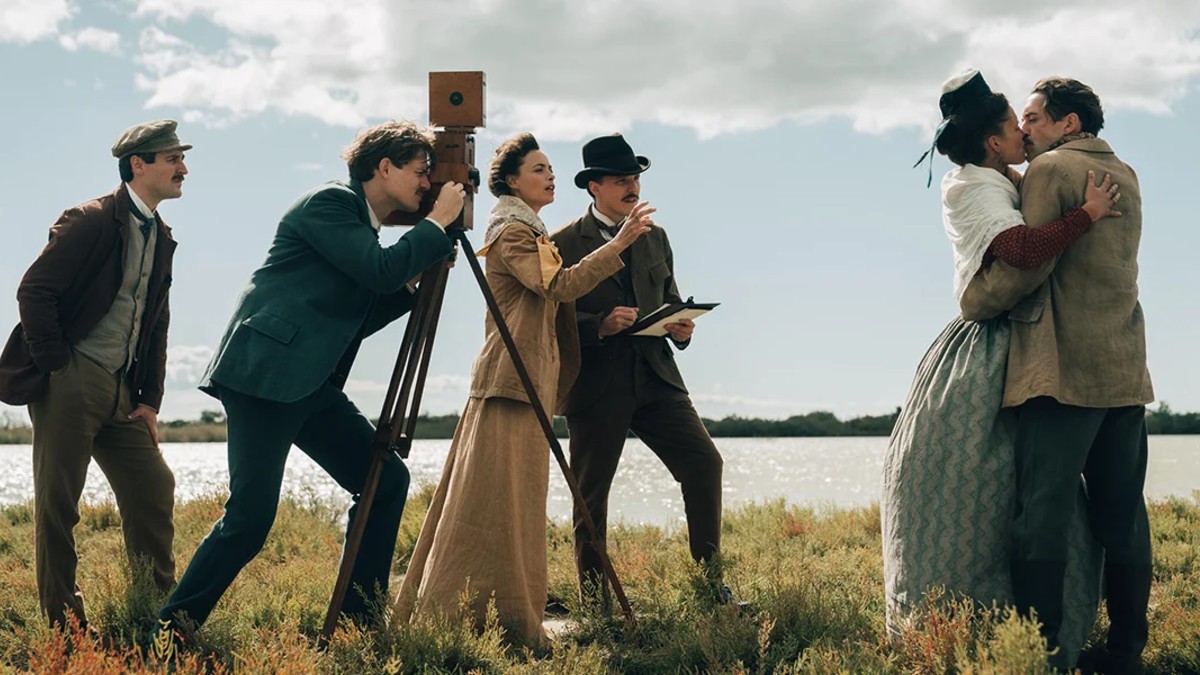
Alice: Pioneer of Cinema is first and foremost the story of a remarkable woman: Alice Guy (Bérénice Bejo), the first woman film director. And as a celebration of cinema and the importance of Guy, it feels particularly groundbreaking. But the show attempts to go further and provides us with a tale about who Alice was, what made her into the kind of person who would be willing to defy not just familial expectations, but society’s as well, to mixed results.
Alice Guy is a very interesting woman. She began as a secretary to Léon Gaumont in Paris before convincing him to let her direct, eventually becoming head of production. She was the first woman to own a film studio, and directed approximately 1,000 films. She also was a pioneer of close-ups, double exposure, hand-tinted color, and early synchronized sound. However, her name was lost in history, her contributions mistakenly credited to male colleagues.
In a way, that’s what happens at times with Alice: Pioneer of Cinema. When Bérénice Bejo is at the center of the narrative, the story works beautifully, and we are all fully engaged not just with what she’s doing but what she’s hoping to achieve. At times, however, the narrative seems to pay too much attention to the men around her, to the story’s detriment.

We didn’t come here to learn about any of those men, even if one of them is played by Heated Rivalry‘s François Arnaud, looking so good in period clothing that we wouldn’t fault him if he wanted to never do anything contemporary again once he’s done with the role of Scott Hunter. But Arnaud’s charm, or the solid acting of Thibaut Evrard and Oscar Lesage are never as interesting as two seconds of Bejo not even speaking, which is sort of the point. This is Alice’s story.
And it’s told really well. I didn’t know almost anything of what I learned in this show, and watching it never feels like a history lesson or an attempt to correct a historical wrong. Or at least, it doesn’t feel like just that. The world already tried with Alice Guy, after all. She received France’s Légion d’honneur in 1955, and since 2018 France has awarded the Alice Guy Prize (Prix Alice Guy), an award that honors the best French feature film directed by a woman.

Despite all of this, the reality remains. Alice Guy is a name too many of us learned only recently, and as big and important as her legacy is, most of my life I’ve had to see Best Director categories at the biggest awards, be it for film or TV, be male-dominated. The glass ceiling was broken, and yet nothing happened. Every step forward is another fight, and another and another.
That doesn’t make Alice’s story less important, or this show any less worthy of your time. Bérénice Bejo is enough reason to give this show a chance. It’s just a little sad that we’re learning about all this woman did, all she changed and created, and have to sit with the fact that this happened over one hundred years ago. Yet, it’s only in the past few years that the world has started really celebrating her and her legacy.
Alice: Pioneer of Cinema is a story about a woman who had big dreams and created big things. But it’s also a reminder that doing all of those things isn’t the end of the story. You still need people to know you did them. Otherwise, you’ll have to wait over a century for a movie that celebrates you the way you deserve to be celebrated.
Alice: Pioneer of Cinema premiered at the Toronto International Film Festival.
