
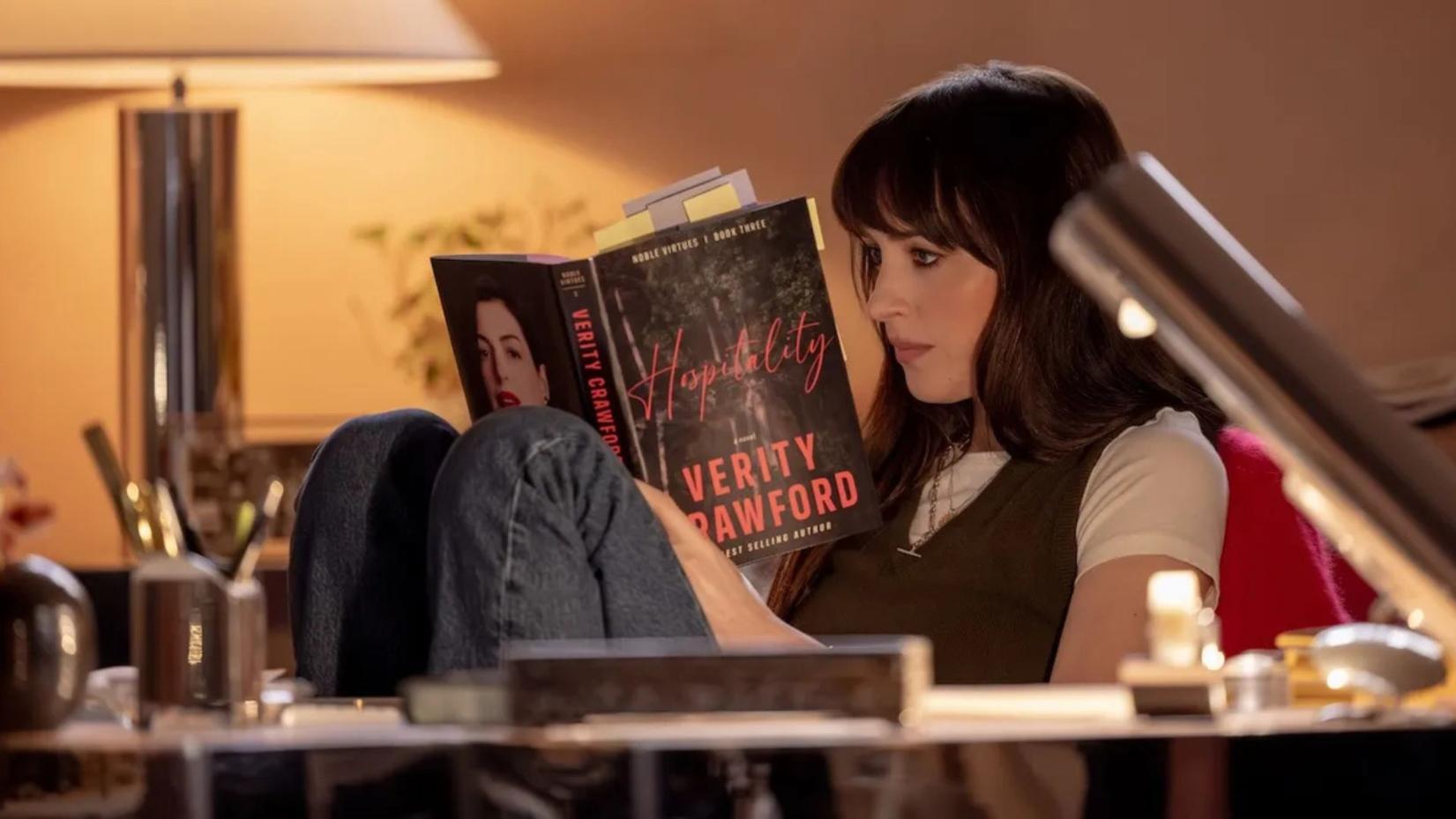
Verity, based on the book of the same name by Colleen Hoover and directed by Michael Showalter, is finally in theaters. It’s a film that will make you question everything you thought you knew. The film explores truth and the ways it can be manipulated to fit our own narratives.
When struggling author Lowen Ashleigh (Dakota Johnson) accepts a job as ghostwriter for Verity Crawford (Anne Hathaway), author of the popular Noble Virtues Series, she has no idea what she’s gotten herself into. Verity’s publishers tell her she was in a terrible accident and can’t finish the rest of the series.
Lowen’s books are not selling, and she’s on the verge of eviction. Though she’s initially apprehensive, she accepts the job after speaking with Verity’s husband, Jeremy (Josh Harnett). It doesn’t hurt that half a million dollars is on the table. Jeremy invites Lowen to stay with him, Verity, and their son Crew at their home in Vermont, where she can sort through Verity’s notes and gather anything else she needs to complete the series. And of course, we all know that staying in a secluded home in the snowy mountains with people you barely know is always a great idea…
More: Materialists Review True Love Should Be Enough in A Relationship
Lowen doesn’t know the severity of Verity’s accident, which is why, when she arrives, she is stunned by what she finds. She learns from Jeremy that Verity was involved in a car accident so bad that she became paralyzed and is in a catatonic state. It’s a lot for Lowen to process, but in her mind it’s only a few days.
“There is no light where we’re going…Darkness Ahead.”
As Lowen conducts her research, she realizes how challenging it will be to write like Verity. Though she and Verity both write psychological books, Verity’s stories are told from the villain’s point of view. And Verity’s villains are some of the worst. While reviewing Verity’s notes, she stumbles on what appears to be Verity’s autobiography. Believing it may help her learn more about Verity, she reads the manuscript.

What Lowen discovers is something she was not prepared for. At first, it’s all about how Verity and Jeremy met and fell in love. But it quickly shifts to something darker. The more Lowen reads, the more she questions her sanity as the lines between reality and fiction begin to blur.
Lowen and Jeremy’s attraction grows, and they begin sleeping together. Yes, in the house where his wife stays right upstairs in a hospital bed. After strange occurrences, Lowen believes that Verity may be faking her condition. When her suspicions are confirmed, she takes matters into her own hands. She feels it’s her duty to free Jeremy and Crew from the prison she believes they are trapped in. Her actions lead to a deadly outcome.
Verity is a psychosexual thriller, but it also explores something deeper: postpartum depression. When I read the book, I didn’t catch on to it. I just looked at Verity as the villain. But in the film, Hathaway draws you in. What you see on her face as she holds the twins is nothing sinister. It’s exhaustion. Sure, we have the creepy, heavy voice-over that she delivers in those manuscript sequences, but you also see a mother who is drowning.
Throughout the film, it forces you to ask yourself who is right and who is wrong. And it also forces you to ask, who’s story is this? At least it did for me. Because it feels a bit like Inception. It’s like a book within a book within another book.
The audience is forced to answer the question of who the real monster is. Frankly, there are no likable characters to root for. Jeremy likes to pretend he is the hero in this story, but he isn’t. He moved a woman into his home and started sleeping with her right under his wife’s nose. And the fact that he found the manuscript and did what he did to Verity was crazy. It was even crazier that he manipulated Lowen into thinking it was the first time he’d ever seen the manuscript.
“Verity was a master at manipulating the truth. The only question that remains is which truth was she manipulating?”
There’s nothing warm about Verity either. The opening scene with the Gayle King interview is cold and sterile. Even her Hot Ones interview manages to lack humanity. It feels as if she’s constantly putting on a show. It truly makes you say, “Who is the real Verity?” I know there is the “Team manuscript or Team letter” debate but I’m team neither. The letter attempts to humanize her and show her as a grieving mother who would do anything to protect her child. But the first hour of the film spends so much time showing the manuscript version of her, it’s difficult to connect with the version we should believe she is based on the letter.

And then there’s Lowen. Lowen came to Vermont to do her job. She could have stopped reading the manuscript at any time. But she didn’t. She dove further into it until it started to rule every decision she made. She reveled in taking over Verity’s life the longer she stayed in the house with Jeremy. And she was the one who encouraged him to handle Verity. She told him exactly what to do. Her hands are just as dirty.
Shawlter’s adaptation of Verity certainly leaned into the creative license of it all. That is to be expected with book-to-screen adaptations. One woman in the theatre I was in was not a fan of the changes and shouted out, “I didn’t like it” as soon as the credits began to roll. I reminded her that adaptations have to make a few changes because they don’t want the film to be too predictable for those who have read the book. Which I was okay with. It’s important to give the audience some unexpected moments.
One change was that instead of having twin girls, they made Crew Harper’s twin brother. Even though they cut one of the kids, somehow, it worked. The one change that I questioned was the Verity, Jeremy, and Lowen Lake moment. But I guess that’s what NDAs were made for. I could not imagine being a nurse to a patient who is paralyzed and comatose and one day they just up and disappear. I get that it was like a nod to the moment Verity supposedly killed Harper in the lake, but it just didn’t make sense to toss her into the lake when they could have left her in bed.
What I will say is that both Verity and Lowens’ scenes talking to the police were very much giving white tears. I don’t know if that was what Showalter intended, but that was my interpretation. Both had committed crimes and used their tears to garner sympathy, and the police quickly moved on. Not one iota of suspicion was placed on the two women. And Lowen’s performance was so unbelievable that the officer should have spotted the fakeness. I cannot even believe one officer dared to ask Lowen about the next book in Verity’s series. Cringe.
I also preferred they cut the epilogue moment from the film. It ended exactly the way it should have. With a lot of unanswered questions. As Verity said, “One should only walk away from an autobiography with, at best, an uncomfortable distaste for its author.” I can honestly say that by the time the credits rolled, I had an uncomfortable distaste for the author, and I don’t just mean Verity. There are two sides to every story, and in this case, there were three: Verity, Lowen, and Jeremy. None of them are right.
Verity is now playing in theatres.
