
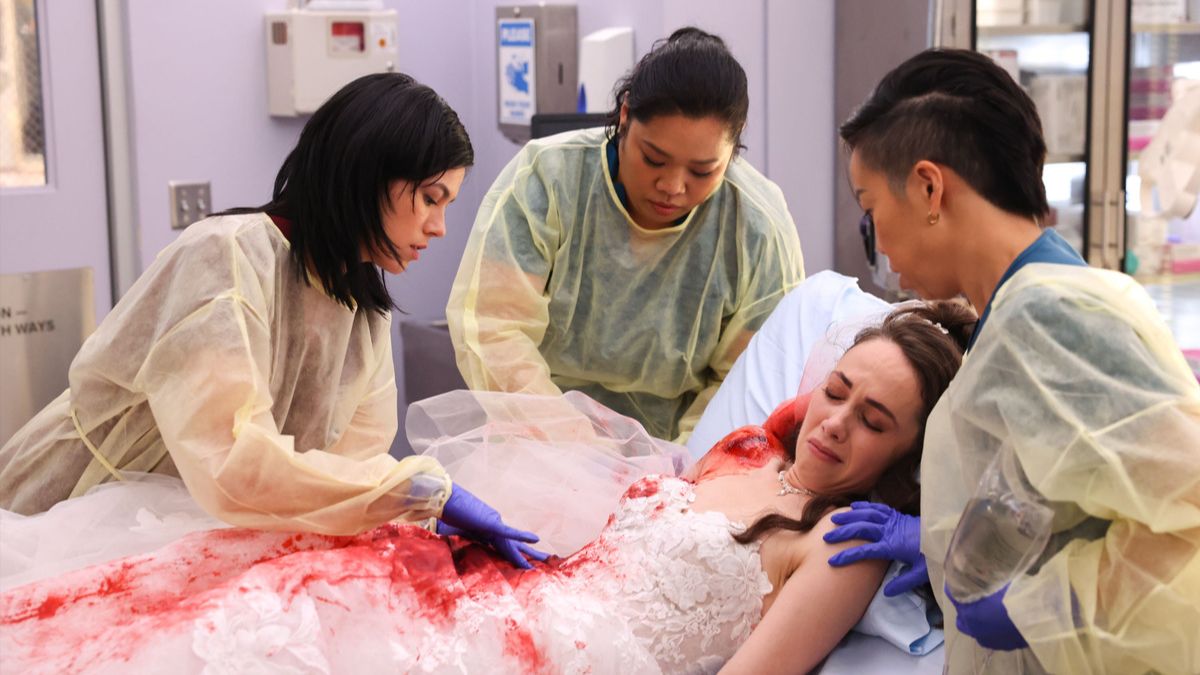
SPOILER ALERT: The following contains spoilers for Chicago Med Season 12, Episode 1.
Chicago Med dropped viewers into the emotional deep end with its Season 12 premiere. “Shots Fired” included another mass casualty event, a wounded child with a missing mother, and a car barrelling into the ED. Amidst it all, the NBC medical drama introduced meaningful changes for several of its main characters. So how exactly did the creative team pull all of this off?
Showrunner Allen MacDonald—who also wrote the episode—stopped by to reflect on the big choices made to start the new season. He teased what fans can expect for Ripley, Hannah, Archer (and baby Mabel!) after the premiere. Plus, he explained what it takes behind the scenes to crash a car into the ED waiting room, and how Chicago Med is able to tell such heart-wrenching stories year after year.
Brittany Frederick: Season 12 is your third season as showrunner of Chicago Med. We spoke when you started about the excitement and nerves that come with that. How do you feel now that you’ve settled into being the guy in charge of the show?
Allen MacDonald: You just get more comfortable with being the guy. I don’t know a better way to say it than that. In the first season, you deal with a lot of anxiety about, how do you handle this? How do you handle that? And then I’m a human being, so there’s insecurity as well. If you feel like you can’t do it, then you realize that you can, then that kind of goes away and you just do the job.
I feel much more confident about the show and my knowledge of the characters, because that’s pretty daunting when you come in [to] a show that had been on nine seasons before I got here, and all the characters are established, and so [you’re] learning who they are.
You start Season 12 with a mass casualty event, which has become what viewers expect from Chicago Med. So using this plot as an example, how do you continue to come up with these big emergencies to start and sometimes end seasons, without feeling like you’re repeating yourself thematically?
I always want to do two things. For all the Chicago shows—most shows in general—you want to come out with guns blazing with the premiere. You just jump right into it and just don’t let up, don’t take your foot off the gas, as they say. And what I always want to do specifically on Med is to do that, but also find a structure and a premise and guest characters that allow us to tell an emotional story.
Doing a wedding where the ex-boyfriend of the bride came in and opened fire and injured and killed many people felt like high stakes [and] heartbreaking to have such a tragic thing happen on what’s supposed to be such a beautiful, special, life-changing day. But it allows you to get into the character dynamics of the family—Dexter and his mother Birdie, and the hold she has over him, and how that affects everybody.
You juxtapose all of that chaos with the joy of Hannah and baby Mabel being in the ED. How much room will Chicago Med Season 12 have for Mabel and for Hannah and Dean’s parenting journey? Because people want to see that, but that’s largely outside the hospital.
You’re going to get enough. I can confirm for you we will go home with them. We will see them at home, and you will see Mabel regularly. Not every episode, but you’ll see her like you did in the premiere.

Another aspect of the Season 12 premiere that was a pleasure was the story arc for Ripley. We see shades of the old Season 9 Ripley, and then we see him pull that back, so where is he headed in the aftermath of what almost happened to him?
That’s exactly right. He’s always fighting an internal struggle, but he’s been winning. The thing with him is that he’s in love with Lenox now. They’re truly in a relationship. She has let her guard down as much as Lenox is going to, but she’s gone. He is so glad that she’s doing this study and that she’s finally taken some action with her prion disease—trying some other things and doing some studies—but she’s gone.
And I think that’s put him in a little bit of a funk and a dark place. In the last three months that have passed between the finale and this premiere, he’s been without her, and the hospital has not been running as well as it used to under Sharon Goodwin. And so the workload and the death around him is piling up, and then to cap that off with someone dying in front of him, getting hit by a car in in a spot where he was standing less than 10 seconds before, really underlines the frailty of life—which is something we hit on a lot on this show.
But what’s unique about it in this particular instance is that he finally kind of gets to be in the headspace that that Lenox has been in. That you could go at any time. He’s always assumed he’ll outlive her, and then he realized he could die today, and she could live another 15, 20 years. And that’s why she says to him, I feel like you’re kind of co-opting my existential dread.
That scene is impactful on so many levels. As you said, emotionally, but also just production-wise as well. What are the discussions that happen when you decide you want to have a car crash into the waiting room? How does the crew make that possible?
Basically the discussion is this: we’re going to crash the car into the waiting room. Now the waiting room is part of our regular set that has a steel structural integrity to it—so you don’t want to mess with that by running a car into it. So what we did is we built a duplicate of that room on another soundstage, and what also helped doing that is you could put the set far enough down the stage, where the car can gain some speed before going through the doors.
Bruno’s death is the linchpin of that scene, but in a short window of time you wrote and actor Michael Alix delivered such an interesting character. It would’ve been fun to see him play off Ripley somehow in the future, so was there any thought to perhaps having him almost die, or did he have to be killed?
He absolutely had to die to tell two stories. He had to die to tell the Ripley story, because how cruel is it that that that Bruno survives the shooting, only to be hit by a car driven by the shooter a few hours later?
And it also had to be that way for the other story about the little girl, Dakota. We couldn’t have had that dramatic moment where Frost is about to tell her that Bruno died, and then the mom—who already knows—stops him, because she’s had enough, that little girl, for the day. She thought her mom was dead. You can’t unload that on a child. So [Dakota’s mom is] basically saying she doesn’t need to know the truth, and I don’t think that would have hit as hard if we hadn’t killed Bruno.
That arc speaks to how Chicago Med has been very good at creating guest characters who feel fully developed, and they’re not merely props to get the main players to whatever their plot or realization is. It really helps the show stand out. How do you achieve that?
The writing staff and I just want them to be like fully fleshed out people that that they come in and it feels like they’ve lived a life, and that they have a background that’s of course not real, but it feels like it’s real. And the other side of that is our casting director Rebecca Mangieri, who just finds us great actors that can really fill that space.
Chicago Med airs Wednesdays at 8:00 p.m. ET/PT on NBC. Photo Credit: Courtesy of NBC.
