
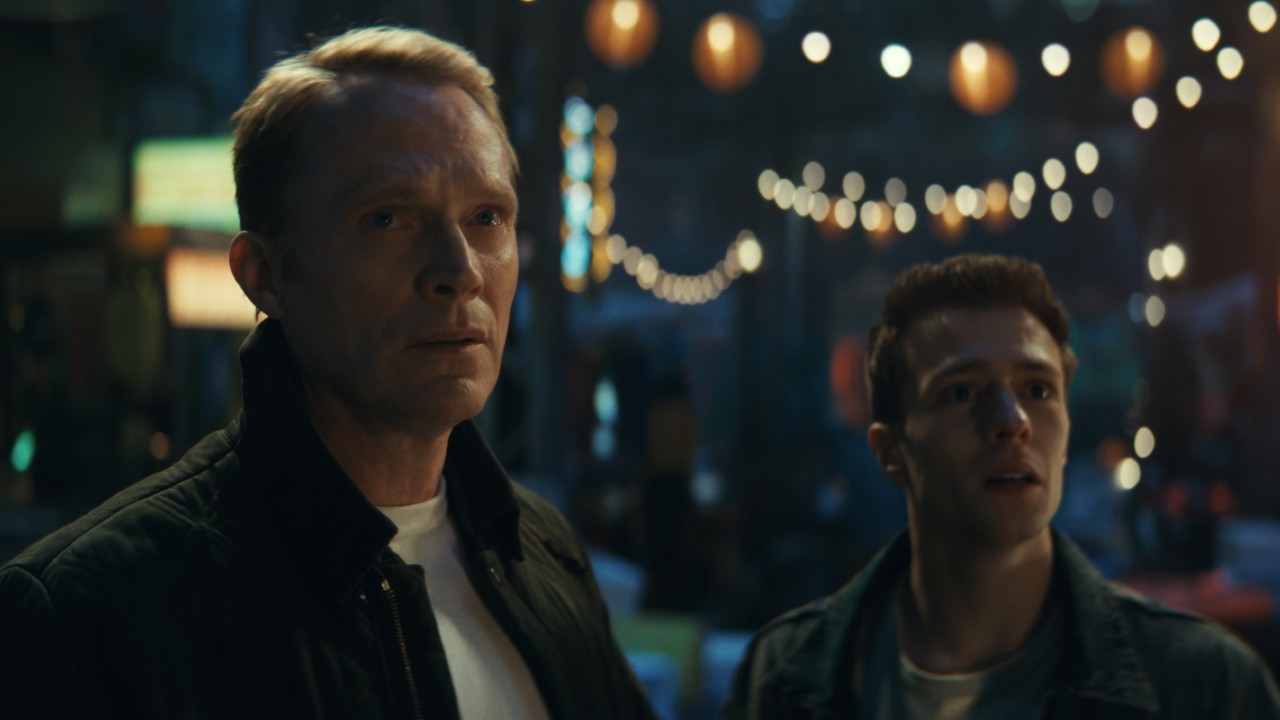
VisionQuest Episode 5 ‘Firewall’ and Episode 6 ‘Deadlock’ build on the same notion we’ve been dealing with not just since the beginning of this show, but since WandaVision: family. The thing is that this journey, for Vision, has taken him to a decision he never saw himself making: sacrificing everything for his son.
For anyone who’s followed this character ever since Avengers: Age of Ultron, the fact that Vision (Paul Bettany) cannot sacrifice Tommy (Ruaridh Mollica), even for the greater good, should not be surprising. But for Vision, the fact that he feels compelled to do it, that there’s really no other choice for him but to do the thing that would let Ultron (James Spader) roam free, just so he can have a chance to save his son, is actually very surprising.
The Vision of VisionQuest has always been living under false pretenses. He thinks he’s not really Vision; he’s just a shell with the same memories, not the same man. But that’s never been true. Who are we, if not our memories? If not the things we’ve experienced? If anything, the problem with Vision is that the set of circumstances that brought him back have allowed him an easy way out, a way to pretend he didn’t actually lose anything, because he’s not the Vision who had anything.
Grief makes you do funny things—even try to pretend you’re not really human just so you don’t have to feel the pain.
THAT’S WHAT HE WAS LACKING… FAMILY
The show hammers on the message of family as an anchor and a tether, not just for Vision, but for Ultron as well and even for Jocasta (T’Nia Miller). The problem is that the message only really hits for Vision, because as delightful as Ultron is, it’s hard to care about anything that’s going on with him and Jocasta—or really, about anything that’s not his relationship with Vision.
It’s to be expected, really. Jocasta is an interesting character in theory, but we have no emotional connection to her and too much of what she is and feels needs to be spoon-fed to us, to the point that it becomes less interesting. Vision’s psyche, meanwhile, is something we’re rediscovering with him, and sometimes before him, which makes it easy to pick apart little moments and ascribe meaning to them.
But every show needs a “villain” and I do believe the choice of Ultron in this one is correct, mostly because of the theme of family and how the cycles of parenthood are such a big focus. Is he Vision’s dad? Well, he’s as much Vision’s dad as Vision is Tommy’s dad, so make of that what you will.
EMOTIONAL DECISIONS
There have been many moments during this show where Vision has felt a little separated from his humanity. See: running through a gazillion probabilities for a conversation. But there’s nothing logical about the decision to let Ultron go free, as long as he can try to save Tommy. And Ultron knows that. In fact, Ultron is banking on Vision being way more human than he believes himself to be.
Ironically, Vision has behaved like Tommy’s father more often than not in this, despite outwardly complaining that Tommy is not his son multiple times. From the little things like remarking on Tommy’s driving and worrying about his morality after the ATM fiasco, to trying really hard to find the right words to explain what they are to each other. Plus, there’s the fact that he didn’t even need to know Tommy for that long to develop this strong belief in not just his powers but his goodness.
The rest—the decision to go save him (all the way to Madripoor), even if that puts him and, frankly, the world in danger—well… that’s just a reaction, one that comes from a feeling Vision cannot put words to. He doesn’t have to understand it to act, though. But soon, he’ll get to a place where he has no choice but to face why he’s willing to make the decisions he’s making. And as much as Vision has sometimes believed that it was Wanda (Elizabeth Olsen) who made him human, that was inside him all along. Otherwise, we wouldn’t be here.
NEVER JUST THE BAD GUY

I have to add a final note here to give kudos to Todd Stashwick, because from the moment I knew he’d be playing Paladin, I knew Paladin was going to be a more complex character than just the straight-up bounty-hunter. Stashwick, who brilliantly brought to life one of my favorite characters ever, Deacon on 12 Monkeys, is just very good at playing flawed characters who often end up doing the right thing, often against their best interests. And hey, that’s a very niche character archetype, but one that really, really works.
Paladin also works very well as a possible, if not ally for Vision, at least a connection outside of his mind. Just for a moment there, during ‘Deadlock’, it almost seems like they understand each other. That’s the thing with being human, you find the weirdest connnections it the most unexpected of places.
Agree? Disagree? What did you think of VisionQuest Episodes 5 ‘Firewall’ and 6 ‘Deadlock’? Share with us in the comments below!
The first six episodes of VisionQuest are available to stream on Disney+.
