
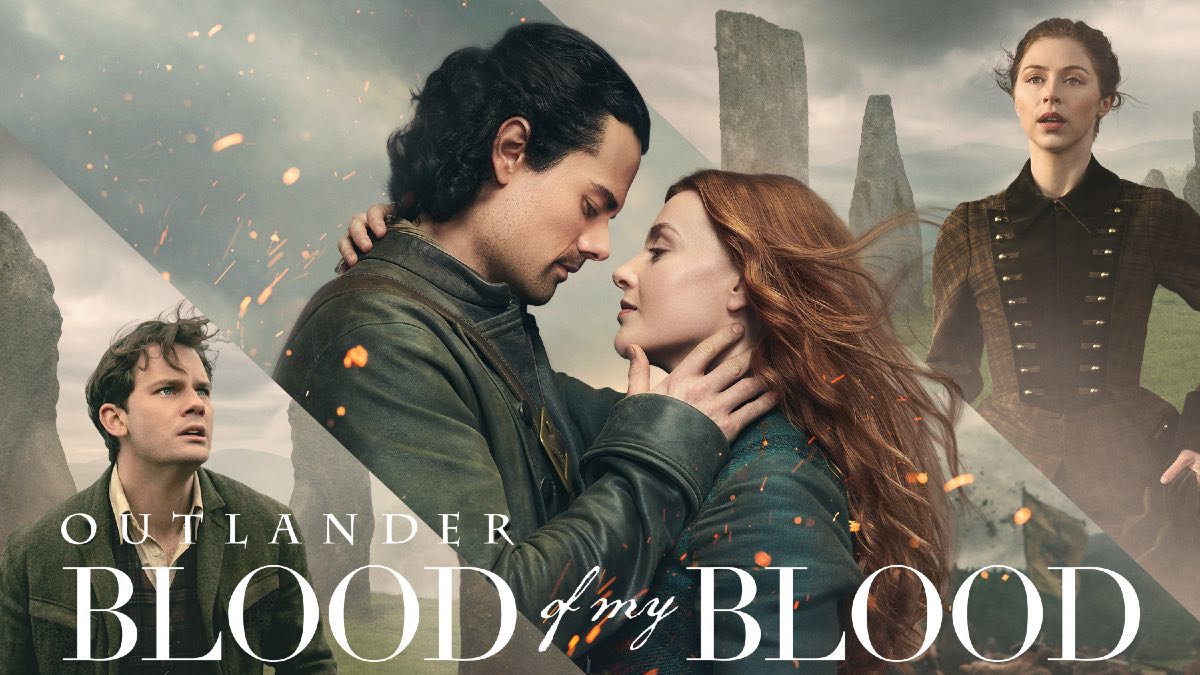
Outlander: Blood of My Blood Season 2 it’s coming to an end—and yes, we already have the tissues ready. But this season left us with moments that will stay with us. And we sit down with director Azhur Saleem, who was the architect of many of those moments to talk about working with the cast through some of the story’s heaviest moments, fighting to keep an ambitious sequence on screen, and finding the freedom to bring his own perspective to the show. Ready?
Here we go!
The Advice That Changed Everything for Harriet Slater

Ellen’s loss has a profound impact on Brellen. That’s why their scene in Season 2 Episode 7 is so difficult to watch. For Saleem, approaching that was something he and Harriet discussed well before filming began. It was, as he explained, “a very kind of heavy storyline,” and they wanted to work out early on how best to handle it.
Even the rehearsal was a challenge. Saleem remembers that it was “quite a tough scene” for everyone, including him. They all found it difficult to work through, and the atmosphere become overwhelming. That was when Harriet suggested that they “just have fun off camera” and keep things light.
He considers that suggestion “one of the best pieces of advice,” because Harriet was going to spend almost six hours crying. She needed an opportunity to release some of that pressure, and the team found ways to do so by being playful and playing games between takes. As Saleem put it, “it wasn’t going to work if we were going to be very serious and emotional all day.”
Once they were filming, his approach was to give the actors room to explore the scene. He explained that there was only “a little bit of nudging” from him here and there because the material already spoke for itself. Both actors were fully invested, and he wanted to give them the freedom to go for it.
Azhur Saleem Was Ready to Take on the Storm

Time and production can force difficult decisions. But there was one moment at the beginning of Season 2 Episode 8 that Saleem was determined to keep: the execution of the Jacobites.
The sequence required a lot of coordination, “from the gunshots and blood to the windows being shot out.” There were concerns about how long everything would take and whether they would be able to capture all the elements they wanted.
Still, Saleem knew how important it was to get it right because of “the contrast with the King’s investiture. The executions needed to have the impact they deserved so that the sequence could cut between the violence of what was happening to the Jacobites and the beauty of the ceremony.”
For Saleem, it was important that both parts of the story came together. Filming the scene turned out to be quite a challenge, too. They had originally planned to spend 4 hours shooting it, but a real storm meant the crew had to get it done in just 3. Still, Saleem wasn’t going to let the weather get in the way of what they had planned.
He remembers being “adamant” that they would go ahead with it, even describing himself as “this kind of mad general” in the middle of the rain, with the wind blowing and the water coming down sideways, trying to get everyone to keep going because they needed that sequence.
Looking at the finished episode, it’s easy to understand why he fought for it. The intercutting between the executions and the investiture gives the sequence its full impact, and the team was “lucky with the sun coming out in the investiture.” When Saleem watched it again, he was struck by how beautiful the investiture looked, particularly with the sun coming out. “We could only dream of that,” he said, adding that “the filmmaking gods shined on us that day.”
The King’s Ball Was Hiding Some Brilliant Details

The ball in episode Season 2 Episode 8 brings together a lot of characters that carry much more than what they said aloud. For Saleem, making sure we could follow those undercurrents came down to paying attention to “the looks characters exchanged, their reactions, and where their attention went while someone else was speaking.” He also remind the actors what their characters should be focusing on in those moments. Then it was a matter of finding ways to capture those reactions on camera.
Those details are “gold dust” in the editing room for Saleem. They help reveal what is really happening beneath the conversations. For example, “there is plenty to follow between Henry and Julia,” but Saleem also points to “the way Lovat looks at Margaret.” Even while Lovat is speaking, the attention he gives her tells us something about their dynamic. Saleem praising their chemistry and “the looks that they give each other are just brilliant,” he said.
Of course, finding those moments also depends on the director having room to bring their own ideas. Saleem explained that one of the advantages of working on Blood of My Blood is having cinematographers who previously worked on Outlander. Because “they already understand the visual world of the original series, including its look, lighting, and framing, which gives the production a shared starting point.”
From there, Saleem has the freedom to shape the episodes through his own perspective. He explained that Matt Roberts makes his priorities clear in the meetings where they sit down to discuss the script, the characters, and what each scene needs to achieve from a story point of view. But, as Saleem recalled, his message is essentially: “As long as you get that, that’s what’s important. And how you shoot it is entirely up to you.” And, for him, “it’s great to kind of have that freedom.” Because allowed to work that way is “a lot of fun.”
Outlander: Blood of My Blood Season 2 airs on Fridays at 8:00 PM ET only on STARZ and at midnight in STARZ App.
