
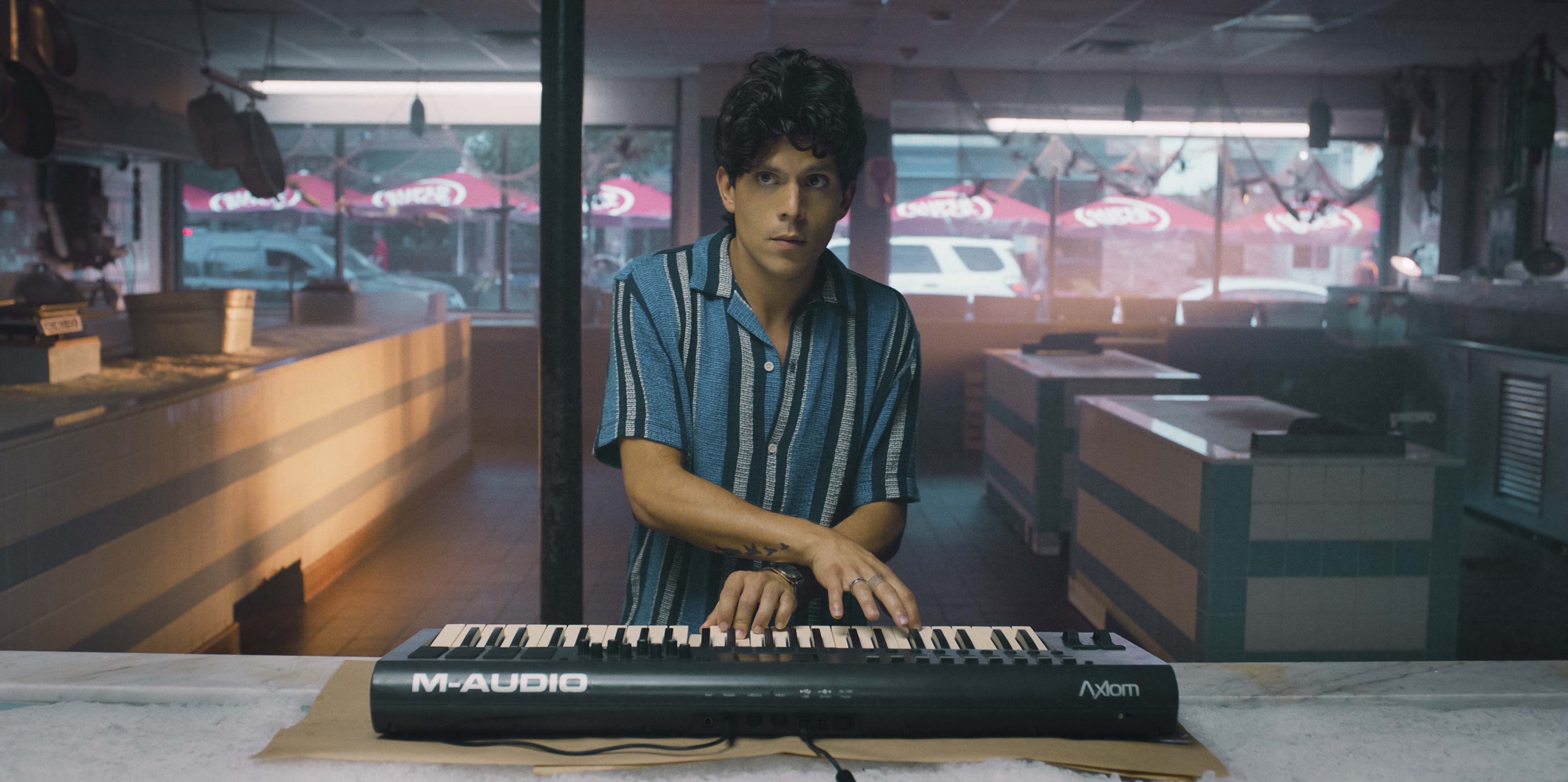
Rudy Mancuso’s Música is a great showcase of Brazilian culture and an interesting look at the way music is part of everything. Despite the marketing, it is very much not a rom-com, however. It cannot even be said the movie is a romance. Instead, Música is more or less a drama centered around music And, despite Mancuso’s valiant attempts, there just isn’t enough in what Música is to make the movie soar as he probably would have liked.
The movie tries, and there are certainly moments of magic – particularly when choreography and music come together to give us a visual for Rudy’s rhythmic synesthesia. Visually, and tonally, there’s something very intriguing – if not new – in Mancuso’s notion of elevating the ordinary moments. But even that feels like a story the movie never really delves too deep into, instead wasting time on a love triangle that also goes nowhere, because ironically, the movie is also not interested in it.

What is the movie interested in, then? Showcasing Brazilian culture, something it does very beautifully. Brazil is so often the forgotten country in Latin America, the one Hollywood gets wrong as it tries to put all Latines in the same box. A lot of people in the United States don’t even understand that yes, Brazilians are Latines, even if they don’t speak Spanish. Mancuso seems intent on changing all of this by just giving us a clear look at Brazilian culture through a very normal mother-child relationship (with the mother played by Mancuso’s real-life mother, a detail that makes this even more delightful).
It’s very refreshing, and the part of the movie that feels the most genuine. Even the little nods at the Brazilian food consumed are more than we usually get. Geographically, it’s easy to see why Mexico is the standard for what Hollywood considers Latinos. However, Latin America is made up of many different countries, with so many different cultures. And if Música succeeds at anything it’s at making us feel like the Brazilian diaspora has its place in not just the United States, but in the stories we consume.
But outside of that, the movie feels like it never really lands anywhere, perhaps by design. There’s something to be said about slice-of-life stories. However, even those need some sort of narrative stopping point that Música is missing, despite the ending attempting to close out this part of Mancuso’s story. What did he learn about himself, other than he had to take his story higher? It’s hard to tell. What did we get from this movie, from his exploration? That’s even harder to pinpoint.

In the end, there’s not enough music in a story presumably about music, not enough romance in a story marketed as a rom-com, and nearly no comedy outside of the out-place-moments. Mancuso doesn’t even play most of these fish-out-of-water moments as comedy, which leaves the movie stuck in a category limbo, because it’s hard to call it straight drama, either.
Música is a movie that relies on Mancuso’s charm and his chemistry with Riverdale’s Camila Mendes, who is delightful in the little we get to see of her. If anything, there’s a sense that the movie would have benefited from more romance. But that was never the story Mancuso wanted to tell. It just so happens that the story he wanted to tell is an okay story, not a particularly memorable one. Whether the culturally appropriate parts and the music are enough to charm you, well …that might depend on how much you buy what Mancuso is selling.
Agree? Disagree? What did you think of Música? Share with us in the comments below!
Música is now available to stream on Prime Video.
