
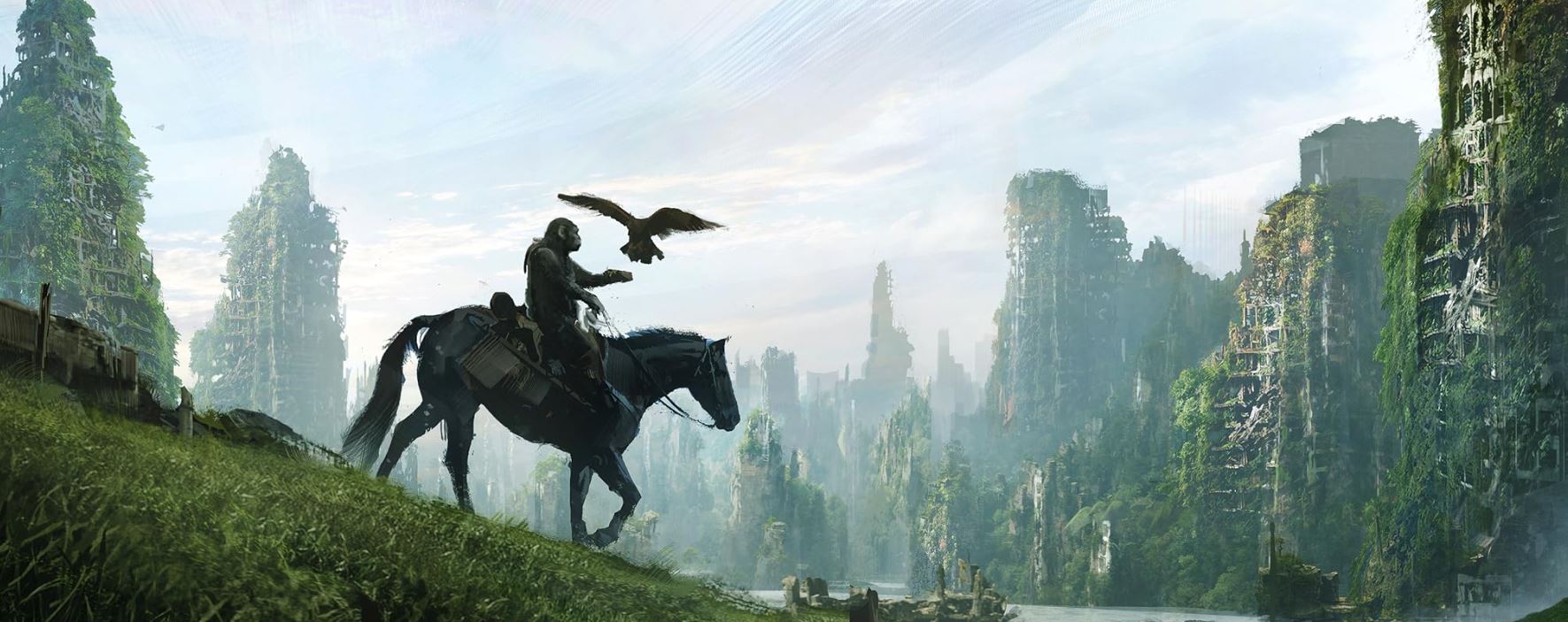
There are a lot of movie franchises out there. But there is one that deserves more attention. The intelligent talking-simian series Planet of the Apes has spanned from 1968 until today, as another installment has just entered theaters. And it works. Kingdom of the Planet of the Apes starts with a good story and then enriches that with incredible visuals and direction, and the motion-capture performances are outstanding too.
The legacy of the original Planet of the Apes from 1968 revolves around that famous twist ending. Three astronauts crash on a faraway planet where apes are intelligent and humans are not. When one of the astronauts manages to escape, he discovers that they did not travel in space but in time. This is Earth’s distant future. Tim Burton directed a reboot of sorts in 2001 that is probably better left forgotten. However, in 2011, a new story was begun in Rise of the Planet of the Apes. Chimp Caesar (played through motion capture by Andy Serkis) was born in a medical testing facility. The testing for a promising Alzheimer’s cure went wrong. Over two more films, it mutated into a flu that made all apes intelligent and did the opposite for the humans left alive.
Kingdom of the Planet of the Apes sets its plot long after Caesar established his sanctuary for apes. But the power of Caesar’s story looms over this new tale through the exciting action and the ending that leaves you hoping for more.

“It’s already their world!”
Young chimp Noa (played by Owen Teague, again through motion capture) grows up in a peaceful clan that trains eagles. They don’t know the history of Caesar or much about humans, whom they call “echoes.” A young human girl (Freya Allan) shows up to lurk around their village. Shortly after, they are attacked by hostile apes who follow Proximus Caesar (Kevin Durand in motion capture). Proximus is enslaving fellow apes to hunt for human technology. He plans to use it to wipe humans out for good.
Noa journeys to save his clan from Proximus and along the way, he meets orangutan Raka (Peter Macon in motion capture). Raka explains to him who Caesar was and what he did. They also meet the human girl Noa had seen before, which allows Raka to educate Noa more about humans as well. This section of the film may be a little too slowly paced but it does provide excellent cinematography. The way nature has reclaimed human constructions of the distant past is striking, especially in the landscape of the Pacific Northwest which was already beautiful.
One of the cleverest touches of the trilogy about Caesar was how the change between apes gaining intelligence and humans losing intelligence was handled. It was gradual and had the maximum possible impact on the narrative. When Caesar spoke for the first time in Rise of the Planet of the Apes, it gave you chills. In this film, entertainment is mined from the moment we discover humans are regaining their intelligence. This time it’s humor. The looks on Noa and Raka’s faces when the girl they’ve helped speaks for the first time are priceless.

“In their time, humans were capable of many great things.”
The girl’s name is Mae and she has a plan to stop Proximus from plundering what humans left behind. The progress of the interactions between Noa and Mae is significant. It also feels like they could be the key to the overall conflict if there is more to Noa’s story. He doesn’t trust her at first and she will prioritize helping humans if she has to. There is a lot of potential there. Caesar never knew a world without humans. He trusted them because his early experiences with them were good. Noa, by contrast, has to learn that trust. That could be fertile ground for future stories.
This script could have developed its ideas about tyranny and how religion is corrupted for selfish purposes by dictators more fully. But it feels nourishing that writers Josh Friedman, Rick Jaffa, and Amanda Silver did it at all. The way Proximus has twisted the “Apes together strong” mantra from Caesar’s time is chilling. And the action sequences are thrilling. Director Wes Ball has a knack for what the camera can add to those moments. And to the quieter moments too. When Noa finally connects with the eagle who doesn’t like him, it hits you.
Caesar was a Moses-like figure as his story unfolded, and I don’t think I have to tell you there’s a bit of Biblical reference in Noa’s (pronounced “Noah”) tale, too. It’s that depth of storytelling that could grow with more installments in this franchise. The final minutes of this movie suggest that there are places for the narrative to go. Interesting places. And I look forward to that. Kingdom of the Planet of the Apes makes a new plot feel connected to a larger story and it looks amazing while doing so.
4 stars out of 5
Kingdom of the Planet of the Apes is now in theaters.
