
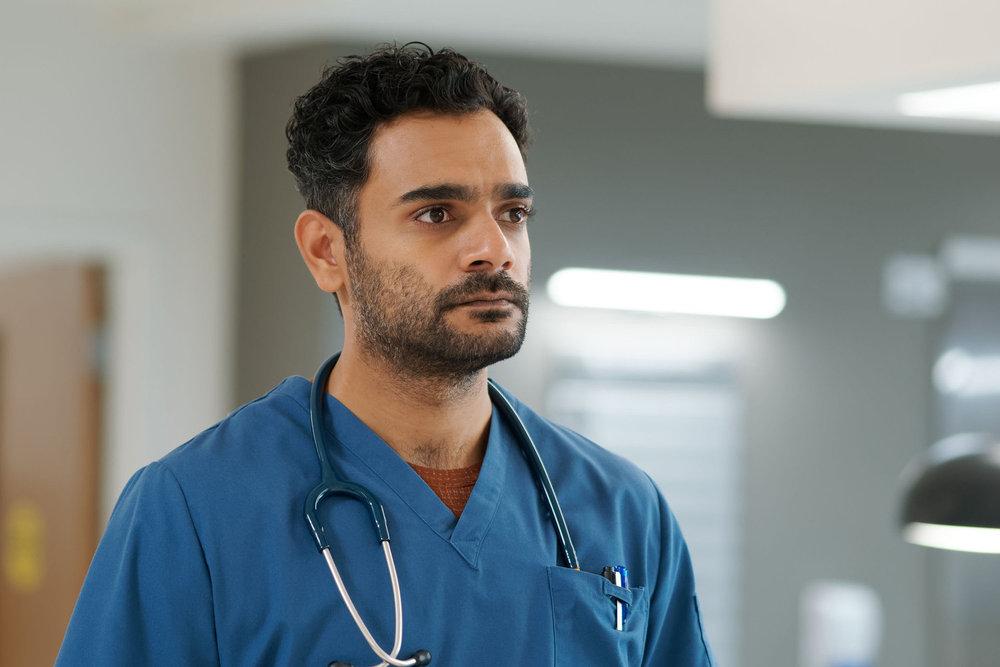
Transplant is a show about changes, heartbreak and freedom. For most, this show goes beyond medicine, focusing on relationships, trauma, and moving forward. At the heart of this beautiful production is a cast that brings characters to life in ways that make them truly unforgettable.
As the final season continues, I got the opportunity to chat with Hamza Haq about his character, Bashir and the stories he has had the opportunity to tell. We also talked about the authenticity of playing a Muslim man, and the cultural and emotional nuances that play into daily life.
Hamza is a man on a mission, with a motto ‘Alhamdulillah Everything Always Everyday.’ He truly embodies gratefulness and focuses on paying it forward by telling authentic and heartfelt stories that give minorities a voice. Haq also manages to elevate the game as he continues his acting journey.
Read below for Hamza Haq’s thoughts on the final season and more!
FANGIRLISH: Bash has been through it – especially in season three, where he decided to go for surgery, but then no surgery, and then he was introduced to psychedelics, and his relationship ended. Can you tease us about his character arcs and relationships this season? What can we see from the final episodes?
HAQ: I think Bashir, he’s being put through the ringer here. This is easily the most emotional season that he will be going through because a lot is in question. It’s the end of his residency, and there are so few jobs available. We find out very early that there’s only one job available.
So now, not only is he scared that he might not get that, he’s also competing for it against his ex, with whom he obviously still has a highly complex relationship. I think through all of that, there’s this beautiful, tense intimacy that evolves through all of that because you know, competition, and competition is a form of intimacy.

In previous seasons, Bashir has done many things to figure himself out. He went back to Lebanon to the refugee camp to help out there. He’s done everything he could to, you know, put himself in a relationship or his mentor-mentee relationship with Dr Bishop, or how he’s going to treat this person or that person. And I think, um, now that a lot of things are falling into place, the only thing left for Bashir is the mirror, and we see him staring into that quite a bit this season.
You know, for a lot of people and a lot of Muslim men, particularly, that’s something that we don’t do. So, for him to be forced to look at his past behaviour and look at why he does the things that he does, as opposed to just being on cruise control, you know, provide or accomplish without really thinking about how it’s affecting himself or the people around him. It was an excellent opportunity to do that on camera and tell the story of. A brown man who’s really struggling, because a lot of us are, and we get to see that, and it is representative of a lot of experiences.
MORE: Just starting out Transplant? Read our review of the pilot.
FANGIRLISH: So, these first few episodes are intense. We’ve gotten flashbacks playing into the present time, and Bash makes a big save with the sinkhole. I mean, he has his day off, but he decides not to take it and instead thinks, ‘Let me put myself in danger because I can’t have anything good.’ So, walk us through the process for getting into this kind of emotional headspace where you’re playing the literal past, and then you’re rehashing the past through the present events.
HAQ: Oh, I said this earlier, so I don’t want it to be ‘he’s just saying the same thing over and over’ – that’s what a junket is. I feel like every action is just processing something. Whether it’s grief, whether it’s sadness and everything like that, and the beautiful thing about how it’s been written is we see the genesis of a lot of trauma, or how we see the genesis of a lot of self-questioning.
When it comes to the present day, we see how it’s manifesting in his life. So, this whole thing about his history, Amira even says, ‘Hey, you know, do something fun today.’ And when he asks her what she thinks he does when she’s gone, she responds with ‘I don’t know, just sit in the chair and wait till I get back.’ Yes, and he does just that, and I’m sure you know what I mean, cause that’s a lot of dads and uncles.

It’s a lot of whatever, I don’t really know what else to do. So, you leave, and then they’re right where you left them. Like, yeah, it’s cool. You binged all the Fast and Furious movies today. That’s great.
FANGIRLISH: It’s like, did you eat? And their like ‘yeah, yeah, we ordered Karahi Boys’ and it’s like fair enough.
HAQ: You know what I mean. So there was just this anxiety about being left alone because there was nothing for him to take care of, and the second that he saw something, his survivor’s guilt kicked in. And there’s this idea that if he can pull off the impossible, maybe he’ll save his parents, you know.
It’s very, it’s very Barry Allen, The Flash, you know, what I mean, if I, if I just ran fast enough, I could have saved my mom, and I think that that’s what he’s doing a lot. He’s just constantly trying to prove why he survived by being, see, I wasn’t meant for this, or I was meant for this, or it’s that constant struggle where he doesn’t even think about his own life because he’s too busy.

He’s preoccupied with all the lives that he’s lost, and that’s a terrible thing. So, we see Bash face that more and more, and even the people whose lives he ends up saving are just like, ‘yo, why would you, you know, what are you doing down here? Man, like, why would you do this?’ and I don’t think anybody ever asked him, because oftentimes people are like, ‘OMG thank you so much.’ But this guy is like, ‘What are you doing here? Man, like, you had no way out, and you just ran in here.’
It’s just everything that he does. It just offers him more questions. It was a brilliant writing device, too, because he does something. and instead of feeling any joy, he just has more questions.
FANGIRLISH: Yup, existential spiral for another three episodes.
HAQ: Yeah, yeah, thanks, Joseph K, for providing this, six-month-long, trauma episode, yeah.
MORE: Transplant showrunner spoke with us about Season 4 of the series. Here’s what he had to say.
FANGIRLISH: I have seen you committed to playing authentic Muslim characters. No matter who you play, and I love that, and I thank you for the work you do to make these characters come to life.
HAQ: Alhamdulillah, I get the chance.
FANGIRLISH: Alhamdolillah, yeah. And, just before I ask, I want to say this, I watched Crashing Eid with my family, and my favourite part of the entire series was when you switch from Arabic to Urdu, and you ask the pool boy if they’ve taken his passport. The delivery of that was phenomenal.
That speaks to your acting, not only being multi-lingual, but also being authentic in your Muslim and cultural representation (again, thank you). There is a comment you made in an earlier season to Theo, where you said, “sometimes I pray 5 times a day, sometimes 0.”
Can you talk to me about how you stay committed to playing these authentic Muslim characters? What’s next for you? What hopes do you have? By the way, I’m Canadian, so I’ve seen all of season four, and I saw it a while back, and I’ve already cried, and asked Joseph Kay about it – and I loved it, but also [insert spoiler here].
HAQ: We were all very happy about that. In terms of the storytelling device, it’s very strong. Trust me, you’re just salty, I know, because you didn’t want [spoiler].
To answer your question, I started my career playing the Iraqi bad guy. You get these terrorist roles and even recently, you know, today even, I was told there’s this interesting new show, a new character, and stuff, and I’m like, ‘what is it?’ They’re just like Al Qaeda has gone digital – and I’m just like COME ON.
I understand that these stories will continue to be told. You know, the trope of the foreign bad guy is not going away anytime soon. Bollywood is still doing it to Pakistanis. These exist. You need a bad guy to make the good guy look good, but the notion that, so frequently, Muslim men are just constantly thrown into the position of being the bad guy. I’m not seeing anything new here.
For me, it was also more about my own personal journey to Islam; I grew up in Saudi. But there’s this weird thing about Pakistani culture where Islam is approached like fear-based, and that made me kind of step away from it. Not to take it lightly, and then just Alhamdullilah to let things manifest in my life in a way that I saw the beauty of it.
I saw the love, and I was just like, ‘I love this so much, and more to the point, Allah loves me so much because I’ve had the opportunity to do this.’ I mean, I know it’s the most cliche thing, I’m gonna say, but it completely changed when I became a father.
Yeah, it was, my daughter was here, and I was just like, huh, I’ve always wanted a daughter. I’ve always wanted to be an actor. I’ve always just never felt like I belong. And now, my job literally has a mark for me to stand on, because that’s where I belong. They tell me there’s a team of 100 people who say you belong right there. Now, do your thing, and I get to do all these things.
So I was just like, “Yo, man, God is real, for sure. This is just a manifestation of love, for me.” And so, I try to approach everything with it, and with an amount of love, and these characters that I get to play have just been a reflection of that.
Alhamdulillah, as soon as that happened, that switch happened. These characters kind of present themselves, and I have the choice to get to do it with everything that I love about who I am in that. As somebody who grew up with pretty low self-esteem and in a culture that doesn’t really celebrate success, but thrives more on competition. Yes, more than anything, “Yes, that’s good, but what else?”
FANGIRLISH: Yes, absolutely! For example, your cousin did this, and this person did this.
HAQ: So to have the opportunity to really, not pat myself on the back, but to be just be proud of myself. You know, the culture is really good at doing everything behind your back, and that includes being proud behind your back, because they don’t want your head to get too big, and that’s fine, but sometimes you need it a little bit.
So now, I’ve been given the opportunity to explore the things that I love about myself through these characters. So, in The Queen of My Dreams, it’s about all right, man, this is a brown guy who shows up this way. In something else, this is a guy who shows up this way.
I’m fortunate enough that when I say, “Can we throw in a scene where he’s praying?” it is actually something that I’m making a concerted effort to do more and more and not to miss. Man, yeah, I travel a lot. Sometimes I’m like, yo, I’ll just bash them all at the end of the time. I get the travel discount, you know? There’s room for improvement and everything like that. But, I think, what’s changed?
I no longer see it as an obligation. Throughout the COVID-19 pandemic, I recall an impressive panel featuring Riz Ahmed, Guz Khan, and Hasan Minhaj. And Riz said this amazing thing, like, it’d be your own to tear you apart first. He was just like — everything that he was approaching, was am I supposed to represent Muslim? Dude. When I go to a character now, I’m just trying to represent myself first. If I’m more specific about representing that, people will see that; people will relate to that.
It’s like it might not be exactly the same thing, but you know the mere fact that, uh, you know, we wrapped Transplant, a year and a half ago, and you know you go back and you watch my one of my favorite scenes which is in Season 3, Episode 12. Two Muslim doctors go back to a refugee camp, and they hug each other and show this true love that brown men have for each other. And then they’re going back to take care of their families.
These are doctors in times of war and refugees, and especially everything that’s going on today. We don’t have enough stories of brown men who get to go home, practice, and be good to their families. And I’m watching a story of me getting to tell this with another Brown dude, another Muslim dude. This is what we need to be putting out in the world today.

So, Alhamdulillah, to have a story where it’s just like, “This guy’s freaking out. He’s being irresponsible. He’s losing his temper here,” and then, a couple of episodes later, he’s just finishing namaz (prayer), because it doesn’t just change who you are as a person; it changes your behaviour. To be able to take a minute and speak to something bigger than me, and hopefully that’ll give me the answer.
And often, what I have found is that it works for me, so Alhamdulillah, to be able to tell an authentic Muslim story. That doesn’t always mean to tell a story of a good Muslim. An authentic Muslim is just one who’s trying. That’s what you know is the dream. I want to be telling a lot of stories, and that doesn’t particularly have to be in the Islamic world, but it’s going to be the story of a Muslim guy who’s trying his best to exist in the world, which has become an increasingly difficult thing.
Transplant airs Thursdays at 9/8c on NBC.
