
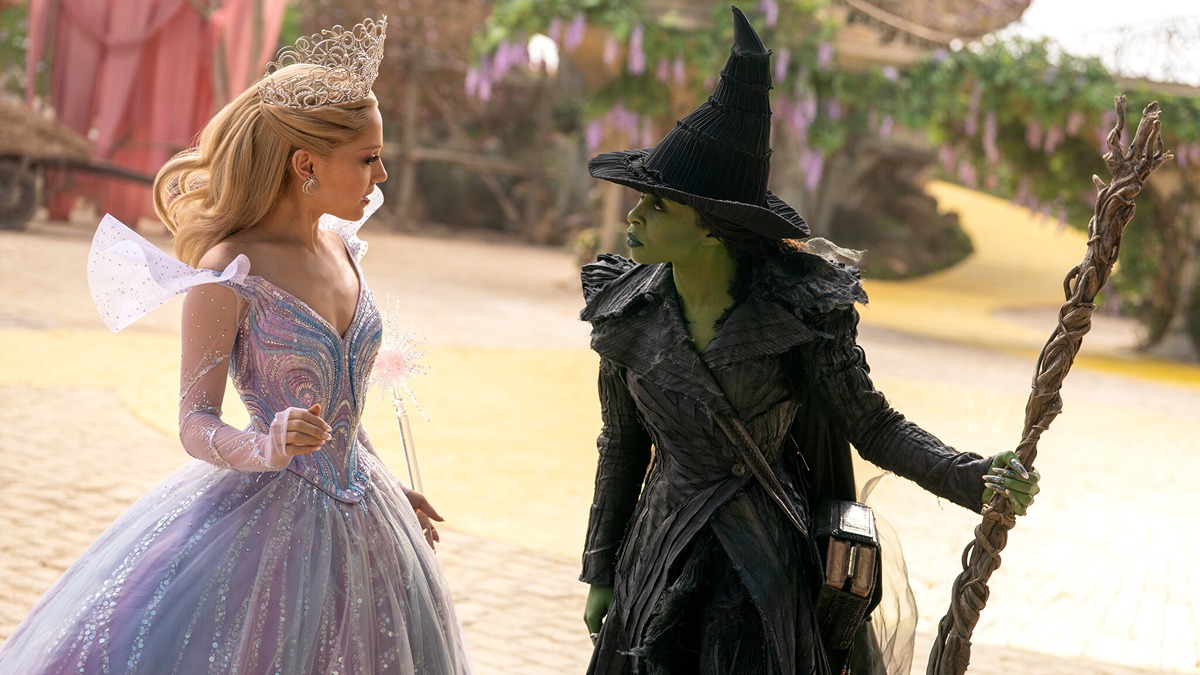
Thank goodness Wicked: For Good is finally in theaters for all the world to see. Because not only have we been waiting for a year to see it, but it improved and/or fixed several things from Wicked the Musical. Act One of the stage version is pretty spot on with Wicked: Part One but with some minor changes. Act Two of the musical, however, is much more different than its film counterpart. And that’s for the better!
WARNING: This contains spoilers for the Wicked movies and stage musical.
Wicked: For Good Doesn’t Forget About the Animal Storyline

The second Wicked movie opens with Elphaba (Cynthia Erivo) literally fighting for the rights of Ozian animals, so it’s safe to say Wicked: For Good wanted to emphasize exactly what Elphaba had been fighting for this whole time. Some Ozian ox-like animals are cruelly forced to work and construct the Yellow Brick Road before we even see Elphaba. She attacks the Ozian officials overseeing the construction and helps free the animals. On Broadway, we never see this kind of activism from her.
Wicked: For Good also includes a scene where Elphaba tries convincing the animals to stay in Oz and join her fight in taking down the Wizard (Jeff Goldblum). Elphaba reunites with her beloved nanny, Dulcibear, before singing “No Place Like Home,” her new Wicked song. The witch tries to help the animals remember that Oz is their home, too, and that alone is worth fighting for. Even the flying monkeys hear it. It may not be a successful attempt — thanks to the Cowardly Lion — but the effort is there, unlike in the stage adaptation.
In the musical, pretty much the only time the animal storyline is referenced in act two is when Elphaba discovers Dr. Dillamond is in the Wizard’s Emerald City palace. The former Shiz professor has been caged and can no longer speak. Elphaba sees him being mistreated and decides once again to run away from the Emerald City and the Wizard’s lies. It’s like the musical forgot the catalyst for Elphaba’s main story was her wanting to fight for animals’ rights.
A Wonderful Addition to Wicked: For Good

It’s no secret the Wizard’s songs in Wicked aren’t fan favorites. And it’s no secret that Elphaba isn’t a fan of the Wizard after realizing he’s a fraud. So the song and musical number of “Wonderful” in Wicked the Musical has always been kind of weak. Somehow we’re supposed to believe Elphaba and the Wizard could put their differences aside after singing about how they could be wonderful together.
Thankfully, director extraordinaire Jon M. Chu realized that doesn’t actually make sense and something needed to change. So what did he do? He added Glinda to “Wonderful.” By including Glinda (Ariana Grande) in the number, Elphaba listens to someone she can actually trust and knows cares about her. It’s no longer about the possibility of teaming up with the Wizard to do whatever he wants her to do. It’s about the three of them working together to show the people of Oz that Elphaba isn’t actually wicked.
Another brilliant change to “Wonderful” in Wicked: For Good from Wicked the Musical is that Glinda and Elphaba share a moment together and sing part of “Defying Gravity.” That nostalgia and connection is a strong factor in helping convince Elphaba to stop fighting and remain in the Emerald City.
Nessarose’s reign over Munchkinland is clearer in Wicked: For Good than Wicked the Musical

We won’t admit to know how Ozian politics work. (Is the Wizard like their president? Does Fiyero (Jonathan Bailey) have any power as a prince? There are honestly so many questions.) But it’s no question Nessarose (Marissa Bode) was the obvious choice for Munchkinland’s new ruler after the death of Elphaba and Nessarose’s father. In Wicked the Musical, the first and only Act Two scene the governess is in is when Elphaba surprises her. The Wicked Witch of the West begs for her sister’s help but ultimately turns Boq into Tin Man after Nessa messes up a spell.
One thing mentioned in the musical is that the Munchkins aren’t allowed to leave Munchkinland, per order of the governess. Why? We don’t know. An explicit reason is never given. But in the second Wicked film, we clearly see why and how Munchkins are under travel restrictions. After remaining with Nessa after her father’s death and working for her, Boq (Ethan Slater) wants to leave. Nessa allows it but doesn’t actually want him to. So what does the governess do? She forbids Munchkins to travel beyond their land without her permission. That brings Boq back to the governor’s mansion after not only he — but an innocent Munchkin family — is denied entry onto a train.
By finally providing motivation and reason for Nessa’s actions, she becomes a more complete character and gives her storyline justice. The inclusion of a random Munchkin family also facing these consequences is powerful, too. It shows how selfish Nessa’s actions are and why she is the Wicked Witch of the East — regardless of her ability to do magic.
This further develops her character in Wicked: For Good, too. There’s a moment where Nessa decides to take negative action against the animals of Munchkinland specifically. Does she have anything against animals? Not that we know of. But she says she feels compelled to do certain things so people don’t think she’s “just like her sister.”
Wicked: For Good Ditches the Ableism

Speaking of Nessa, we’ve known that by casting a wheelchair user in the role — an earlier improvement we noted in Wicked from the musical — what happens to Nessa in Act Two would change.
For those who haven’t had the fortune of seeing the stage musical, Nessa walks in Act Two. When the governess complains that her sister is out using magic to help animals she’s never even met instead of helping her sister, Elphaba casts a spell that allows Nessa to walk. While there are wheelchair users who do have the ability to walk — shoutout to Broadway actress Jenna Bainbridge, the first wheelchair user to portray Nessa on stage — Bode does not. And even if she did, Elphaba using magic to give Nessa that ability was always problematic and ableist. It gives the impression that disabled people are to be fixed, that they want their disability to disappear and go away completely.
In Wicked: For Good, Nessa still asks for Elphaba’s help. But she doesn’t want to be able to walk. She just wants to relive the feelings she experienced at the Ozdust Ballroom, where she felt like she was floating on air and that Boq loved her. Unfortunately we don’t think Boq ever loved Nessa romantically, but Elphaba was successful in allowing her to relive that feeling. Instead of walking, Nessa literally floats in the air and then returns to her chair. This change not only gets rid of a problematic part of the stage musical but simply makes sense for this Nessa.
In Wicked: Part One, it’s clear Nessa doesn’t want anyone’s help, especially regarding her ability to move around in her wheelchair. She doesn’t want anyone to push her. Not Elphaba and definitely not Miss Coddle (Keala Settle). Movie Nessa clearly doesn’t have a problem with being in a wheelchair, and the changes to the story reflect that.
A True Glimpse at Glinda the Good

Perhaps the biggest change from act two of Wicked the Musical to Wicked: For Good is the ending and how it coincides with Glinda’s arc. She is still mourning Elphaba and is not happy at the end of either Wicked adaptation. But things are better at the end of Wicked: For Good.
A circular narrative, Wicked the Musical ends with Glinda informing the Munchkins that the Wicked Witch of the West is indeed dead and they all rejoice during “No One Mourns the Wicked.” Glinda’s pretending to be happy, the Munchkins are actually happy, and Fiyero and Elphaba walk off into the unknown together. Curtain closes. The end. More happens at the end of the second Wicked film, though.
The movie does circle back to “No One Mourns the Wicked” clips. We see Glinda ignite the Wicked Witch of the West effigy and tell the Munchkins that “their paths did cross, at school.” But then Glinda steps off her bubble, puts down her wand and addresses every Ozian — animals included. She tells them she wants to make Oz better for everyone and truly be Glinda the Good. Glinda then returns to her Emerald City palace quarters, takes the Grimmerie back up to the attic/balcony where she and Elphaba sang “Defying Gravity” and looks out at Oz. A true departure from the Broadway musical, the Grimmerie opens for Glinda.
By declaring her intentions and including the animals in Oz again, Glinda isn’t just a better person because she befriended Elphaba. She takes actual steps to being a good person and serving all of Oz. Apparently that’s the key to her gaining magical abilities — or so says Ariana Grande, and who are we to question Glinda herself?
Have you seen Wicked the Musical and the Wicked movies? How do you think they compare? Share with us in the comments!
Wicked: For Good is now in theaters.
