
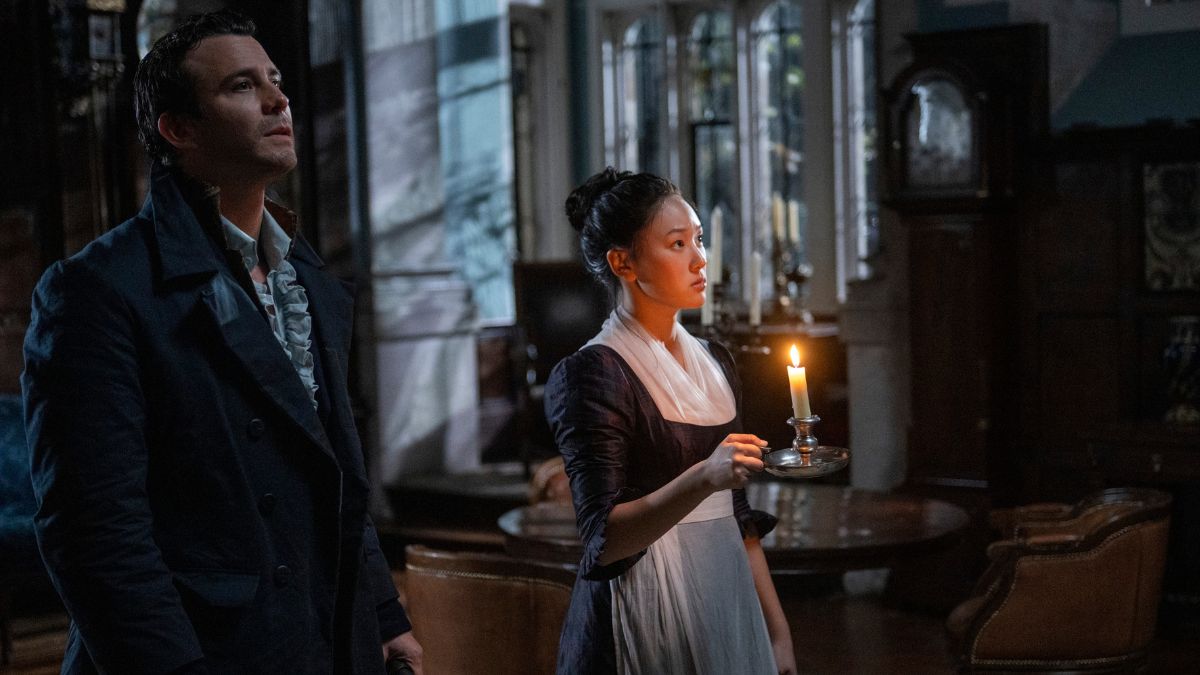
Benedict and Sophie find fleeting yet fulfilling reprieve in the romantic countryside in Bridgerton Season 4, Episode 3, “The Fields Next to the Other Road.” Bridgerton Season 4, Episode 1, “The Waltz,” is about Benedict and the Lady in Silver falling for one another. Bridgerton Season 4, Episode 2, “Time Transfixed,” navigates their time apart. This outing gives Benedict and Sophie – not the Lady in Silver – the time they need to connect and fall for each other.
Everything that entails is a dream come true for this book reader and show watcher. “The Fields Next to the Other Road” is simply enjoyable for someone who loves these characters. Benedict Bridgerton and Sophie Baek shine at My Cottage. Their first scene sets such a tone for the episode, making its end all the stronger. Their banter is still sharp, in tune with a romantic comedy. Benedict’s awareness, even of the environment around him, isn’t the best. Sophie’s intelligence is a matter of fact – it does rain, they’re far from London as the constellations prove, and Benedict is injured. Also, as she says, “Servants are resourceful.”
This episode, written by Cathy Lew and directed by Tom Verica, relieves the pressure of that second episode. The streamlined plot slows down enough to get a deeper impression of the characters and where they stand as gossip stirs and society shifts. Gradually and organically, Bridgerton rebuilds that internal and external tension between Benedict and Sophie. Their story is complemented by growing anticipation and curiosity among and beyond the ton. Really, “The Fields Next to the Other Road” feels like a luxury in today’s TV landscape. There are only eight episodes in the season, like the others before it, and this one effectively plucks the leads away while making every second count.
MORE:


The Maid Wars
“The Fields Next to the Other Road” earns the conflict between Potria and Varley. The “maid wars” generate enough nervousness among the elite to shift attention to the power the staff have in the work they do. That sentiment extends directly from Sophie’s absence at Penwood House, exemplifying the season’s streamlined storytelling. It’s also impressive that what exists mostly through Whistledown’s writing in the source material becomes a tool to emphasize the importance of the show’s tertiary characters.
Contextually, Bridgerton has been upfront about the critical role of the working class from the first episode. In which Benedict – in a bit of foreshadowing of where the show is now – defends those who work for a living. Shortly after, Violet turns to Celia, who plays a more prominent role this season, and the maids spread gossip that causes Nigel Berbrooke to flee town. So, it works two-fold when Lady Danbury tells Queen Charlotte, “Maids are gossip,” in this episode. This throughline has always existed in some capacity in the show. It’s only that this season turns the lens there with even more interest.
So, of course, Varley wants a wage increase after 20 years of overextending her role. Regardless of having seen Varley go above and beyond the last three seasons, it’s tough, though entirely realistic, to see Portia (and Philippa) be so out of touch. Bridgerton combines all of that into the emotional scene where Varley defines the difference between being a part of the Featherington family and being an employee for them. Lorraine Ashbourne wraps up Varley’s care for the Featheringtons and her frustration with the workload and pay disparity in her line delivery. Polly Walker plays Portia’s reaction so the emotion is in her eyes rather than in her words. It’s truly great work all around.
MORE: Kate and Eloise’s Underrated Sisterhood Deserves the Peneloise Treatment

Growing and Learning
In the season’s meditations on roles, “The Fields Next to the Other Road” discusses what it means to be a wife through Francesca. At the time, having children is often an expectation and role for a wife to fulfill, so Francesca is in a rather anxious spot. It doesn’t help that she encounters sex education that is coded, limited (Pinnacles = babies), or entirely nonexistent, to say the least. Ironically, Violet doesn’t do much better at conveying any information about a “pinnacle” than she did for Daphne in Season 1. There, Hannah Dodd’s performance is so dialed in – there’s so much humor to it. There’s also an honest desperation for answers in Francesca’s expressions.
That conversation’s shortcomings lend themselves to the development of Penelope and Francesca’s relationship. Their dynamic found its footing pretty early last season. It’s exciting to see it evolve. For example, it’s inconsequential, but it’s endearing to see Francesca tuck Penelope’s hair behind her ear. Not to mention, Francesca and Penelope growing closer puts a visible strain on Eloise. Though she is disinterested in marriage, Eloise now finds herself on the outside of inside jokes about keeping biscuits warm. A detail like that is imperative in pushing Eloise forward.
Likewise, that initial conversation with Francesca leads Violet to Marcus. Ruth Gemmell is spectacular in this scene, which has a real monologue for Violet. The honesty just pours out of Violet, giving the dialogue a real rhythm and a delicate sentiment. The words have such range, too, touching on Violet’s desire, her consideration of and love for Edmund, and her concern for her children. It’s great to see Marcus be nothing but supportive of Violet through all of it. Bridgerton earns this revelatory conversation between these two characters after a season and (nearly) a half.
MORE: Bridgerton Season 3 Breaks the Family Mold with Francesca’s Reintroduction


Introducing My Cottage
Rightfully, the highly anticipated My Cottage becomes a character. From the start, the bit about My Cottage being anything but what one thinks of as a quintessential cottage is straight from the book. It plays out wonderfully between Thompson and Ha; they have such a handle on their characters. As for My Cottage, it’s good to see the episode use so much of the space, given its significance to the couple now (and later, if Bridgerton sticks to where the characters reside in the books. But that’s a question for the second part of this season). The mostly natural lighting, as well as the set dressings, make the building exist in the show’s time, rather than feeling manufactured.
It’s the ideal setting for Sophie’s internal conflict to become externalized. Even as she wears Benedict’s sisters’ old dresses (Francesca’s, in fact!) and is treated like a guest, Sophie knows she is still a maid. Even if she only calls him Mr. Bridgerton, Benedict’s well-intentioned persistence for Sophie to call him by his name blurs lines that Sophie tries to keep bold.
“The Fields Next to the Other Road” intersects all of that with the Crabtrees, who are even better than imagined upon reading the book. Mr. Crabtree nudges them together by suggesting the lake to Sophie, while Mrs. Crabtree reminds everyone to remember their places. It’s an interesting way to actualize the story’s push and pull of fantasy and reality. They visually overlap when Benedict, in the throes of a fever, finally sees the Lady in Silver in Sophie. Yerin Ha and Luke Thompson’s performances, as well as the practical direction, sell this scene’s heightened nature. It also makes a great change to the book – Sophie doesn’t kiss Benedict while he’s unwell.
MORE: Bridgerton Season 4 Promo Video Finally Introduces Sophie Baek


Soaring and Swimming
Still, that scene is full of yearning and tension. The weight of both bears down on Benedict and Sophie. It’s alluring yet dangerous, earning that special and stormy title card. “The Fields Next to the Other Road” uses the light of a new day to find some levity. The breakfast scene between Benedict, Sophie, and the Crabtrees is endearing and telling on Sophie’s part. Unbeknownst to him, the home-cooked meal that is a more frequent occurrence for him is rather indulgent for her, having grown up with and then worked for Lady Araminta. That seemingly inconsequential detail makes the characters’ hurdles ever-present.
Relatedly, Bridgerton knows when to diffuse that tension or engage with it differently. Sophie’s walk, where she can’t help but pull a weed, is such a fine example. Quiet moments like that really reflect the character’s core. It’s sweet that Benedict gets a glimpse of that from his window.
The kite scene – new for the show and perhaps a nod to 1998’s Ever After – is golden. It’s pure joy. It’s exactly what Benedict calls fresh air – “restorative.” Benedict and Sophie mend a part of their inner child with the kite. Also, Benedict finally fixes it – after all these years – for Sophie. Therefore, the scene has gravity and levity. It’s genuine, which gives weight to Mrs. Crabtree’s seeing and understanding them.
Meanwhile, the lake scene, which Thompson has been talking about adapting for years, is entirely private. Yes, it makes quite a few divergences from the book, but they’re thoughtful and welcome. The overall essence remains. It’s in the banter where they challenge each other, and the tears in Sophie’s eyes when Benedict pulls away and apologizes. With Verica directing this after “The Waltz,” this kiss feels like Benedict and Sophie’s first and second kiss.
MORE: Bridgerton S3 Uses Dance to Tease Benophie and Benedict as S4 Lead

Benophie Get to Know Each Other
Those outdoor scenes juxtapose the ones in the library. The latter is a more intimate space, loaded with context. The first of its kind is more about Benedict and Sophie getting to know each other. Importantly, Sophie sees that Benedict is an artist in a way that is complementary rather than accusatory. Moreover, she recognizes his intention, which is rewarding after Benedict’s relationship with art sours in Season 2. As the kite scene does for Sophie, this part of the episode feels like it’s healing something in Benedict.
The dialogue also sprinkles in details about Sophie, like her ability to speak French, that prove her to be different than Benedict’s expectations. (It’s fun to watch Thompson pretend to be bad at French.) That beat when Benedict tells Sophie that she’s picked up his French grammar book is excellent. Ha makes it so that Sophie’s thought process is visible. You can see the exact moment where she shoves aside the accident of picking up such a book and uses it to exercise her fluency in the language. Even having the characters speak the language of love in the season deemed the “Season of Love” is charming. It’s all so romantic!
Regardless, folding their exchange in French into Sophie telling Benedict to focus on the lips is impeccable. After all, that’s the only part of a lady’s face he focuses on when trying to find the Lady in Silver in other women. It’s as good a detail as Sophie taking off her necklace at the start of “The Fields Next to the Other Road.” Interestingly, those exchanges also reflect Benedict’s inability to commit himself to anything. His art has fallen to the wayside, as has his promise to fix Gregory’s kite or learn French.
MORE: Benedict Becomes a Leading Man in Bridgerton Season 4 Promo Video

Reality in the Countryside
That aspect extends into Mrs. Crabtree telling Benedict, “You owe it to yourself to dedicate yourself to something.” It’s a beautiful sentiment for him. It puts Benedict back on the path to find the Lady in Silver, but it’s also something he needs to hear. The only way that lands for the audience and Benedict is if “The Fields Next to the Other Road” builds Benedict and Mrs. Crabtree’s dynamic and the trust between them.
Otherwise, Mrs. Crabtree wouldn’t push Benedict to understand the class difference between him and Sophie. She wouldn’t be able to tell Benedict, “Well, you may see her as a friend, but her station doesn’t allow her a choice in the matter, does it? Whatever there is between the two of you, she must acquiesce because it is what you wish.” He wouldn’t be receptive to any of it. Thankfully, she does, he is, and it all speaks volumes.
Everything compounds in Benedict realizing he must let his feelings for Sophie go. The love triangle is present in that final library scene – he’s drawing the Lady in Silver! The light coming in through the window is rich with symbolism. It complements Benedict’s apology for being improper and highlights his regret. It makes it impossible to avoid Sophie’s walls going back up – Ha is excellent in showing that happening in real time. Likewise, it’s evident in Thompson’s physicality that Sophie’s shift resonates with Benedict.
It’s perfect that “The Fields Next to the Other Road” has the bookend in the carriage. It shows how different things are for Benedict and Sophie as they leave fantasy in the countryside and head towards reality in Mayfair. The instrumental version of Paramore’s “All I Wanted” scoring the coda just makes this writer’s heart ache more!
MORE: Bridgerton Season 3 Isn’t the End of Cressida’s Story – It’s a New Beginning
—
