
Josephine is a haunting film about the life altering moment when the world’s cruelties bleed into your life. And you don’t have to be a parent to understand what this movie is about. Because all of us were kids at some point. We all experienced the wonder of this world. And we all had that moment where we realized there are bad people out there, that our parents are human, and that one day we too would face this world.
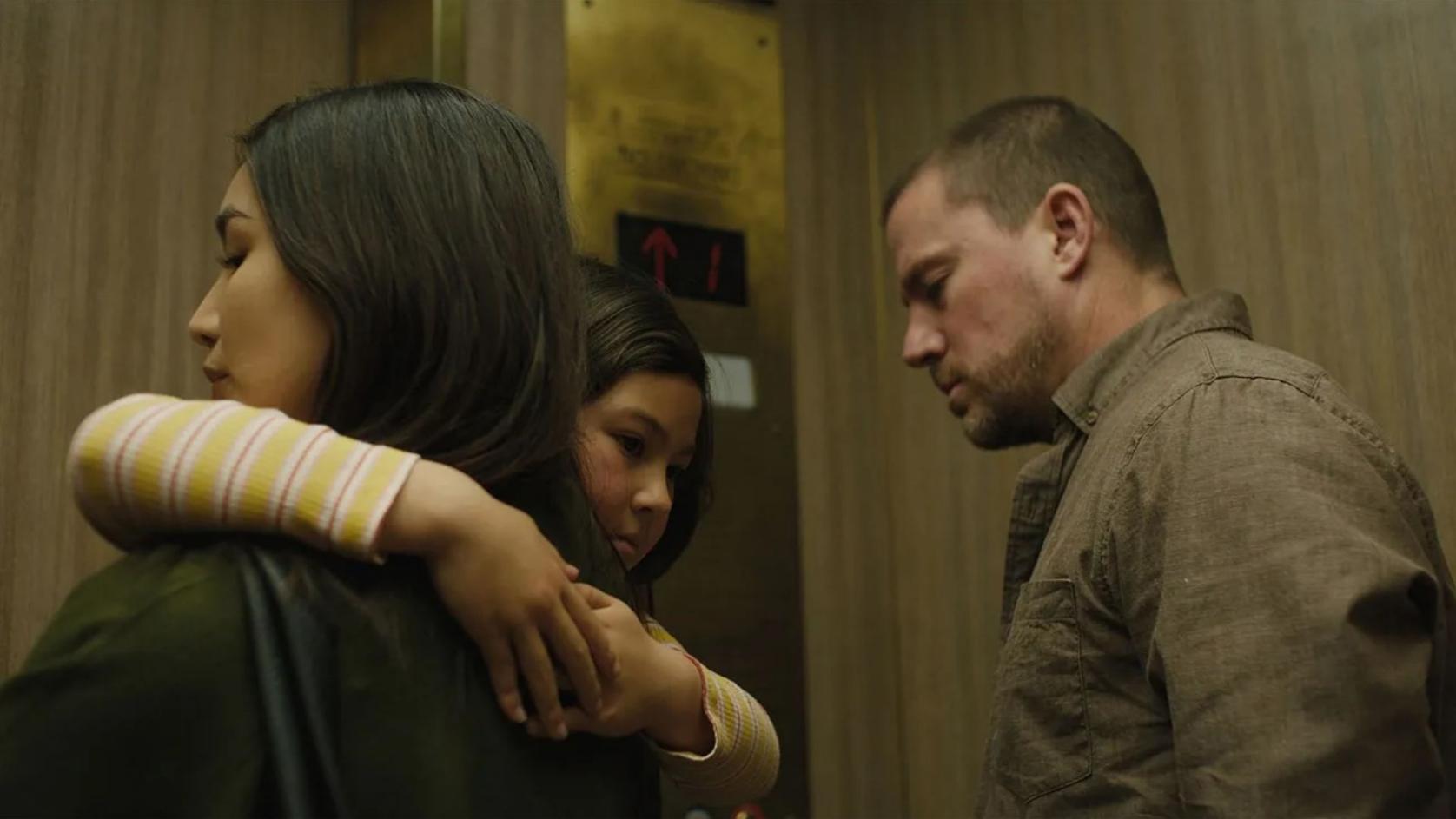
At the center of Josephine are parents Damien (Channing Tatum) and Claire (Genna Chan) and their daughter Josephine (Mason Reeves). Their idealic life is forever changed when their daughter witnesses a sexual assault. And every moment that comes afterwards, centers on the helpless parents as Josephine tries to understand what happened, how it fits into her life, but also how she can live with this knowledge.
MORE: This isn’t the first time Channing Tatum surprised us with a dramatic role. Read our review for Roofman.
It’s hard enough as an adult to deal with the realities of the cruelty that we experience day in and day out, especially on the continuous news cycle. But when you’re an 8-year-old, you don’t understand what you’re seeing. And parents, who rightfully are there to protect you, struggle with how to keep you safe but also away from those cruelties. And Josephine, she doesn’t let her parents’ limitations stop her from finding answers, even if those answers lead to her hurting others, herself, or her family.
In the span of 2 hours we see Josephine fall apart, look at the world in black and white, before finding the strength inside to let go of the ghost of something that she cannot control. And you can’t look away for a second because Mason Reeves does a phenomenal job at expressing her characters frustration, confusion, and anger at what her character is facing. Even in the quiet moments, Reeves takes you with her as her character shifts her behaviors in tiny ways in response to what happened. And that’s why I would be shocked if she doesn’t get an Oscar nomination. No, correction. All the nominations.
As a woman, it was devastating to watch Josephine go through something that follows you forever. Because I do some of the things that Josephine started doing after the assault. And I’m in my mid-30s. I take off one headphone if I’m walking in a public space. I’m hypervigilant about my windows and if my doors are locked. And after my own assault I questioned if that cruelty can live in someone else, can it live in me? That’s why I feel like this movie handled the assault and the aftermath in a way that was honest, delicate, and honored how hard it is to grow up as a girl or woman in a world where our biggest threat is the opposite sex.
MORE: Sundance’s The Incomer sees Domhnall Gleeson shine in this quirky comedy. Read our review.
Gemma Chan herself gives a performance that is anchored in her character wanting to protect her daughter. And her character Claire represented us, the women who survived men. She was the voice of reason and the guardian that we all wanted to be to Josephine and that we wished maybe someone would provide us when we were younger. Or at least that’s how I look at it. Because no matter how much her husband Damien tried to help in the film, he was seeing the cruelty that Josephine experienced from an outside perspective. He would never understand. And Chan brought this character to life with a poise and fury that all women carry as we try to not let the damage of the world define us.
For Channing Tatum, this is the career defining role for him that will get him an Oscar nomination. His character had to grapple with the fact that the thing that his daughter was afraid of, a man, is what he is. His character also had to grapple with not being able to understand the situation like his wife does while also promising things he cannot actually promise. And he seamlessly navigated through the horror of what his daughter had experienced, the anger that comes with helplessness, and the pain of knowing that at the end of the day you can’t protect your kid from a threat that looks like you.
When it comes to directing, I have to take time to applaud Beth de Araújo for keeping the focus primarily on Josephine. The parents’ helplessness was important to give context to the overall story. But its strength is in us following Josephine through her confusion, anger, and the wrong directions she takes as she tries to find a new normal for herself. Also the manner that the assault haunts Josephine, it’s a constant specter that follows our lead around without overtaking her narrative. And when Josephine finds her own strength, this movie uses that ghost to signal the end of this journey and the start of another.
MORE: Sundance’s Silenced tells a scattered story that is nonetheless worth telling. Read our review.
The things that haunt Josephine and her parents in this film are never going to go away. Because it never leaves us when it happens to us. We just learn how to live with the haunting reality of our world and try to make sure that the women that follow after us know that they’re not alone. None of us carry this weight alone. And there will always be people fighting back against the cruelty in our world. But most importantly, that whatever may come of this world, especially the evils, we will survive them. Claire did. Josephine did. I did.
Josephine screened at the 2026 Sundance Film Festival and was recently acquired by Sumerian Pictures.
