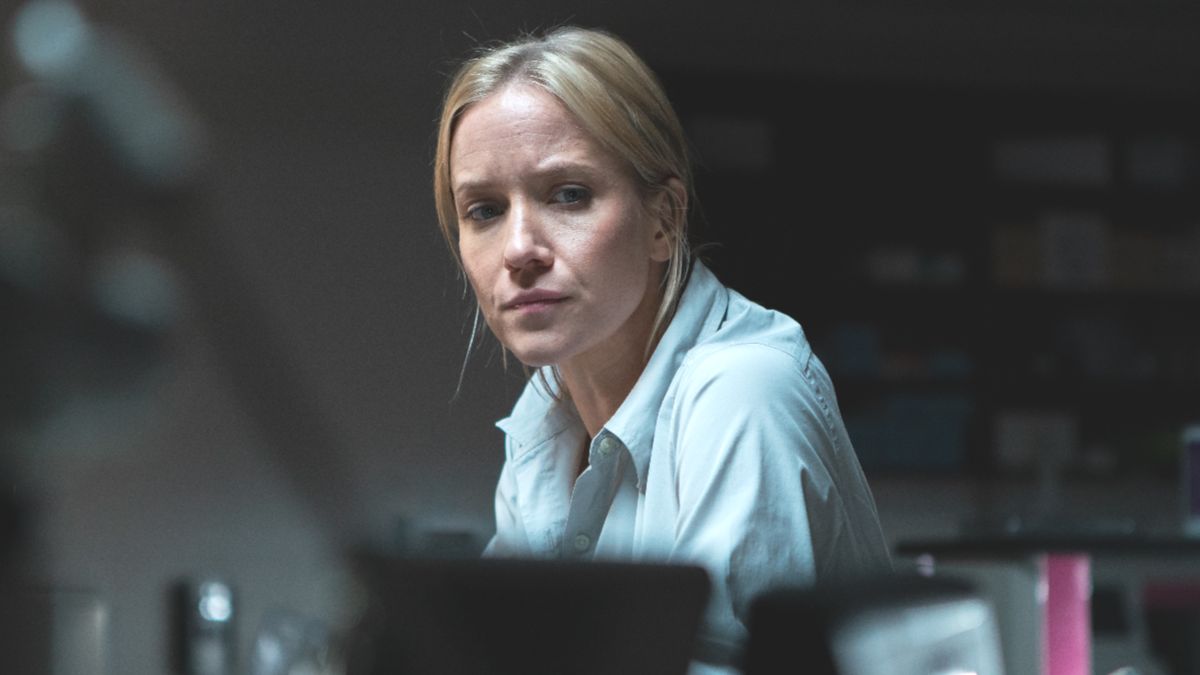
Jessy Schram has been on an incredible journey with Chicago Med, going from guest star to the heart of the NBC medical drama. Her character Dr. Hannah Asher is in the middle of her biggest season yet, expecting a child with Dr. Dean Archer and most recently risking her life to save an infected patient during the One Chicago crossover.
Yet at the same time, Jessy has gone in a completely different direction with her starring role in The Huntsman. The thriller features her portraying Det. Darby Albright, a dogged Oklahoma investigator on the trail of a serial killer. She spoke about stepping into a new character, continuing to evolve Hannah, and what she learned from the movie that she brought back to the TV show.
You’ve gone through such an evolution with your role on Chicago Med, as Hannah left and returned while going from a guest character to a series regular. What is that like for you as an actor, to play different iterations of her?
Jessy Schram: It really is unlike most journeys, especially on a show like this. The start-stop is very true to what this journey has been. But I was talking with [Chicago Med showrunner] Allen [MacDonald] the other day about the relationship between Archer and Asher—what are we doing with it, where is it going, all of that kind of stuff. And I was telling him how I feel like Archer and Asher are so interesting on their own, and there’s so much to grow there. But they’re even more interesting in their dynamic with each other.
I’m very lucky within the world of Chicago Med [with] how they’ve been able to keep grounding the character, while also keeping her alive and really relevant.
The growth of that relationship is impressive. Archer was initially skeptical of Hannah returning to the hospital, and now he’s in love with her. Were you surprised by how Hannah and Dean’s relationship developed?
Very much so. I feel like it’s been fun because their relationship has naturally developed, which has then led [the writers] to write different things along the way, in different ways than maybe originally intended. But I never saw being where we are now. And I think that’s the part that can be really fun, when you choose to trust and you don’t get in the way. You can see what can happen.
That being said though, while I trust, I’ve also been very vocal. [Laughs.] We’ve had many conversations along the way. The main thing is making sure that we’re staying true to our characters and the relationship from the past, wherever we go in the future. I like to touch base and understand the different directions, just making sure that we’re staying true to who we are, as opposed to just dropping one narrative to service another.
So much of what we’ve seen in Chicago Med Season 11 has been focused on Hannah and Dean, for obvious reasons. Is there any other character that you’d like her to get more screen time with, to see what that dynamic could be?
I haven’t really gotten to explore too much with Dr. Charles, so with Oliver [Platt]. Or with Goodwin as well. I feel like when I came back, Goodwin and Asher had some stuff together—but for the most part, she’s not as involved with Dr. Charles or Goodwin. I feel like that would be fun, to explore what their dynamic is a little bit more.

When you spend so much of your time invested into Hannah, what is it like to then say you’re going to do a movie like The Huntsman and transition to another character such as Darby?
It’s difficult. It’s difficult because as an actor, you don’t want to be playing the same character in everything. You get in the swing of knowing one character so well and then you need to be aware of making different choices for a new character, but then also let that go. Obviously, there’s elements or mannerisms that will be similar because that’s just how you take a breath in or you breathe out.
It’s definitely a fear that you’ve been living in one character so long that you’re not able to break them for something else, which is why I try and find opportunities during hiatus or other times to switch it up or break it or prove to myself that I can do something different.
Are there any scenes in The Huntsman that were really different from Chicago Med, or that you just particularly enjoyed?
When I got there, I asked the director, Kyle [Kauwika Harris], if there was anybody I can shadow or ask questions to… He had put me in touch with an amazing mentor, and I got to do some shadowing of the Oklahoma City Police Department.
I had this scene that comes up in the movie where we approach someone’s home who we think might be The Huntsman. And within that, there’s the negotiation. There’s the trying to get somebody out of the house. I had called this mentor right before the scene to ask some questions and he was like, wait a second, let me put you on with a real negotiator.
Just getting to hear the language, hear the psychology behind things, what their tone is, and all of this stuff—that was one of my favorite scenes, because it was all so impressive. And had I not had that conversation with the negotiator, I probably would have done a lot of Jessy-isms or figured out how to say it my way. It was just so neat to step into other shoes. To have some of that knowledge. And it really only scratched the surface, to be honest, within the time that we had with this.
As well as there is an interesting scene with my partner, played by Brent Bailey. My character is very frustrated with the red tape that’s put around her within her department, and even within the town, making this case almost like a show pony. They just want to close it up and make it go away so that nobody’s scared and we can move on with life. She’s a very logical and methodical character who just wants justice for her victims, but isn’t allowed to do her job, and is having a hard time doing it well, because people just don’t want it to move forward.
Within that, she also has this storyline with her brother, played by Shawn Ashmore, of being very concerned about his mental health and his physical health, because he’s getting too close to the story.
But I think my favorite part of this was just getting to scratch the surface a little bit on this position that a detective could be put in… It’s a really interesting line to play. Being a little bit more of a grounding force, really trying to figure it out as it goes along, as opposed to letting her emotions take over. She’s just a very frustrated character trying to do a good job.
Obviously it’s two different mediums, but were there any other differences in the filming experience between The Huntsman and Chicago Med? Did your process change?
The research is much different for me than when working on Chicago Med. I want to go back to Oklahoma, hands down; I absolutely adored my time there, and the crews were so fantastic. The DP [Sam Calvin] was amazing; how this movie looks is great. But everybody was so professional, while really putting their spin on everything.
It’s a much smaller production than Chicago Med. I also don’t really get to go on locations anymore within the Med world. But, you know, on Chicago Med and a lot of the procedural shows that you do, there are formulas of how you’re shooting the show… So just getting to be on a movie set and getting to be in a different role, it’s a luxury to get to play as an actor and to get to learn all different ways of production—within and outside of your comfort zone.
I had complete access to somebody who was able to take me under his wing. He taught me so many things, and I was able to get the nerd parts out of my brain and ask all the specific questions that are in the script. I feel like those are the subtle things that can show on screen. I personally really love knowing what I’m talking about, which just makes the work a lot more in-depth.
But the amount of people that lent their time and their skills, even in the areas that weren’t needed within the script, was really cool. It just opened my eyes to another world. What I loved the most with The Huntsman [was] working in Oklahoma with so many people that were just excited to lend their expertise and really create something different—something that had a mood and a visual effect.
You mentioned getting out of your comfort zone. When you’re working with different people, getting a different perspective, is there anything that you then take back to Chicago Med when you step back into what’s more familiar?
Very much so. I felt like I was a little bit more free in terms of where I was coming from. I was looking at things a different way, maybe how we could put a different spin on it, or I was then used to filming in a different environment.
So I would say the things that I learned on that, I learned what I liked about it. And then being a very harsh critic of my own, I learned what I want to do differently and dissect how to make that happen. I definitely learned a lot from Darby and the way I got to be curious. I’m [in my] fifth season on a show now, which is just an amazing thing to say. But what I brought back from playing Darby and in this world was to reinvest in the OB element of Hannah and the recovery element of Hannah.
I think you start that so much in the beginning, shadowing at the hospital and looking at your words and Googling and then also calling everybody. And at a certain point, you feel comfortable. I think what The Huntsman did, is it shook me up and reminded me to not be so comfortable. That’s what Darby did for me.
Speaking of other roles, you’ve been part of some great TV shows outside of Chicago Med. Are there other characters you’d suggest that fans should check out after The Huntsman?
In Mad Men, Bonnie Whiteside was a favorite character of mine. Just adored her. Something that’s back on Netflix right now, and is a little bit more into this character range, is Falling Skies. That was a Steven Spielberg TNT project that dealt with a post-apocalyptic alien invasion. And throughout that, my character Karen had kind of a start-stop, finish as well… I went away, and how I came back was just something that you don’t normally get to see, kind of like with Chicago Med. In both scenarios, I come back with a purpose and drive.
I’m actually re-watching the show right now because my husband had never seen it, and it’s been however many years. It’s basically like a very visceral photo album to me. I was very young. That was one of my first big projects. That was a life-changing job I just loved being part of and [it] shaped me.
Your very first role on NBC was in a series called Life, with Damien Lewis and Adam Arkin, that’s now also on Prime Video.
Damien Lewis, I fell in love with his talent. Especially the character on that show, how he’s listening to the Zen Buddhist tapes and obsessed with fruit; he had such quirky ways about him. [Damien] was such a pleasure on set, and just so good.
I haven’t seen that one in a while, but I adored being part of that show. I feel like that was one of those special ones that I got to be a part of. I’ve always been very lucky and blessed to not be typecast, I guess you could say… But Damien Lewis, I learned so much from, and Adam Arkin. That was definitely a show that I got to be on really early in my career and just absorb. I just absorbed that set so much.
So what have you taken away from this whole journey that you’ve been on, whether it’s recently or over the breadth of your career?
I’m just loving getting to play different careers, different roles, and stepping inside of people that really have a passion for justice. I feel like a lot of my characters, that’s where they live. And to get to play those in different realms is really cool, whether it be fairytale or post-apocalyptic sci-fi or Last Resort.
I was talking to somebody about this the other day. They had asked me what the difference of playing in Once Upon a Time was to Last Resort. And I’m like, you really couldn’t get more different. One is this fantasy world, which you have to realize as the actor, [you] need to ground that and your reality needs to become this fantasy world and everything can be very normal. Then you’re coming into a quote-unquote “normal” character and playing the wife role, and some people can view that as boring.
I remember during the process of that, getting to learn just how important and how beautiful it was to get to be part of the heart of a story—something that somebody was so passionate about, her getting to show the emotional elements of things. And who knows, hopefully this hiatus, I’ll get to blow you away with something else.
Chicago Med airs Wednesdays at 8:00 p.m. ET/PT on NBC. The Huntsman is now available on all digital platforms. Photo Credit: Featured image courtesy of Epic Pictures, body image courtesy of NBC.
