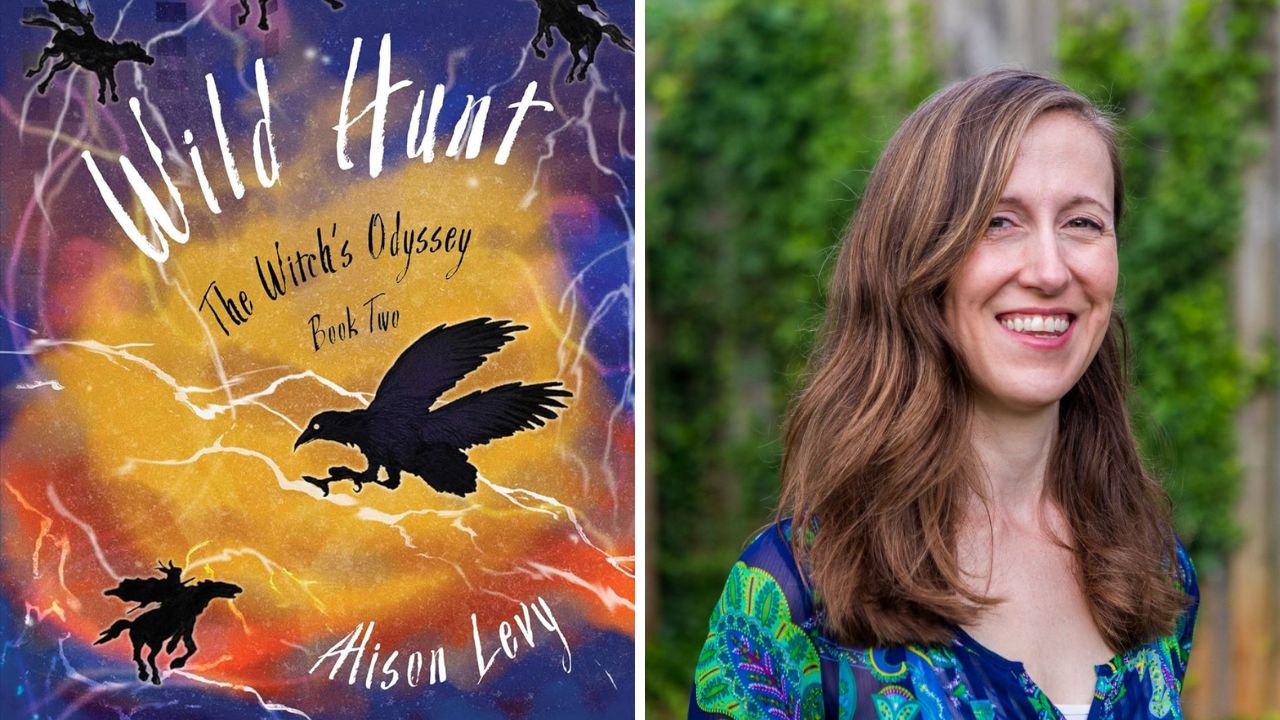
Writing can be an escape. Reading too. Immersing yourself in a world of fantasy sometimes feels like the perfect escape when the world feels a little too much. Don’t take our word for it, YA fantasy author Alison Levy, who just published The Witch’s Odyssey, agrees.
We talked to Levy about The Witch’s Odyssey and the surprising ways writing (and reading) fantasy can make painful, even traumatic experiences easier to process. This is what she had to say.
1. The fantasy genre is often considered to be wholly imagined, inventive, or escapist. But fantasy can also give readers and writers a way to explore difficult emotions and real-world struggles in a fresh way. Does that resonate with your experience of “The Witch’s Odyssey” series?
Absolutely! I started writing The Witch’s Odyssey during a challenging part of my life. I had just cut ties with a toxic family member and I was living on an emotional roller coaster. It was the right decision for me but it was still painful and part of my recovery was to channel my feelings into my writing. In the first book of my series, Magic By Any Other Name, my main character, Georgette, cuts ties with her toxic family and she goes through a lot of the same emotions I did: fear, sadness, guilt, doubt.
Examining Georgette’s emotions helped me process my own feelings and definitely helped me come to terms with some hard truths. In fact, writing Georgette’s story felt so personal to me that even though her life involves magic and fairy tale creatures, I had to create a little more distance between her and I by making her toxic family member her mother (not the case for me).
2. Were there any themes in either Magic by Any Other Name or Wild Hunt that surprised you by becoming more personal or emotionally layered as you wrote?
A lot of both books was very personal for me but one element that surprised me was Georgette’s resistance to seeing herself as part of a community. In Wild Hunt, Georgette encourages her friend Ishak to let the other Fae residents of Nocturne help him with daily tasks while he adjusts to life as a parent. She urges him to see himself as part of the Nocturne community however, when he tells her the same thing, she resists the idea. Despite how close she’s gotten to the residents and how hard she works for them, Georgette never considered herself part of their community.
When I wrote this, it felt entirely natural to the character but it took some thought for me to understand why. Those of us with mental health issues often avoid joining groups or embracing friendships because we don’t feel worthy and assume that others don’t enjoy spending time with us. Understanding why Georgette didn’t feel like she was part of the community she had thrown herself into serving was a bit of a gut punch to me. Since having that realization, I’ve made a conscious effort to engage with others more readily.
3. How has writing helped you identify, confront, and/or process your own mental health struggles?
Using my life as a rough blueprint for Georgette’s has led me to taking a closer look at how I process emotions. I’ve written a lot about the way Georgette responds to stress and emotional triggers, including how quickly her feelings overwhelm her. In researching how toxic families affect mental health, learned about the concept of “emotional dysregulation”: the inability to manage the intensity and duration of emotional responses, resulting in overwhelming feelings that can be disproportionate to the situation.
Emotional dysregulation can be a symptom of trauma but can also be a sign of neurodivergence. Around the time Magic By Any Other Name came out, I spoke to a professional about my symptoms and got diagnosed with ADHD. Being able to recontextualize my life (especially my childhood) through an ADHD lens, as well as getting medicated, has been huge for my mental health.
4. What drew you to YA fantasy as the “right genre” for the stories you write?
I didn’t have YA in mind when I first started the series but as I wrote, I found that the story I came up with fit most neatly into that category. Looking back on it, I think I may have subconsciously been writing the story for a younger version of myself who really could have benefited from reading it. Nowadays, when writing new chapters of “The Witch’s Odyssey,” I imagine writing to a person dealing with the sort of struggles I faced as I aged out of childhood and gradually developed into a fully-fledged adult.
5. How do you balance more “real world” explorations of mental health in your stories with the more fantastical elements readers enjoy from the genre?
Balancing reality with fantastical elements is nothing new. The oldest fantasy stories—fairy tales, folklore, mythology—tend to involve “real life lessons” for the reader in the form of morals or explanations of natural phenomena. In the case of my series, I started with a main character dealing with real world issues of trauma and mental health and then started weaving in fantastical elements as I build the world around her.
The character and her struggles are entirely grounded in reality, which I hope helps readers relate to her, but the magic brings the story to life.
6. Do you think fantasy can sometimes make hard subjects feel safer or more accessible for young readers? Why or why not?
Without a doubt. Fantasy by definition puts distance between the reader and real world through the use of magic and/or the supernatural. Diving into a fantasy book means leaving reality behind. That’s the appeal for fantasy fans! I can’t be tempted to read realistic fiction about family drama or social/political divisions because I get enough of that in my own life. However, if the writer can dress up the story with witches, dragons, elves, etc., then I’ll happily read a book with the same themes because it feels different from my day-to-day experience.
That little bit of distance definitely provides a safe space for readers, especially younger readers who are already expected to process a massive amount of change in a few short years of their lives as they transition to adulthood. Fantasy deals with many of the same issues as realistic fiction but because it takes a “softer” approach, young readers will often find it more accessible.
7. For young readers or aspiring writers who see pieces of their own struggles reflected in your fantasy stories, what do you hope they take away from “The Witch’s Odyssey” series?
I hope readers who see themselves in “The Witch’s Odyssey” take away that family isn’t necessarily something you’re born into; it can be something you make. Family members are those who love you, care about you, and don’t want to see you hurt. You deserve to feel supported by your family and if you don’t, it’s okay to take a step back and reevaluate your relationships. You owe it to yourself.
Alison Levy is the author of “The Witch’s Odyssey” YA fantasy series, including Magic By Any Other Name and Wild Hunt. She has been writing since childhood as a means of coping with undiagnosed anxiety and ADHD. She earned a BA in Anthropology from the University of Virginia and moved to the Washington D.C. area after graduating. Two years later, she moved to Pennsylvania, where she attended the University of Pittsburgh Law School and met her future husband. She is currently a stay-at-home mom and lives with her husband and son in Greensboro, North Carolina. Find out more on her website.
