
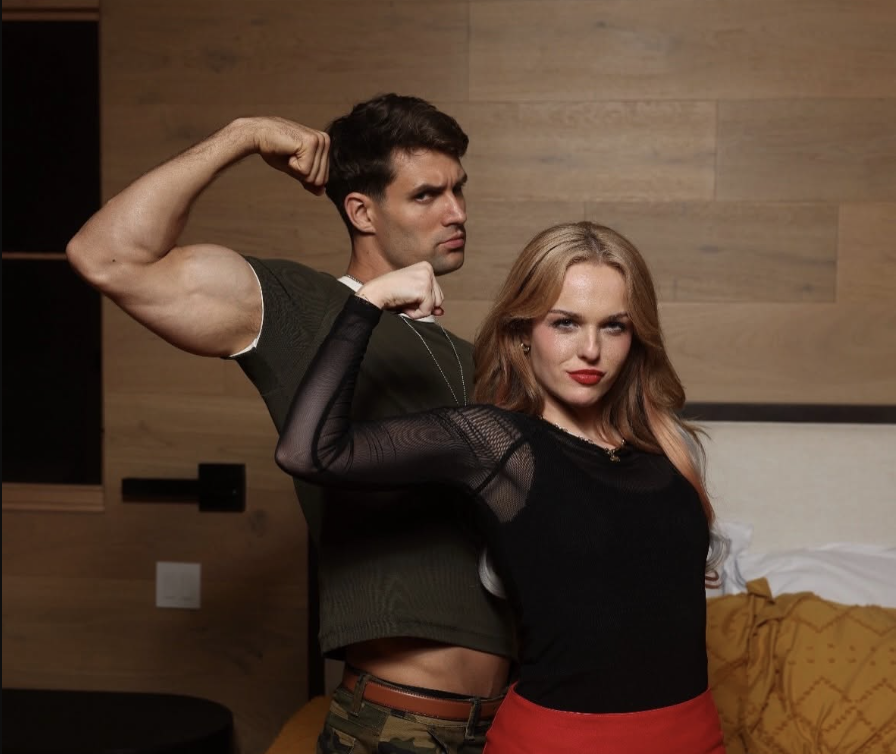
First things first: In The Taming Game, I did not understand why Chase needed to be a billionaire.
I was far more interested in the fact that he is in the military, has seen combat, and comes home on leave only to decide that his time would be best spent babysitting his best friend’s sister. I was also interested in the fact that his best friend apparently thought this was a reasonable request. There are many questions here, and the billionaire angle is not the one that made the story more compelling.
But I should probably start at the beginning.
The Taming Game gives us the brother’s-best-friend/sister trope, starring Shayne Davis and Luna Seranova. It is different. Whether that difference is good or bad depends on what you want from a vertical drama, but it is difficult to deny that the series makes choices.
The premise is simple: billionaire heir Chase agrees to help his friend keep rebellious Luna in line, assuming she will be an easy challenge. Instead, the more they clash, the harder it becomes for him to maintain control.

OH CHASE YOU’RE FUNNY
Except Chase was never really in control.
That is where the drama becomes more interesting. The premise wants us to believe Chase is the steady, disciplined one—the man with the authority, the money, the military background, and the supposed ability to handle Luna. But Luna is not someone who can be managed into submission, and the show is at its strongest when it lets her challenge the idea that she should be.
Seranova is the reason those scenes work. She has a presence that demands attention, and she pushes every actor opposite her to meet her energy. Luna is not written to be convenient, and Seranova does not soften her into someone easier to accept. She lets Luna be defiant, complicated, and fully aware of the effect she has on Chase.
Chase may think he is there to tame Luna, but the real story is watching Luna expose how quickly his confidence falls apart when he realizes he cannot control her at all.
DAVIS’ STRENGTH
Shayne Davis is a seasoned veteran of microdramas, and he understands exactly where his strengths are. He knows how to play intensity without losing the audience entirely, which matters when Chase spends much of The Taming Game acting like his military experience qualifies him to run a household like boot camp.
The concept is comical—not because Davis cannot sell the role, but because I would challenge anyone to go up against a woman with a mission and expect to win. Chase may arrive with discipline, authority, and an ego the size of his supposed billionaire bank account, but Luna is not interested in being managed.
Davis’ self-awareness is what makes Chase watchable. Some of the dialogue is undeniably cliché, and there are moments where Chase is asked to say things that should make any reasonable viewer close the app immediately. But Davis knows how to play the discomfort underneath the confidence. He makes it clear that Chase’s control is performance as much as personality.
CHASE YOU GOTTA CHILL OUT
At first, Chase is an annoyance. He is domineering, rude, and so convinced that he knows what is best for everyone else that it is difficult not to wonder why anyone lets him into the house. He has the kind of confidence that reads less like leadership and more like a man who has never been told to sit down and listen.
But Davis eventually gives the audience a reason to stay invested. He lets Chase’s growth feel earned, not because the character suddenly becomes perfect, but because he starts recognizing that control is not the same thing as care.
Luna is not much easier at the beginning, and maybe I am more willing to understand her attitude because she is a woman who is tired of being told what to do. I can admit that bias. Still, her resistance makes sense. Chase walks into her life assuming he has authority over her, and she responds accordingly.
Neither of them is immediately likable. That is part of the point. The story works when it stops asking us to choose a side and instead lets us watch two people learn that being right is not the same thing as being kind or understanding.

It is through the arguing, the challenges, and the constant push-and-pull between them that Chase and Luna realize they want to be together. Their relationship does not develop because one of them changes the other. It develops because neither of them is willing to let the other hide behind their worst instincts.
LUNA YOU’RE STRONG
Luna is willing to take on anything if it means being with Chase. Chase, however, is more afraid of what loving her requires. When he is called back to base, he ghosts her for a year and leaves Luna with the kind of heartbreak that does not disappear just because someone eventually comes back.
Luna does not let that heartbreak define her. She graduates from college, focuses on her future, and starts building a life that is not dependent on whether Chase decides he is ready to show up. Her pain becomes motivation, not because she suddenly stops loving him, but because she learns that loving someone cannot come at the expense of herself.
Her brother is understandably furious that his best friend hurt his sister. That is what makes the brother’s-best-friend trope so complicated: there is never just one relationship at risk. Chase does not only have to earn Luna’s trust again. He has to face the damage he caused within the family that trusted him.
Still, Davis and Seranova make the relationship work. They make the angst, yearning, and drama feel less like a collection of familiar trope beats and more like two people trying to figure out whether love can survive the versions of themselves they are no longer proud of. Their chemistry carries the story from the first argument to the final reconciliation.
TAME… HAHA
Luna is not tamed. She should not be. She is herself—opinionated, determined, and unwilling to shrink so someone else can feel more comfortable. Chase’s real growth is learning that love is not about controlling her. It is about respecting her enough to meet her where she is.
Their attraction works because they are most drawn to each other when they are being honest. Chase is willing to give up everything to be with Luna, but more importantly, he is willing to learn from what he did wrong.
What more can you ask for from a redemption arc?
