
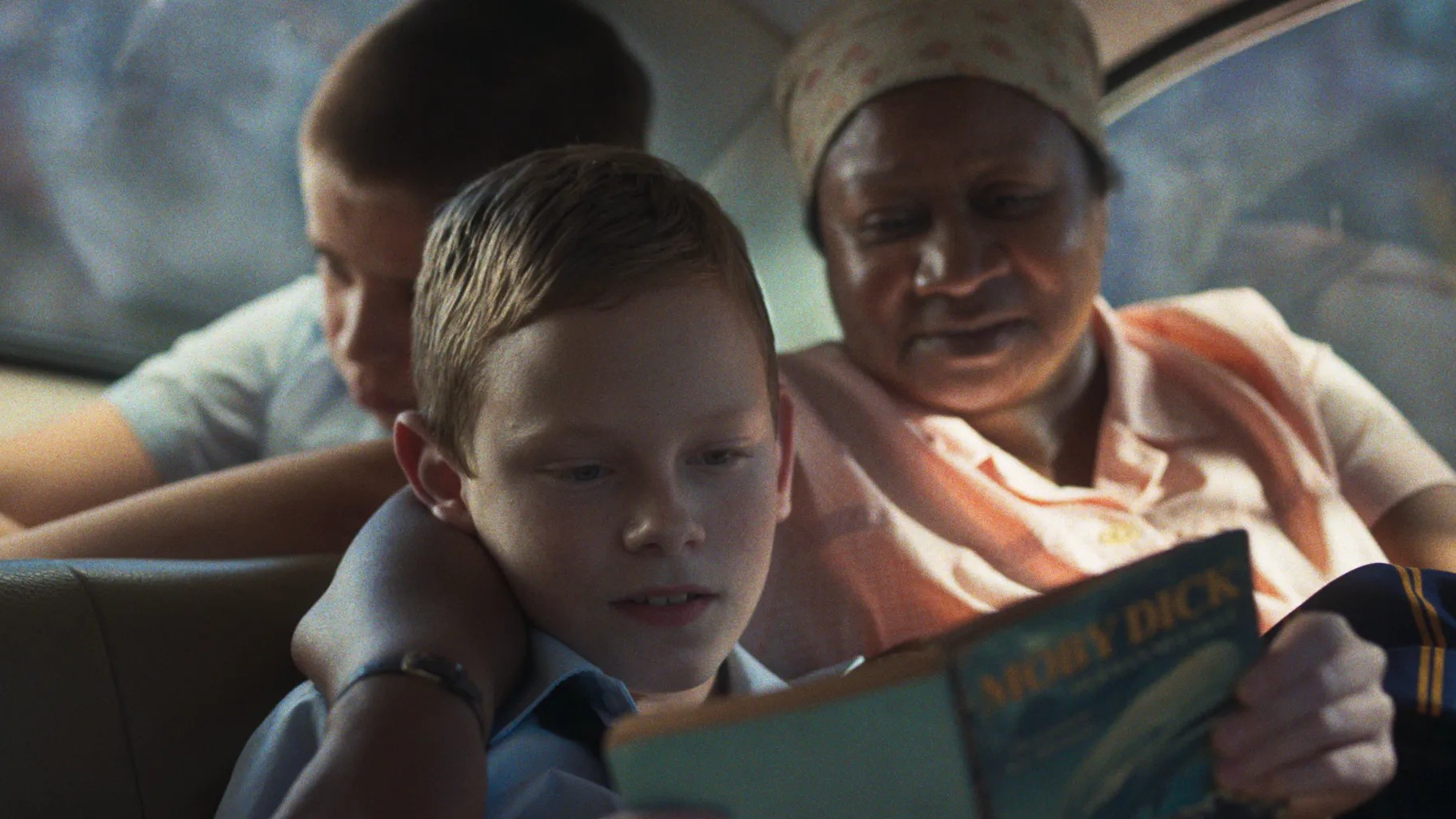
The Smell of Apples is the kind of movie that forces you to reckon not just with the reality of apartheid South Africa, but also with the things seemingly normal people did to justify the horrors and continue living their lives. Adapted from South African writer Mark Behr’s 1993 bestselling novel, The Smell of Apples is a hard watch, and yet it’s also the kind of movie that, once you get into it, you cannot look away from.
John Trengove depicts South Africa in the 70s in a way that feels real, and yet manages to sprinkle mundanity into the day-to-day atrocities. The movie isn’t about what it means to live in apartheid South Africa for the Black population; it’s about the system that made it so people who considered themselves decent accepted the reality of discrimination.
Some might say this isn’t as necessary a movie as those from the point of view of the people on the other side, and I very much agree with that general idea. There’s a need for more understanding of what people suffered during apartheid, and the white perspective isn’t giving us that. In fact, what we get here is just an oblique view of that pain, as a separate thing from the story that’s being told.
There’s, however, still value in this perspective even if it shouldn’t be the prevalent one. For systems of oppression to be dismantled, we need to understand how they came to be and who held them up in the first place. 11-year-old Marnus (Dawian van der Westhuizen) isn’t personally responsible for how his world works, but he is a cog in the machine, and though the movie gives him increasing awareness of how the system he’s part of hurts not just his nanny Doreen (Celeste Matthews Wannenburgh) but even his friend Frikkie (Wian Carstens), that doesn’t make it any easier for Marnus to make any meaningful change.

In that regard, The Smell of Apples isn’t an idealistic movie, and it shouldn’t be. Some problems cannot be solved with the power of love or even friendship, and sometimes people don’t make the right decisions, even if they come to understand what that decision would be.
Marnus’ mother, Leonor (Maude Sandham), is a devoted wife who gave up a possible singing career. His sister, Ilse (Karoline Watson), is a young woman with increasing awareness of the unfairness of the world she exists in. Marnus himself comes to understand that, despite his father Johan (Hilton Pelser)’s veneer of playful affection, there’s a darker side of him. And yet, no one does anything to change the status quo. In many ways, no one feels like they can.
The movie focuses on one inciting event: the arrival of Doreen’s grandson, who is staying with her at the property. After Marcus misplaces his grandfather’s fishing rod, it feels like the easy solution is to blame the boy. That decision, however, begins to expose the cruelty hidden beneath the mask of civility his father wears. And that, coupled with the arrival of Mr. Smith from Chile, is meant to showcase not just what’s going on in South Africa, but in the world.
Ironically, Mr. Smith is presented as charismatic and cultured. On the surface, he seems like the opposite of Jonah, whose cruelty and that of the military complex he is part of are very starkly presented, as Doreen’s grandson is burned nearly to death by the military after he is forced to go live with another family member. But Mr. Smith is obviously a member of the Pinochet government, and is likely just as bad as Jonah, just much better at hiding.
All of these things make for an interesting cocktail of ideas, particularly if we consider that this “Mr. Smith” is treated as white in South Africa, whereas in today’s United States, he would be considered a person of color. It’s, if nothing else, a great reminder of the way different groups in power use race, among other things, to obtain and keep power. Perhaps not the movie or the message we expected from a movie about apartheid South Africa, but a worthwhile watch nonetheless.
The Smell of Apples premiered at the Toronto International Film Festival.
