
SPOILER ALERT: The following contains spoilers for Chicago Med Season 12, Episode 1.
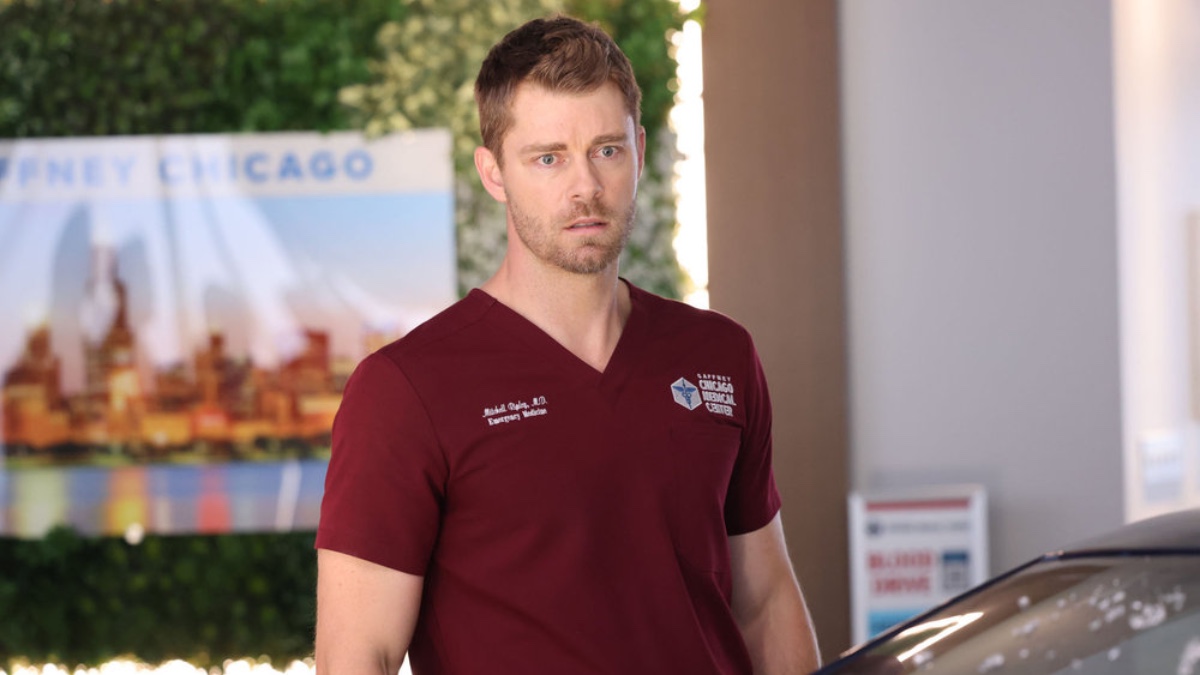
Chicago Med is coming for Dr. Mitch Ripley—and it could be the best thing the show ever does for him. The Chicago Med Season 12 premiere was a statement episode for Ripley in multiple ways: emotional, infuriating, inspiring and even a little chilling. But its message was clear, that his fourth season is when NBC viewers are going to see Ripley’s past, present and potential future all slam into each other, and he’s not going to handle it well. Nor should he.
Since Ripley was introduced by original showrunners Diane Frolov and Andrew Schneider in Season 9, he’s been a character who can rarely stand still, propelled by an intense energy. He’s learned a lot—probably more than any other character in the last three-plus seasons—but he’s also regressed a lot. He still needs that one definitive moment where he kicks the proverbial door down and shoves himself forward. It can’t happen to him just from some external force like that car, because then it wouldn’t be authentic. He needs to do it for himself.
“Shots Fired” gave him the impetus to break that cycle, but the journey of doing so is just as important as the end result. By putting Ripley under tremendous pressure once again, Allen MacDonald and company can prove just how much he’s truly changed. This time, the story will end differently—because it’s not so much an end as a beginning.
Ripley Is About to Go Down Another Hole of His Own Making

Remember when Chicago Med trapped Ripley in a tunnel in Season 10? And that experience was the wake-up call he needed to get himself together? Welcome to the second tunnel. And this time, it’s going to take more than one episode for him to get out. Because throwing a car at Ripley isn’t the turning point; it’s the catalyst. There will be more—and what fans will hopefully see at the end of it is the next evolution of Mitch Ripley.
Ripley’s entire character arc has been a series of circles. When he was first introduced in Season 9, he was a little bit of an angry young man as Frolov and Schneider put the focus on his bitter past with Dr. Charles. It made all the sense in the world; of course Ripley wouldn’t be happy coming face-to-face with Charles again, and of course the audience would want to know what the hell happened between them. But as with all One Chicago characters who arrive with some sort of previous baggage (most recently Eva Imani on Chicago PD), that plotline only works for about a season before the character has to get over it in order to function, and the fans get over it in general. The writers can’t define the hero by his or her past.
So viewers got to see Ripley move forward, and not only in repairing his relationship with Dr. Charles. He established himself as a reliable member of the ED team. He also developed a romance with Dr. Hannah Asher that was (for a while) a positive influence for them both. He was building constructive relationships and getting comfortable in this world. He was proving his worth, even if the only person he actually had to prove it to was himself.
Which is why it was critical that not all of Ripley’s progress was with other people. The audience also saw him working to accept and redefine himself. One of Luke Mitchell’s best scenes came in the Season 9 episode “I Make a Promise, I Will Never Leave You,” in which Ripley was horrified to discover that his patient had been lobotomized. Mitchell didn’t have a single word of dialogue in that scene, but his reaction was heartbreakingly, beautifully perfect. It didn’t just say how Ripley felt for Jimmy; it said how he felt about himself. He felt like he’d “made good,” but then there’s this realization that could’ve been him, and the grief and doubt that rushes up from that.
Literally the very next episode, Chicago Med jumped into the Sully storyline. Ripley didn’t get a break between that and learning about Sully’s cancer. Then two episodes later he was getting pulled into the Pawel situation, and three episodes after that he was trying to keep Sully’s cancer diagnosis from Lynne, on top of Lynne being brought into the ED with complications in her pregnancy, at the same time that he was being deposed in Pawel’s lawsuit. The entire back end of Season 9 just hammered Mitch Ripley, and that would have been enough, especially with the break between seasons and the change in showrunners. Diane Frolov and Andrew Schneider put in the effort to build a compelling character and they took that character to a natural pause point. But new showrunner Allen MacDonald stayed the course, in what was both a frustrating and fascinating decision.
On one hand, there’s a reason shows largely reset between seasons; it makes them easier to follow, and enables new stories to be told and new characters to get the spotlight. And for Ripley fans, there’s the instinct to say “enough.” No one wants to see their favorite character get dragged for a long period of time. But MacDonald knew he had a storyline left unresolved with Sully’s cancer, and he also probably knew he had an incredible resource in Luke Mitchell. Mitchell’s casting in Season 9 has been the linchpin to Ripley’s entire character. He’s not only incredibly talented but also specifically great at playing characters who undergo substantial life changes (see: The Republic of Sarah and Blindspot in particular). He’s the one person who could walk this wire for that long and make it count. When you have an actor that you know you can push that far, you hit the accelerator, and you trust them to take you on that ride.
Because as much as it was terrible (and a little predictable) that Sully had cancer, it wasn’t a whole negative for Ripley. The returns of Sully and Lynne to his life were good things, even if ultimately under bittersweet circumstances, and even if his renewed friendship with Sully caused some trouble in the time they had left. He found something in his past that wasn’t entirely lost or broken. Not to mention, the audience got to learn more about young Ripley that wasn’t just through the filter of Dr. Charles. They were able to not only juxtapose past and present, but understand more about how Ripley became the man he was. He was still learning and growing even in the face of tragedy.
And then, of course, Sully died, and MacDonald ripped everything out from under Ripley. All the progress he’d had was unraveled by his own making, and Ripley would be the first person to acknowledge that. He’s never not been self-aware; he just struggles with a loss of control, which goes hand in hand with his self-image. Ripley’s an intense character. When he feels like he’s got it, nothing can stop him. He could run through a brick wall. And when he feels like he doesn’t have it, when he’s vulnerable, it’s just as easy for him to let go. When you have that negative voice in your head, it doesn’t leave; you just learn to ignore it. And there are some days where it wins.
So Ripley self-destructed in spectacular Chicago Med fashion. The assault, the suspension, Hannah breaking up with him even as he said “I love you,” and then getting buried in a tunnel. MacDonald and his staff deserve a hat tip here; they could have gotten superficially melodramatic here. How many TV drama characters’ hard times just end up in the bottom of a bottle or a bad relationship? But the exploration of Ripley’s mental and emotional health has been refreshingly akin to what Blake Masters did in Season 2 of Brotherhood, where he gave his co-main character a traumatic injury and then stuck with the consequences. Not every step has been perfect, but it makes Ripley that much more human because his choices, his traumas, his mistakes can’t just be set aside for the next week or the next plot.
What Seasons 10 and 11 did was show that Ripley hadn’t moved on or recovered as much as he thought he had, and he made new choices and started again. His personal life became one example of that: whether it was Hannah, Sadie, or now Dr. Caitlin Lenox, Ripley tried, and he screwed up, but he never stopped trying. Even when it would have been easier to give in. Because what he learned—thank you, vision of Sully in that tunnel—is that he can’t stop. He’s going to fall down, but he’s got to get back up. What’s changed over the last two seasons is who he’s fighting for.
Hannah’s breakup lines to Ripley were important then, and they’re still relevant now. She told him that she couldn’t be the one to “save” him, and she’s still right. Ripley has to save himself, which is what he’s about to do in Chicago Med Season 12—after he digs himself out of another hole first. It’s the test to prove that he truly has become the man he wants and deserves to be.
Ripley Can Be a Leader—But Will He Rise to the Occasion?

The Chicago Med Season 12 premiere did more for Ripley than force him to confront his mortality. It also revealed that he’s the attending physician who is already butting heads with the new arrival, Dr. Annie Wu. For the first time, Ripley is responsible for someone else on the org chart, and that is a gift of a storyline.
One of the most interesting things Chicago Med does is when it enables a doctor to move into a greater position within the hospital. It’s a recognition of their talent, certainly, but it’s also a recognition of their character. Fans saw that with Dr. Connor Rhodes and his mission to build the hybrid OR; setting aside all the personal drama, that storyline was an opportunity to see how important Connor was to the hospital. Later on, his replacement, Dr. Crockett Marcel, had a whole subplot about his involvement with the administrative aspects of the hospital, which likewise demonstrated how Crockett had evolved from the guy once found napping on a spare bed in the ED. Now that opportunity is coming around for Ripley, and he’s earned it. He just hasn’t realized that yet.
Based on his locker room scene with Annie in “Shots Fired,” one gets the sense that Ripley is taking being her attending as more of a responsibility than an accomplishment. And it is a responsibility—he has to teach her the right things and make sure she doesn’t do the wrong ones, which is what their mini-fight is all about. But being put in that position is also a sign that Ripley is now trusted to have that kind of authority. That people believe he’s someone who can and should be learned from. That’s a far cry from where he was in Season 9, or even in that first half of Season 10. It works because the viewer has seen how much effort he’s put in, both in and out of the ED. Take, for example, the turmoil in his relationship with Lenox. It has nothing in-universe to do with this, but the audience has seen his growth and maturity in how he confronted her when he needed to. He wasn’t afraid to say the hard thing. Leaders have to say the hard thing a lot. Lenox’s whole character at her start was saying the hard thing unprompted. Ripley has learned from her, and he’s just more confident in himself.
Yet watch that scene with Annie again; there are cracks there. Ripley first acknowledges them in talking to Bruno (rest in peace), when he talks about the loss he sees catching up with him. It hurts more when that latest loss is someone he can see himself in—along with, again, realizing that could’ve been him. One more time, Ripley is aware that this life he’s built for himself is still fragile, years later, when you’d think it would finally be stable after all that effort. He reacts to Annie in an emotional state, and that vulnerability is not visible to her, but thanks to Luke Mitchell’s nuanced performance, the audience gets to see it. It’s in his tone; he’s clearly upset, but he’s also holding back. When she just has to get that last comment in, viewers see Ripley stop and take a breath, and that’s the moment of asserting control over himself. He wants to lose it. There is that anger inside him. But he knows he can’t, even as she’s goading him. He does what a leader should by keeping level and not engaging. Yet Mitchell is able to convey that it’s a struggle.
That’s what makes this storyline immediately intriguing. Numerous other medical shows, and previous seasons of Med, have brought in new residents and med students as an easy way to toss something fresh into the ensemble. It’s frankly often boring, because it typically tends to play out in a predictable way. But Annie is obviously going to push Ripley, and he’s no shrinking violet. How much does he push back? How much does he look at her and see Season 9 or even pre-canon Ripley? Annie has already shown she’s lacking two things Ripley has already had to deal with: she has a temper, and she’s got zero self-awareness. Her character is a way for Ripley to potentially look in the mirror. And if he sees those similarities, and he ends up using his experiences from Seasons 9-11 to help Annie become a better doctor, then that’s also huge for him. It makes all those challenges he went through constructive.
Why Ripley Needs This Storyline Now (And What Chicago Med News Just Made It Better)

What Allen MacDonald is doing in Chicago Med Season 12 is essentially running it back for Mitch Ripley, and seeing what Ripley does now with all the tools he has from his experience up to this point. He’s in a situation, both professionally and personally, that could be amazing for him. But it also has hallmarks of where he was when he fell short before. And it’s wholly up to him if he goes back to past patterns or steps completely off the ledge. It’s a comprehensive character study for a beautifully crafted character.
Ripley’s original journey on Chicago Med was about closure. It was about both him and Dr. Charles dealing with his past, and him being in a much better place today. But the writers have done—and he’s done—everything he can do with his history. In contrast, the journey he’s taken in Season 11 is looking forward; it’s about building a future. Both in his budding relationship with Lenox and in his playing a more prominent role in the hospital. If he pushes through here, he’s making choices that could benefit him for the rest of his life. He’s got everything to play for.
And he should come through, because what’s always been so great about Ripley as a character is that dynamic characterization. The true joy of television—and especially long-running shows like Chicago Med—is getting to watch characters evolve over years. That’s why last season’s “The Book of Charles” and “Altered States” were so memorable; they were these huge steps forward for a character that the audience thought they already knew. But few TV characters grow as consistently and noticeably as Ripley has. He hasn’t had a few big episodes or a big season; he’s pretty much constantly been rolling. To give him this story now not only benefits the character, but it sends a positive message to the audience, something that Med has been low-key good at during the MacDonald years. If Ripley is no longer just surviving, not just thriving, but now he’s leading, that’s a belief that no matter what burdens you carry, no matter what scars you wear, anyone can still find their power. It doesn’t matter when it happens or how long it takes; it’s there. Ripley has a heroic quality not because he’s a great doctor; he’s heroic because he’s always trying to make himself a better person.
What’s fantastic is that Chicago Med‘s recent casting choices have played right into the Ripley storyline, if MacDonald wants to go that far. Audiences know that Luke Mitchell’s wife Rebecca Breeds is playing the temporary hospital administrator Mallory Sloan, and it would almost be rude if they didn’t get at least one scene together. But that could be a lot more than a fun aside. Mallory’s already had one argument with Dr. Dean Archer about her handling of hospital resources—putting Ripley in front of her would be a huge test for his emotional discipline. He doesn’t have Archer’s tenure or his rank, and if he breaks, there would have to be consequences. He’s already been suspended once. And he’s the guy who won’t go quietly; if he’s not afraid of fighting in the ED, he’s not afraid of much.
Except, of course, for what’s in his head. Any potential blow-up would, aside from serving as the obvious “okay, he’s really not okay” benchmark scene, be emblematic of Ripley’s entire saga: his battle is on the inside. It just keeps spilling out, as these things always do, just like they did for Charles. And it would be a poetic but also meaningful difference if this time, Ripley went down fighting for the rest of the hospital staff instead of just himself. That’s been the shift in his perspective that viewers have seen over the last few years; for everything he has going on inside, it’s getting easier for him to focus outward.
The absence of Lenox, however temporary, is rife for this. Their scene in “Shots Fired” is hopefully just the first instance in which Ripley can learn from Lenox. The key point between them last season was her prion disease and the push-pull about that, but she’s the exact right person he needs to listen to right now. Not only because she knows “existential dread” and the uncertainty that goes with it, but wait until she gets back in a professional capacity. He can also confide in her about being in a leadership capacity. They’ll probably disagree on certain points, but she’s his best resource—both as head of the ED and because her previous storyline with Naomi shows Lenox can navigate the emotional component of leadership, too. Because Ripley shouldn’t get it all right at the beginning; not only is that unrealistic, but that’s just not him. He’s a character who needs the process. And what will it be like for Lenox to have things somewhat reversed, where after Ripley was trying to take care of her, she might have to take care of him? What does that open up for her?
Plus, the newly announced return of Colin Donnell as Connor Rhodes would create a great opportunity for Ripley. There’s the obvious magic of putting two of Chicago Med‘s best actors together and just enjoying what happens; Donnell and Luke Mitchell have similar strengths as performers, so they’d work very well opposite each other. But Ripley and Connor have a few things in common, too. Chronologically speaking, Ripley is the current end of the Connor Rhodes “coaching tree,” as he filled the space left by Crockett, who was the replacement for Connor. And both characters have had these wonderfully transformative arcs, not just as doctors but as people. It would be interesting to see them come face-to-face and thus compare different eras of Chicago Med. And see if they see something in each other.
Ultimately, looking ahead to the end of Chicago Med Season 12, viewers are poised to see Mitch Ripley’s breakout year—and based on what he’s been given so far, possibly Luke Mitchell’s best performance. Everything Ripley knows about himself is coming good right now. He has three reasons to reckon with everything that’s been left unfinished or flawed, and then let it all go. If Ripley can look himself in the mirror and not look back, if he can step forward as a leader and recognize that he deserves to be one, if he can hold onto a relationship through the pain instead of it breaking down, he’ll be in a whole new place in his life. And the best part of that is that it won’t be the end. Ripley doesn’t need to be carrying all this weight to be interesting. He’ll just have new challenges to tackle, and he’ll finally get a chance to completely stop and breathe.
The saga of Dr. Mitch Ripley is a fascinating one, on and off-camera. This is a character whose journey has persisted across two separate showrunners; Diane Frolov, Andrew Schneider, and Allen MacDonald all deserve credit for how much effort they put into telling such a layered story with Ripley, and then MacDonald has committed to telling the full breadth of that story. And it’s also the product of Luke Mitchell, who’s the only actor with the right toolkit to play this part—knowing how to access all those layers and to navigate them without losing sight of the baseline of who Ripley is, and bringing the intensity to make all of Ripley’s ups and downs matter.
What Chicago Med fans are seeing is the result of a true group effort, and in a way that mirrors where Ripley is now. He’s been working to put the pieces of his life together for four seasons. Now he finally has all of those pieces, and he just has to assemble them. And is he ready to see what happens when he does? Who knows, but it will be an absolute pleasure to find out.
Chicago Med airs Wednesdays at 8:00 p.m. ET/PT on NBC. Photo Credit: Courtesy of NBC.
