
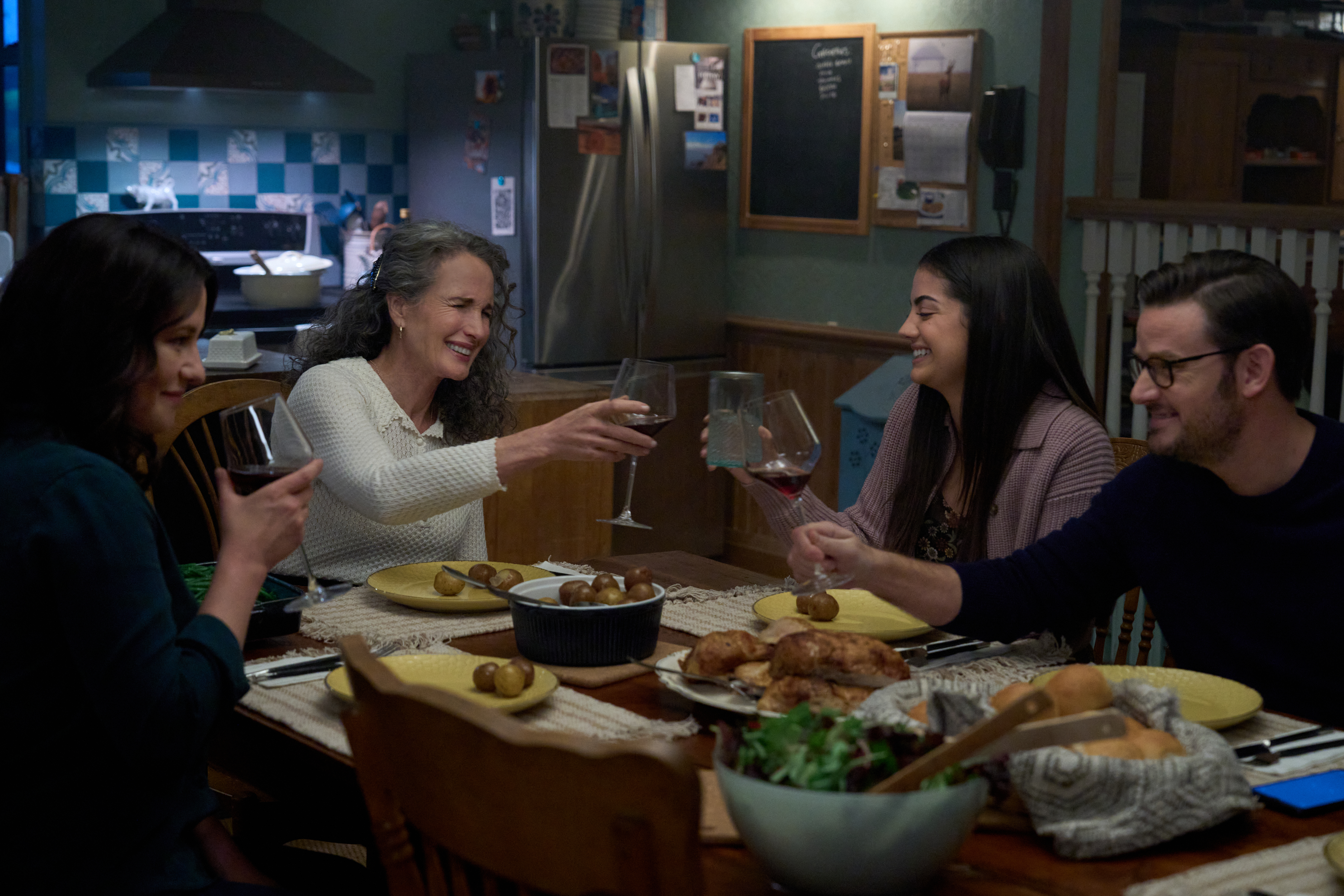
You probably know Hallmark Channel as the home of dozens upon dozens of sweet-as-pie romance movies. So you might be surprised to learn that it is also home to one of the best depictions of grief on TV right now, thanks to The Way Home. I say this both as a critic and as someone learning to live with grief myself.
I came to the show this year during a season of loss and grief in my own life. Maybe that’s why the show hit squarely in the chest. Depictions of grief in fiction often fall into one of two camps: despairing and dramatic, or predictable and tidily resolved. The Way Home offers something else – something more realistic – in depicting untidy, complicated grief without falling into despair.
The Way Home Breaks New Ground for Hallmark
Hallmark’s breakout hit drama combines a women-led, generational family drama with a time travel twist. In 1999, the Landry family’s eight-year-son, Jacob (Remy Smith) vanishes at a town carnival. Just months later, the family patriarch Colton (Jefferson Brown) dies in a car accident. Now, daughter Kat (Chyler Leigh) returns to Port Haven, a divorced mom with a rebellious teenage daughter Alice (Sadie Laflamme-Snow). As Kat navigates her prickly relationship with her estranged mom Del (Andie MacDowell) and tries to uncover what really happened the night Jacob vanished, Alice discovers a pond that sends her through time to 1999, where she meets and befriends teenage Kat (Alex Hook). Kat’s childhood BFF Elliot (Evan Williams and David Webster) keeps everyone’s secrets in both eras, all while struggling to manage his own grief, trauma, and maybe-unrequited-maybe-not love for Kat.
If that sounds more complicated than your typical Hallmark fare, you’d be right. Characters actually hurt each other; people behave messily; relationships have real fire beneath them. You’d also be right to note that the pain of loss undergirds the vast majority of the story. More importantly, it’s about how grief tends to be non-linear.
There’s Never Enough Time

One of the biggest threads throughout The Way Home is Kat’s back-and-forth over trying to let the past go. Sometimes, she focuses on “solving” the past to the detriment of her relationships in the present. Other times, she swears she’s done with it. (And she means it, or at least believes that she does). Sometimes, her memories are golden and bring her joy. Other times, they just bring her more pain. Her grief isn’t progressing tidily – and neither is mine.
I’ve spent months watching one of the most important people in my life – a great-aunt who has played a grandmother role to me – slowly decline and slip away, after already suffering multiple other losses in the last couple of years. On some days, things almost feel “normal.” The memories I have with her bring me warmth and comfort. On other days, I can’t stop dwelling on a yearning to go “back,” or on the anger I feel towards the outside forces that made us miss years together. It’s not “stages” of grief; the “stages” intertwine and overlap.
The Way Home, more than most shows I’ve seen, understands how that feels. Even if you could go back, it’s not the resolution you really need. There’s a bittersweet tenderness to the threads of the story, from the writing to even the tiniest acting choices. A story about these themes could so easily be maudlin or trite, but instead, The Way Home gives its characters – and its audience – permission to explore the messy side of grief, along with the hope that can come.
“The Pond Is All About Reflection”

Grief in The Way Home isn’t just about death – it’s also about lost time and lost opportunities. Here, it’s Elliot who has the knottiest journey. He’s introduced as the stable, reliable guy – the Giles figure, as he himself quips. Soon, though, we see what it costs him to be that guy, and why he persists anyway (until he can’t anymore and cracks). On top of the trauma of finding out the future when he was just a teenager, and losing surrogate-familial figures, he makes himself smaller to avoid his abusive father – the one person he doesn’t want to be. He’s grieving too, but he always puts himself last because he doesn’t want pity. And, perhaps, because he fears being left behind if he’s not useful.
And sure enough, what happens to Elliot, both in-universe and among a chunk of the audience? Grief, and the journey of working through it, isn’t always pretty, and it can lead us to make mistakes. The same season that cracks Elliot’s façade wide open is the one that also offers Kat yet another potential love interest: charming smuggler Thomas Coyle (Kris Holden-Reid), during her sojourns to 1814. Thomas and Kat’s relationship starts off pretty badly, but there’s a narrative ease to his “bad boy with a heart of gold” arc. It’s a painful bit of meta-narrative, how it makes it easy for audiences to favor someone else just as Elliot is going through “growing pains” as a character.
Elliot’s arc is messier and harder to root for and so very painfully human. It’s uneven and painful and even ugly at times. But, oh, that’s exactly why I root for him, both as an individual and to be “endgame” with Kat. Because what is romance, and what is learning to live with grief, if not discovering that you are worthy of the love you yearn for, with all your mess and all your scars?
I, like Elliot, have lost a beloved familial figure who acted in place of a relative who hurt me. I, like Elliot, have imagined how my life might have gone if I didn’t let myself get pigeonholed as the “responsible” one or the “fixer.” During Season 2, I caught myself tearing up more than once, like when Elliot describes imagining conversations with Colton to get advice. I full-on wept in the season finale, when he finally got his “five more minutes” and got to hear how much Colton had loved him. I, too, would give anything for “five more minutes” – and I don’t have a magic pond to take me there. Only memories.
Coming Out the Other Side

That’s not to say that The Way Home is a heavy watch – far from it. It’s quite cozy, often wryly funny, and packed with lovingly-depicted elder-millennial nostalgia. It’s full of characters who are largely good people – if complicated – doing their best to live good lives. That’s true even when they screw up because they’re scared or grieving or impulsive or overthinking.
On a channel best known for romance, it checks all the boxes, even for the romances that don’t last. It allows the characters to feel three-dimensional, with human emotions like frustration and desire, not mere low-stakes archetypes. ‘90s-era Colton and Del are warm and unashamedly flirtatious with each other even after parenthood and many years of marriage. Alice is our “first love” rep, with her utterly charming yet ill-fated romance with teenage Nick. Honestly, I think we all wish our first loves had been a little more like Nick!
And then there’s Kat and Elliot. Both Leigh (Grey’s Anatomy; Supergirl) and Williams (Versailles) are no strangers to convoluted, heart-wrenching, and epic love stories. Their individually magnetic performances (and their ability to deliver moments that feel pulled straight from the best romance novels – looking at you, Season 1’s “I’ve been waiting a long, long time to kiss you” dialogue!) combine with their exceptional chemistry to create a love story with a real spark. You can’t help rooting for these two crazy not-kids-anymore to work come out the other side together. Not just because of chemistry, but because of the hope that outcome would represent.
It’s the hope that you don’t have to be defined by what you missed, or where you messed up, or the grief you carry. Grief doesn’t go away, but it’s easier when you understand that and have people you love around you. The Way Home doesn’t shy away from the messy parts of grief, but in doing so, it also offers a hopeful vision of what can happen when pain begins to transform into beautiful, bittersweet memory.
