
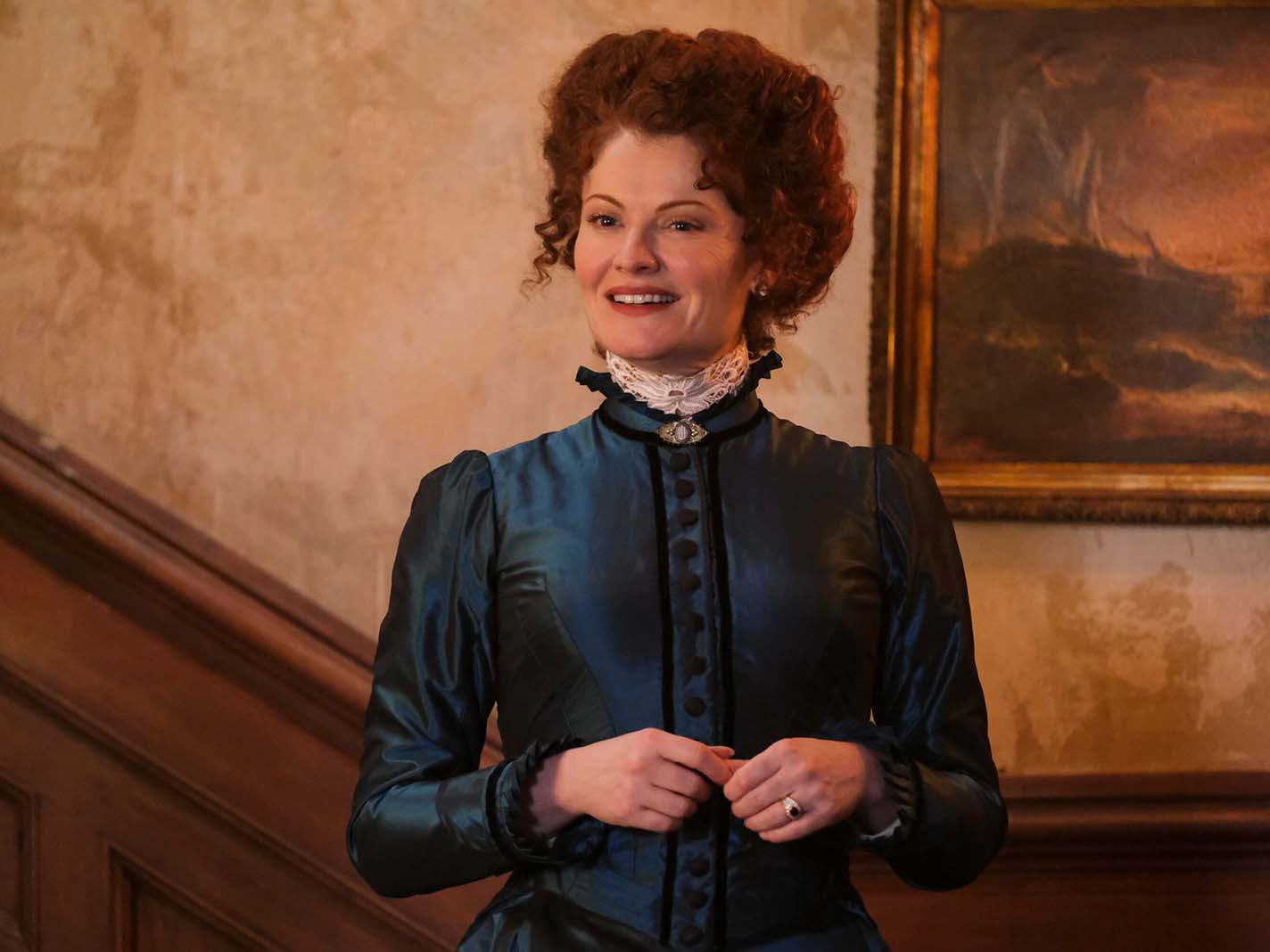
At the moment, few TV shows nail character development as thoughtfully as CBS’ Ghosts. Writers and creators alike understand the importance of planting delicate invisible strings that tie the arcs together in a transcendent and emotionally earned manner. With the episodes evenly dispersed, there’s no ghost left behind (unless, of course, you’re Crash). However, we need to single out Hetty Woodstone’s character development, which continues to be the most surprising treasure in the massive estate.
In many ways, Hetty is just as crucial as Sam and Jay. She is the only other Woodstone ancestor in the series thus far, pushing her characterization to be even more significant. Additionally, Hetty is a complex conundrum of sorts, which Rebecca Wisocky consistently amplifies with such natural layers that it’s always an absolute pleasure to watch her evolve. She goes from a closed-minded, self-satisfying robber baroness to one of the most selfless and loving characters, making for the kind of growth that always feels wonderful to bear witness to.
Why Hetty Woodstone’s Character Development Feels Earned

Hetty’s character development stands out because when we look back, we can see all the seeds the writers planted into fruition. We can carefully piece together a puzzle that takes someone from who solely cares about cocaine and her estate to someone who’d do anything for her friends, including revealing her longest-kept secret: the cause of her death.
Ghosts Season 3 is full of incredible storylines left and right, but it’s the eighth episode, “Holes Are Bad,” which poignantly lays everything bare. When Sam and Jay are out of town, the ghosts realize Flower is alive, but they have no way of physically getting her out of the well that’s trapping her. “Holes Are Bad” also marks a big revelation about Patience (a Puritan ghost we briefly see in the finale), as it places Hetty center stage to openly exhibit how she is braver today than she was before.
When every method of getting Flower out of the well fails, Hetty steps up, revealing a hidden telephone cord wrapped around her neck. The episode seamlessly utilizes a flashback to unveil that when she had no other option but to protect her son, Hetty took matters into her own hands. Suicide is a challenging subject to explore, and writers who aren’t careful shouldn’t be adding it into narratives. It isn’t something that can merely be made a plot device if it doesn’t make sense for the character’s journey. Yet with Hetty Woodstone, everything locks into place when we learn the truth about her death.

It starts to make sense why she would stick to the fact that she died from an overdose and poke fun at it because she can’t do the same when it comes to her actual death. She can’t talk about it because the son she was trying to protect ended up murdering the woman who later became one of her best friends. In her mind, everything is convoluted and unclear. We get the sense that this truth consistently plagues her far more than the purgatory she’s stuck in. Further, it takes an undeniably skilled actress to wear a plethora of emotions on her sleeves, and that’s what Rebecca Wisocky does brilliantly as she later tries to talk things through with Isaac and Sam.
Additionally, the revelation gives us insight into Hetty’s growth because she exposes her truth for a friend who might not exactly remember what her secret costs. (Although Flower being Flower, it’s clear when she thanks her that even if she doesn’t remember, she can see the depth of Hetty’s heart at that moment.) It’s during this episode that we understand that Hetty no longer cares about how the other ghosts perceive her because she cares too much about them and wants to protect them at all costs.
The woman who once solely wanted to be alone, revered, and feared is the same woman who’s now willing to do whatever it takes to ensure that her friends are safe and happy. Most importantly, what makes the story organic is that Hetty doesn’t do a complete 180; she’s still very much the fiery matriarch of the house, but she’s more open to love and friendships, and that alone is a small but monumental detail worth celebrating.
Ghosts Gives Hetty a Second Chance at Motherhood

The details we get about Hetty Woodstone’s death make it more apparent how she isn’t trapped in the mansion because of wrongful doings but because this is her second chance at motherhood. She could’ve been ascended (or, “sucked off,” as the ghosts say) when she chose to forgive her ex-husband Elias. That didn’t happen. It also didn’t happen when she told Alberta the truth about who murdered her. Season 3 gives us multiple scenarios to see reasonable ways for her to finally leave this earth behind, but it never happens.
It makes sense now more than ever that this is her way of getting to know real, lasting love again. She isn’t just someone who needs to take care of people, but those around her need the love that only she can provide. This idea is especially true for Sam, whose relationship with her mother was rocky. Sam needs Hetty as much as Hetty needs Sam. Flower needs Hetty. Alberta does, too. Maybe somewhere down the line, even Patience will. As Hetty takes care of those she loves, she understands the significance of second chances and unyielding loyalty. Here, people around her know the weight and vitality of her actions. They see her value, and they’ll stand up for her as she does for them.

The best character journeys allow viewers (and other characters) to see the value in complexities and how jagged pieces fit together to fix what’s broken. Ghosts Season 3 continues to take steps toward showcasing how it isn’t coincidental that these characters are stuck together. There’s a reason for everything, and it’s a promising reminder that, if nothing else, things will work out in favor of each of them.
What are your thoughts on Hetty Woodstone’s character development in Ghosts? Let us know in the comments.
Ghosts returns to CBS this Fall.
