
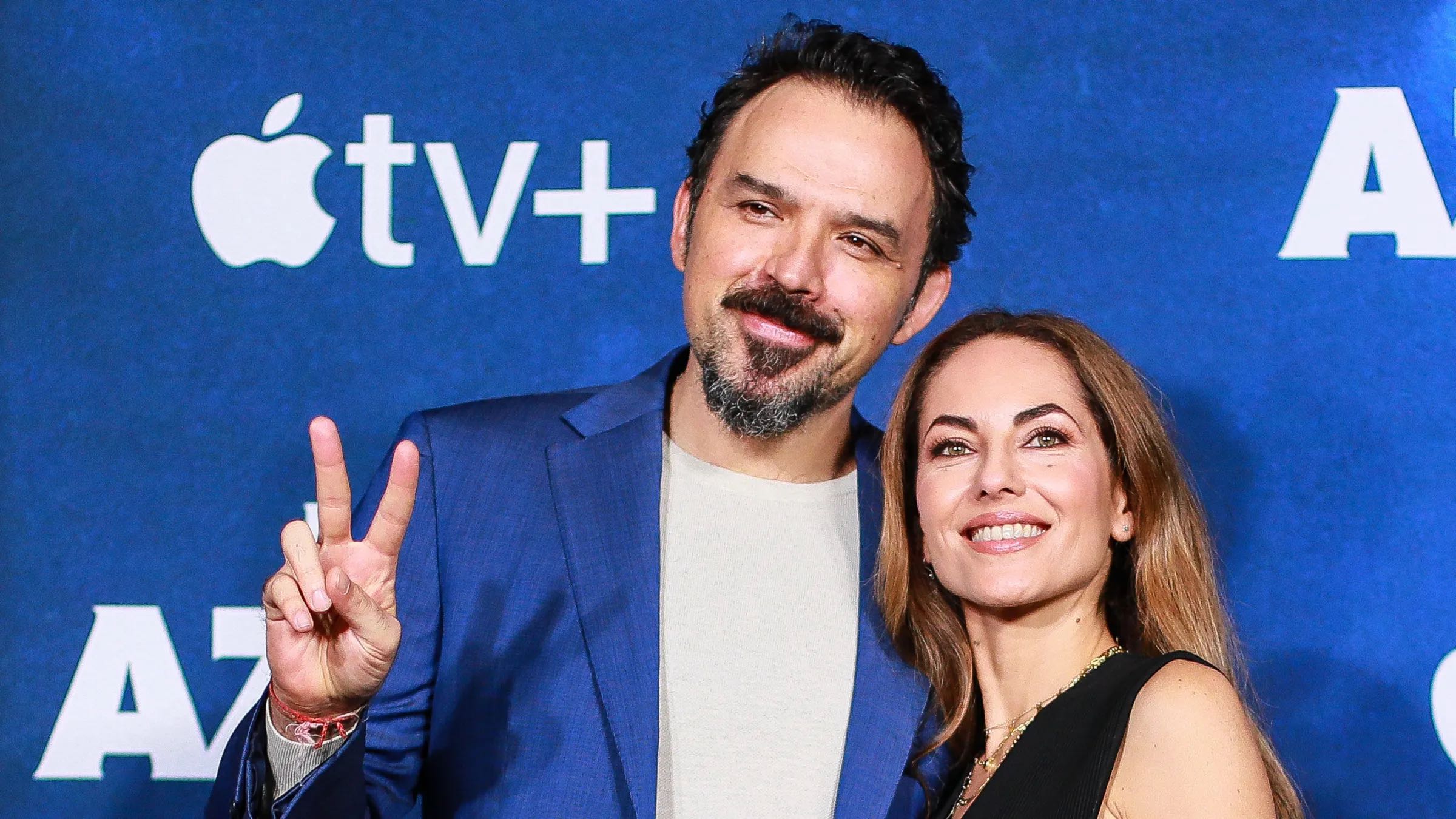
Women in Blue is still on our minds! After the end of the first season, we sat down to talk with Bárbara Mori and Fernando Rovzar, star and executive producer of the show respectively, to talk about the importance of telling a story with clearly feminist overtones like Women in Blue and to dissect that last scene that left us with our hearts in our mouths.
Ready?
Here we go!
Considering everything that happens in the last episode of the season of Women in Blue, in terms of everything that is recognized professionally to María and the other Women in Blue and everything that is not recognized to them, in addition to what happens in their personal lives, Bárbara Mori and Fernando Rovzar shared their thoughts on why the ending is so bittersweet.
Rovzar shares that she tried “to portray what reality unfortunately is. It’s the reflection of what this type of victory would be like in my country, Mexico. Because we realize how much more we still have to conquer and that the system we seek to change has secondary measures to continue limiting a complete victory. A single victory doesn’t change the world and that is a bit of what I think we wanted to portray: this is a fight that, although María, Ángeles, Gabina, and Valentina began in 1971, women today, in 2024, in Mexico, continue to fight. So I didn’t want to conclude as if to say ‘and from that, everyone was happy,’ because the reality is not that.”
Bárbara Mori agrees with Rovzar and adds that “the reality of Mexico is that, today, more than 3,000 women are killed within a year and that is a sad reality that has been normalized. For everyone, that is something that happens commonly in our country. Back then [in 1971] it wasn’t like that, the number wasn’t that big and now we’re getting worse. So I think that this series does portray many things about our society today, despite being a series that talks about more than 50 years ago.”

“It’s a series that touches on issues that we still have to resolve and that, as in this case, have worsened. So on that side, it’s alarming, that’s why it’s important to talk about those things. On the other hand, I think that María, Gabina, Ángeles, and Valentina represent these women who at the time were the pioneers, they were the first female police officers who created, let’s say, the bases, so that today women can carry weapons. So, the work they did in those years has been very significant for our society,” she confessed.
Speaking from this feminist perspective, which is impregnated in all the episodes of Women in Blue, like we can see in its trailer, Fernando Rovzar told us how it felt for him to reflect this female perspective and how he worked to make it as accurate as possible, in addition to everything he learned from the experience.
Rovzar admits that he learned a lot and is grateful for “the opportunity to have been on this project because, despite having a mother who works and takes care of children at the same time — very much like Maria —, having a wife in the same situation, and having two wonderful teenage daughters who are getting to know the world of adulthood, for the first time I felt that writing needed a lot of that perspective to learn, to be able to be open and to contribute to the plot, but also to be able to listen. And we had two phenomenal writers on this series. Wendy Rice, who is one of them, is a tremendous American writer who worked on a huge series in the United States and fell in love with Women in Blue. And also Sylvia Jiménez, an incredible Spanish writer who lives in Mexico, with whom I was also in the writers’ room. And so I think that what we finally achieved was a perspective where together we understood that the series is not only about the system that has conditioned women to live a certain reality but that same system also conditioned men to live a certain reality.”

“Men are also repeating patterns that were taught to them by their father, by their grandfather, by society. And we realize that not only the four Women in Blue, but all the characters in the series have an opportunity to look at themselves and decide if they want to be who they really want to be in life or if they want to continue being what society dictates. So I think that the beautiful thing is that we all achieved a certain empathy for all the characters and tried to give them that opportunity to change. The change that the women propose, as the series clearly shows, has a kind of domino effect on their personal lives. Brothers change, parents change, husbands change, children change. Because it is not only the change of four women, women are the first domino and the rest of the world feels the effect of that,” he ended.
Speaking with Bárbara Mori and Fernando Rovzar about the last scene that we see in Women in Blue, which left us quite intrigued and thinking that the story could continue in a second season, both of them gave us their impressions and confessed some behind-the-scenes secrets.
Mori comments that the ending “is open because anything can happen.” In addition, she tells us how the filming of the scene was. “We spent the whole morning filming the scene. And just five minutes before the last take, when Goyo stood up and left, it was a sunny day, with the birds singing, and suddenly we did that last take where the rain started to fall. And it was very exciting because it was almost like a message from heaven as if pointing out that the story didn’t end there and also all the danger that Maria was in at that moment. In other words, there were so many messages within that event that it was very emotional for everyone.”

Rovzar agrees and mentions that “it was amazing.” He also shares that “in the real story, in that period from 1970 to 1976, there was a Mexican serial killer named Gregorio Cárdenas who killed four women in the late 40s and was locked up in Lecumberri for more than 30 years. President Luis Echeverría was the one who released and forgave him. And not only did he release him, he invited him to the Senate to give a speech about second chances and this shows us an important thing about Women in Blue, which is that the very program aimed at creating a team of female police officers was a way to distract people. It was initially a program with no intention of advancing the struggle of women, but with the full intention of making people feel that the police were trustworthy and releasing this murderer of four women without any reason, simply to be able to tell one more story of how Mexico was on the right path, was something that shook the country.”
“So, taking that inspiration, we realize that Maria also has to understand that all actions have consequences. And when you play in a system as deceitful as the Mexican political system of that time, you have to understand that anything you do can be used against you. For me, the ending of being able to free Goyo and his having this idea of ‘I am light or I am darkness,’ at the end of the day is a little nod to the people who like the show and, if enough people watch it, then we will certainly be ready to do a second season,” he pointed out.
Check Out our Women in Blue’s Interview With Bárbara Mori & Fernando Rovzar
With stories of female empowerment and deep characters like those in Women in Blue, Mori and Rovzar are leaving a mark on the entertainment industry, proving that women’s narratives, told with honesty and courage, can and should be the center of attention. Hopefully, they get the chance to come back for a season 2!
Women in Blue is available to stream on Apple TV+.
