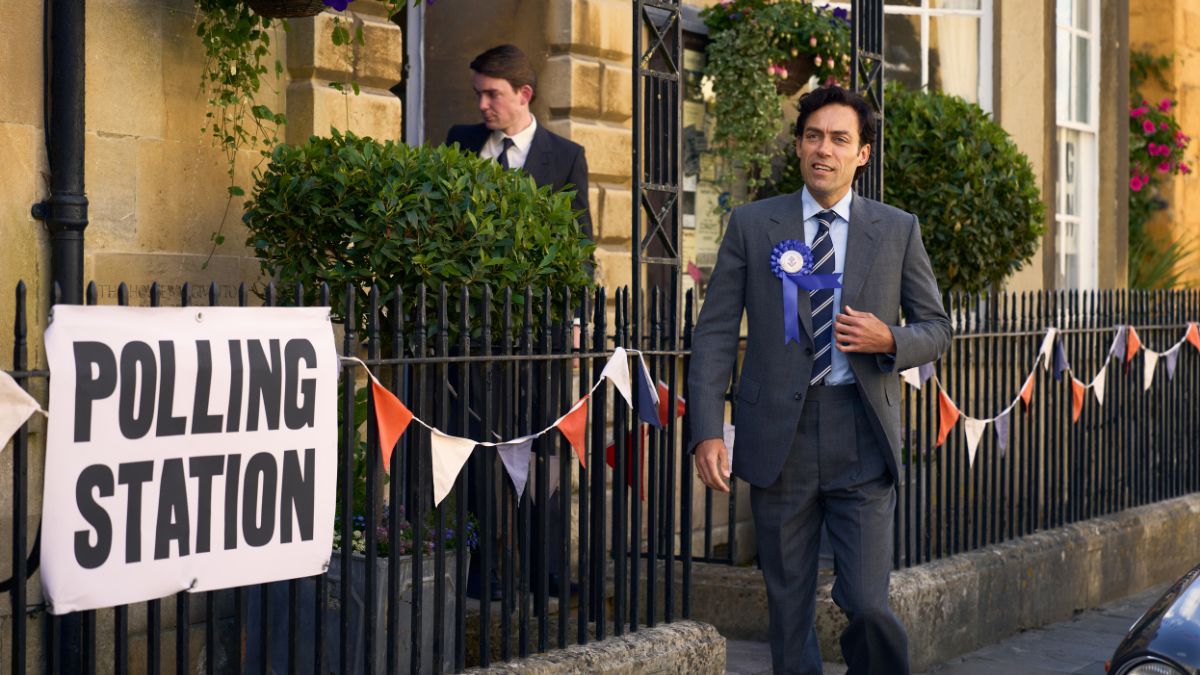
Game-changing decisions are made as the general election coincides with a vote about Venturer’s future in Rivals Season 2, Episode 3. This episode, written by Dominic Treadwell-Collins & Laura Wade and directed by Elliot Hegarty, makes literal debates about morality and responsibility gripping television in its universe and for the audience of Rivals. It’s a smart choice on the episode’s part to sparingly – when compared to the previous episodes – use needle drops. Then, Rivals earns the punch of Joy Division’s “Love Will Tear Us Apart,” making it the perfect note to end on. That’s a technical example of how this episode spotlights the show’s skills with pacing, payoff, and emotional depth.
Rivals has an ever-growing ensemble that could become quite sprawling and impossible to maintain. This episode proves the opposite is true with Rivals. For example, they may have smaller parts in these first three episodes, but I love what this one (and the others) does for Gerald and Charles. Their discussion about Gerald’s place in politics is nuanced and interesting. Even Caitlin gets that great bit about Thatcher being Prime Minister forever. In case you ever doubted it, this episode is a reminder that Rivals is a confident adaptation of a book written and set in the 1980s. It approaches the characters and their stories through a multi-layered lens, both then and now. It embraces it all to create some of the best and juiciest storylines on TV right now. As it ends its three-episode premiere, Rivals confirms that it’s operating on another level.
MORE: What’s New and Leaving Hulu in May 2026

Rupert’s Past Catches Up to Him
This episode puts a spin on Beattie Johnson’s memoirs from Dame Jilly Cooper’s book by giving them an audio/visual component. It works for Rivals because the information reaches everyone else, including Taggie, so much faster, letting it snowball better. That bombshell from Corinium tees up all of these great conversations about accountability and consequences within Venturer, which I would love to see even more of moving forward. At Corinium, Rivals also takes the time to explain the personal motivations there – Beattie is hurt, and Tony is vengeful. Meanwhile, Cameron feels understandably protective of Rupert.
Rivals capably and quickly prioritizes all of these voices. All the while, Declan is skeptical of Beattie’s assertion of her journalistic integrity. That slip of paper in Season 1 proves that Declan knows more about Rupert than Beattie’s tape recorders. This episode relies on Aidan Turner’s talents to showcase Declan’s internal conflict. Rather than Declan over-explain what he’s thinking, Rivals will catch a look from Turner that says it all. Rivals also folds in these characters like Malise (Rupert Everett) and Helen (Hayley Atwell). I could write a thousand words about that Rupert and Malise scene – it’s one of the show’s best. There’s so much substance in every bit of action or dialogue. There’s all this history between Rupert, Helen, and Malise. It’s thrilling to see Rivals play with it. That one-on-one scene with Helen and Malise does so much heavy lifting.
It’s actually a relief that Rivals gives Helen the space to have that reaction. Atwell lets Rivals into Helen’s mind when she opens up about how the public will view her as an embarrassment for forever being associated with Rupert, while he continues to succeed. Just as quickly as Rupert succeeds, though, it all comes crashing down around him. His MP seat, his Minister of Sport position, and his spot at Venturer fold. Again, Rivals doesn’t need to be too heavy-handed in where that leaves Rupert because it’s all in Alex Hassell’s expression and physicality when the camera visualizes Rupert’s world turning upside down.
MORE: Rivals Season 2, Episode 2 Review: Daughters and Dinner Parties


What Does It Take for Someone to Change?
Rivals also has all of these incredible character discoveries happening in and around the election. The coverage of which at Corinium gives Freddie and Lizzie these blissful moments to just be together, but they’re also bittersweet. Their scenes are always fleeting. Still, they get these achingly tender, revelatory moments, like Lizzie saying she married James because he asked, while Freddie married Valerie because he loved her. Through his son, Wayne, who’s going the extra mile at Eton for Valier, Freddie starts to realize that maybe he’s staying married to Valerie to make her happy. But what about his happiness?
As for Lizzie, I really like the comment she makes about Rupert’s friends showing up for him and helping steer him on the right path. That lands particularly well after Lizzie and Sarah kinda hold Rupert over the fire about how he treats Taggie in Season 1. With this episode, I didn’t anticipate how much I’d enjoy seeing Sarah be by Rupert’s side and grate on Cameron’s nerves because Sarah won’t go home. Again, Nafessa Williams is so good in this episode. Whether it’s Cameron realizing what she says when she admits – to Patrick, of all people – that she loves Rupert or her reaction to “The Chicken Song,” Williams just doesn’t miss a single, wide-ranging beat.
Emily Atack also keeps a golden streak going with the range of emotions Sarah Stratton experiences on Rupert’s couch alone. I love where that emotional release leads her – reclaiming a bit of the power in the marriage when Paul retains his seat. Likewise, Rivals picks back up with Maud, who understandably takes Tony’s offer as the lead in Corinimum’s A Midsummer Night’s Dream. Declan is practically painfully uninvolved and uninterested in Maud’s work, so it’s nice to see her take on something else for herself. It also works in Tony’s favor. He is so calculating that he’s made Monica think that they’re on the same page with their plans for the future. Meanwhile, all Tony has done is shift his focus to Declan, with Maud’s help. David Tennant really makes that spark in Tony’s eye glow. But what does that mean for everyone else this season?
MORE: Rivals Season 2, Episode 3 Review: Uncensored Discoveries on Election Day
—
