
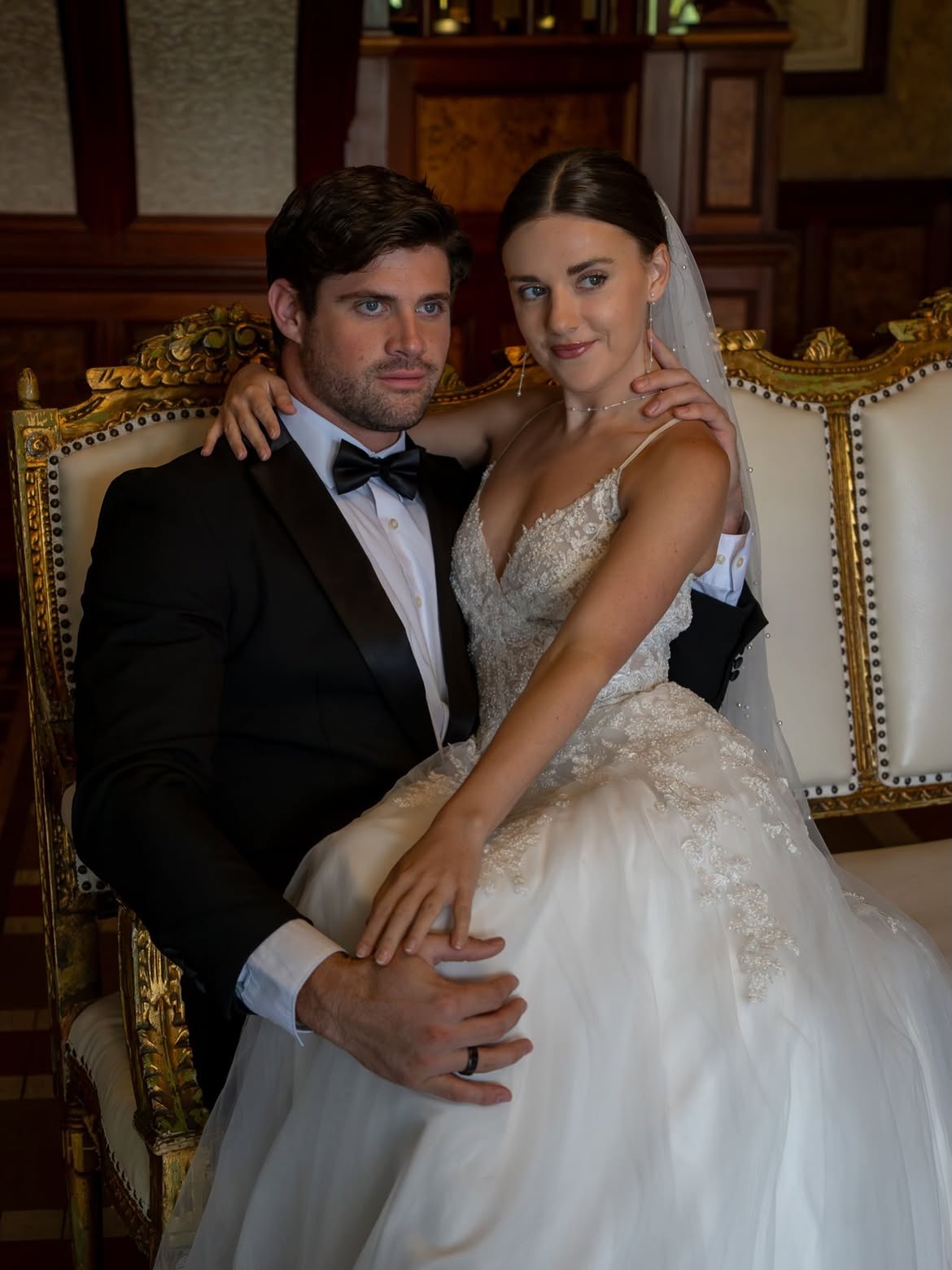
Me After You Is Quietly the Best Thing These Two Have Done
Where to watch: Me After You is streaming now on TikTok, where you can binge the whole thing in roughly the time it takes to convince yourself you’re only watching one more episode.
If we’re handing out crowns in the vertical drama space – and I think we should, quietly, with intention – Erin Orcutt and Cayman Cardiff are already wearing them. Their newest vertical, Me After You, just dropped on TikTok, and it functions as a reminder in case anyone forgot.
There’s something almost unfair about what these two do with the format. A vertical gives you a minute, maybe ninety seconds, before the cliffhanger yanks the floor out. That’s the whole architecture: emotional intensity, no room to breathe, no room to build. And yet Orcutt and Cardiff keep finding the breath anyway. They find a way for the viewer to be unable to breathe because the intensity with which they deliver characters leaves the viewer breathless.
They locate the small, private human moments inside the chaos and hold it there just long enough for you to feel it, and which drives you to unlock the next one like a person with no self-respect. Which, fine. Guilty.
Let’s be honest about the genre
Nobody stumbles into a billionaire willing to solve their fertility timeline over a coffee shop conversation – though that is genuinely the premise of A Deal with My Billionaire Donor, which these two carried. Nobody’s fated mate is also their sworn enemy and also secretly a werewolf CEO. The premises are engineered, deliberately and expertly, for maximum trope density. That’s the product.
We buy any of it because of performers like Orcutt and Cardiff. They treat the absurd circumstance as a given – no winking, no apology – and then go looking for the emotion underneath the words. They find it, and they deliver it. The text is normally ridiculous; but these two – they make the feeling true, and the ridiculousness stops mattering because at some point you are simply rooting for them, regardless of context.
What Orcutt returns to the script
Orcutt has been described as bringing something both vulnerable and strong to her leads, playing women who read as actual people rather than trope delivery systems. In a genre this stylized, that’s not a small compliment. It’s the whole job. The scripts hand her an archetype, and she keeps returning a person – someone with a history the script never wrote, who has clearly been surviving something for a while before we got here.
What Cardiff undercuts
Cardiff is built to be cast as the immovable object. The alpha, the anti-hero, the man who fills the frame and makes the room smaller. What makes him interesting is that he spends every episode dismantling that. He plays the crack in the armor before the script asks for it — sometimes before the character would notice it himself. So you’re never really tracking his dominance. You’re tracking the exact moment he stops performing it, and what’s underneath turns out to be softer and more frightened than the costume suggested.
The chemistry question
Me After You is these two at their finest, and it puts a fine point on something I’ve been noticing for a while: Orcutt has a rare kind of on-screen chemistry, and so far she’s found it with exactly two scene partners — Cardiff, and Shay Dinneen, who she’s sparked with in Legally Sexy and Mr. Ice Cold and again in Can’t Get Enough of You.
What I like about it is that it isn’t one-directional. She pulls something out of both of them — a willingness to be uncertain on camera, to let a scene be quiet. And they pull something out of her right back, a groundedness she doesn’t always get to use. It’s reciprocal, which is genuinely uncommon and completely impossible to fake.
Teresa
Teresa is the girl her family takes for granted. The day her mother was buried, her father came home with a new wife and a stepsister. He simply forgot her. Since then, she’s been treated as an outsider in her own house — an inconvenience, even while doing everything she could think of to make them proud.
That last part is the detail that guts me. Not the neglect. The effort. Teresa is still trying. She has built her entire personality around being useful to people who have never once looked up, and Orcutt plays that with a kind of exhausted competence that feels specific rather than tragic. There’s something beautiful about Teresa’s spirit — she’s working so hard to be a pillar of strength while privately terrified she’ll never be enough for anyone.
And that’s the fracture the whole series runs on. She isn’t afraid of being unloved. She’s afraid that being loved wouldn’t change anything, because the problem is her. That’s a much lonelier fear, and it’s the reason her family’s cruelty works on her at all.
Noah and the tenderness problem
Her family forces her into a marriage alliance with Noah. And Noah is — kind. Sweet. Patient. He doesn’t ask much of her, gives her space, protects her without making a production of it. He clearly wants more and won’t push for it, because he’s afraid too.
Here’s the ache: she kind of wishes he would. She doesn’t want him to be this timid. But if she says so and he pulls away, she loses the one steady thing she has, so she can’t commit fully either. Two people being carefully gentle with each other and accidentally building a wall out of it.
It’s such a smart engine for a story like this, because the obstacle isn’t a villain or a secret twin or an amnesia plot. The obstacle is that neither of them has ever been shown that wanting something out loud is safe. Cardiff is very good here — all that physical presence pointed at restraint instead of pressure, which is a much harder note to hit.
And what she hasn’t said publicly, she has already decided privately. Her heart is committed. She just can’t find the shape of the sentence.
The nepo wife problem
Noah wants her to trust herself. But more than that, he wants her to trust him. He wants the world to know she’s his everything, because she genuinely is, and he’s tired of being a secret.
She doesn’t want anyone to know they’re married. And her reasoning is airtight, which is what makes it so frustrating to watch: she wants to get somewhere in her career on her own. Not as the nepo baby. Not as the nepo wife. She wants to earn it.
Which sounds like ambition, and it is. But watch where it goes.
The math she learned at home
Because that same instinct transfers directly into the marriage, and that’s the part I think is genuinely brilliant writing. She doesn’t feel like she earned Noah either.
Think about what she grew up inside. Love in that house was conditional, and the condition was performance — be useful, be quiet, be impressive, and maybe your father remembers your name. So she learned that affection is compensation. Something you’re paid for labor completed. And by that logic, Noah makes no sense to her. She didn’t do anything to get him. He was handed to her by the same family that never wanted her. So either it’s not real, or she’s going to be found out.
She doesn’t understand why he would love her, because nobody has ever loved her like that. She has no reference point. He’s speaking a language she was never taught, and she keeps trying to translate it back into the only one she knows, which is transactional.
Where the two fears meet
So the career thing and the marriage thing are the same wound wearing two outfits. “I need to earn this myself” is a beautiful, self-possessed sentence in a boardroom. In a bedroom it becomes “I can’t accept something I wasn’t charged for.” One version of that instinct will build her a life. The other one will cost her the only person who has ever seen her clearly.
And Noah’s whole role in the story is to keep standing there while she works it out. Not fixing it. Not arguing her out of it. Just refusing to leave, which is its own kind of argument.
She deserves that love, and he’s begging her to see it. Begging her to say it back.
But she does. That’s the thing. She already does — she just hasn’t found the way to hand it to him yet.
The patience is the love story
His patience is the most endearing thing in the whole drama, and it’s also the most narratively disciplined. People try to hurt Teresa constantly, and Noah lets her handle it. Not out of indifference — out of respect. He understands, somehow, that stepping in too early would only confirm what she already believes about herself: that she can’t do this without someone rescuing her.
So she deals with it on her own. And she presses forward at every turn, every opportunity, absorbing the hits and going back to work. Over time you can watch the confidence assemble itself in real time — small at first, then structural. Orcutt plays that accrual really carefully. It’s not a montage transformation. It’s a woman who stops apologizing before she speaks, and then one day stops flinching.
Determination too. Sharper than confidence and harder to take away from her. It stops mattering who’s trying to destroy her, because she’s decided she isn’t going anywhere.
When he finally moves
And then, yes — at a certain point he does step in. He has to. She’s been set up to take the fall for something she didn’t do; her stepsister engineers it to look like Teresa stole company secrets. She didn’t.
So Noah steps forward and explains, plainly, that he bought the company under her name.
I had to sit with that one. Because look at what it does. It clears her, obviously. But the reason it’s devastating is that he did it long before this moment, quietly, expecting nothing — he made sure she had the legacy she’s always wanted, and he never said a word about it. No credit taken. No leverage held over her. The woman who couldn’t accept a gift she hadn’t earned has been holding one the entire time.
And it reframes the whole nepo wife anxiety in the most generous way possible. He didn’t hand her a shortcut. He built her a door and let her decide whether to walk through it on her own steam, which she did, repeatedly, before she ever knew it was his. She earned it. He just made sure the room existed.
The legacy she always wanted, and the love she always deserved. He arranged both and then waited for her to believe she was allowed to have them.
What it’s actually about
That’s the beauty of a story like this. It’s not outlandish plotting, though the plotting is delicious and I won’t pretend otherwise. It’s the story underneath — figuring out your own worth, and the love you actually deserve.
It’s about not selling yourself short. And more than that, it’s about not letting the people who have sold you short be the ones who define what you’re worth. Teresa spent her whole life accepting her family’s math. The romance isn’t the reward for surviving that. The romance is just what happens once she starts doing the math herself.
Me After You is easily worth the watch. It’ll give you that giddiness — of loving someone, and of the much scarier thing, being loved back. That swooping, slightly unsteady feeling of being seen clearly by a person who isn’t going anywhere.
Which is why I’ll keep watching these, one coin at a time, with no shame whatsoever.
