
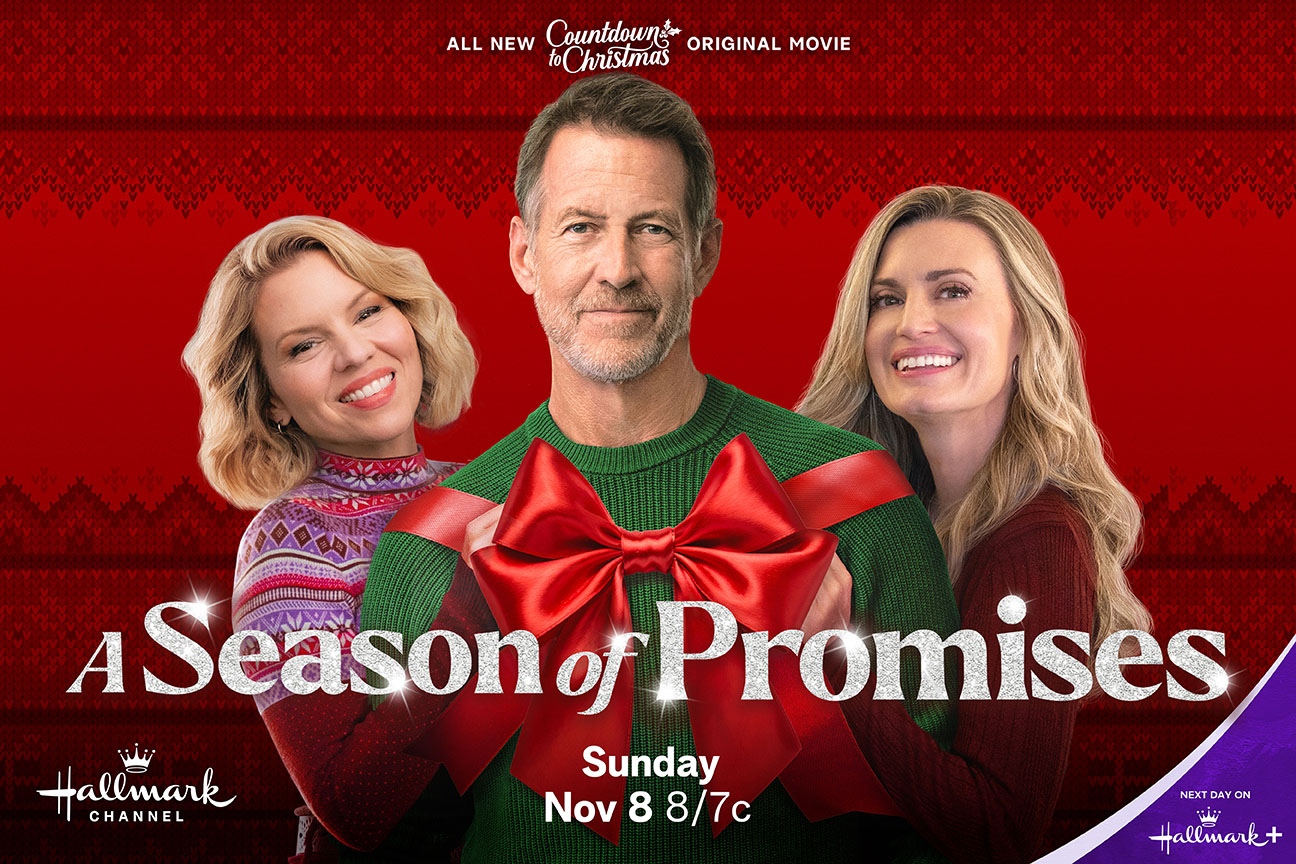
It’s easy to talk about Christmas movies like we already know everything they’ll give us. A meet-cute. A misunderstanding. Two people finally admitting what everyone else figured out an hour ago. And listen, I love those things. There’s comfort in knowing that, for a little while, the world is going to be soft enough for love to win.
But there’s room beneath those Christmas lights for other kinds of love stories.
A Season of Promises makes room for two sisters who have lost their mother and, somewhere in the aftermath, lost their way back to each other. Heidi (Brooke D’Orsay) and Sophie (Ali Liebert) reunite when their father, Ed (James Denton), lands in the hospital after a fainting episode. Worried about him spending another Christmas alone four years after their mother’s death, they decide to help him find companionship. But that shared mission also brings them back into the relationship they’ve been avoiding: their own.
That’s the part of this story that matters most to me. Sometimes the person you need isn’t someone new. Sometimes it’s the person who remembers your life before everything changed.

Grieving Doesn’t Mean Having the Same Grief
Grief can make you desperately want someone to understand you while leaving you without the words to explain what hurts. It can turn a conversation into an argument because anger feels easier to express than the thing underneath it.
I don’t know how to do this.
I needed you, and I didn’t know how to ask.
That’s what makes the distance between Heidi and Sophie so sad. Their disagreements may look small from the outside, but calling them trivial doesn’t leave much room for what those disagreements might be carrying.
Sometimes you aren’t arguing only about what someone said. You’re arguing about every phone call that didn’t happen. Every moment you felt alone. Every time you looked at someone who was supposed to understand and wondered why they seemed so far away.
Heidi and Sophie have very different personalities and ambitions. Heidi is focused on landing a professional hockey play-by-play job, while Sophie is pursuing stand-up comedy and working as a waitress. Their mother’s death is part of their shared history, but it hasn’t brought them to the same place.
They lost the same mother. They didn’t necessarily lose the same relationship, the same routines, or the same version of themselves.
One sister’s way of surviving doesn’t automatically make sense to the other. But different doesn’t have to mean wrong. Before they can repair anything, they have to stop treating understanding as something that should happen without a conversation.
Loving someone doesn’t mean you can read her mind.

Why the Sister Relationship Is the Heart of This Story
There’s something about sisterhood that makes this kind of distance hurt differently.
A sister can remember the sound of your mother moving around the kitchen. She can recognize the expression you inherited from your father. She can hear a family story and know exactly which part you’re leaving out.
She knew you before the résumé, before the carefully managed answers, before you learned how to tell people you were fine and make it sound convincing.
That doesn’t make the relationship easy. Sometimes it makes it harder.
The person who knows your history can also know where you’re most vulnerable. Familiarity can become an excuse not to ask questions. You think you already know why she made that decision, why she didn’t call, why she reacted that way.
And suddenly you’re responding to the sister you remember instead of listening to the woman standing in front of you.
That’s why I don’t think being “built-in best friends” is quite enough to describe what Heidi and Sophie need from each other. Sisters don’t owe each other effortless closeness simply because they grew up in the same house. A relationship still requires care. It requires apologies that don’t come with an explanation of why the other person was also wrong.
Most importantly, it requires curiosity.
Who have you become since we stopped talking?
Have I misunderstood?
What did you need that I never realized you were asking for?
Their shared history gives them something worth protecting. It doesn’t do the work of protecting it for them.

HelpING Their Father Gives Them A PLACE to Begin
There’s something very Hallmark about two estranged sisters deciding that what their widowed father needs for Christmas is a little matchmaking. It gives a painful family situation some warmth and humor without removing the sadness beneath it. Their plan to help their Dad, Ed date is the practical reason they begin working together again.
But what interests me is how much easier it can be to focus on someone else’s life than to talk honestly about your own.
Helping Dad gives them a task. Something to discuss. Something to disagree about, that isn’t immediately the wound between them.
They can talk about his happiness before they’re ready to admit what happened to theirs.
And while their concern comes from love, there’s an important tension in deciding that someone else is ready to move forward. Four years may sound like a long time when you’re counting from the outside. That doesn’t mean Ed experiences those years the way his daughters do.
Heidi and Sophie need to offer each other grace and they need to talk to their father. He needs to listen before deciding what healing should look like.
You can open a door for someone, but cannot decide when they’re ready to walk through it.

Christmas Makes the Empty Places Harder to Ignore
Christmas is supposed to bring everyone home.
But what happens when home no longer feels the way you remember it?
The decorations can be familiar. The traditions can be the same. And still, someone’s absence changes the entire room.
That’s what makes Christmas such an emotional setting for this story. It asks Heidi and Sophie to return to a family that still exists, but no longer exists exactly as it did when their mother was alive.
There’s no recreating that earlier version perfectly enough to make the loss disappear.
And there’s no way to love each other well if they spend every Christmas measuring what remains against what can never come back.
That doesn’t mean abandoning traditions or pretending the holiday doesn’t hurt. It means allowing Christmas to hold more than one feeling.
They can miss their mother and laugh and worry about their father and feel hopeful for him.
They can be angry with each other and still want to find a way through.
A happy moment doesn’t make the loss smaller. It means there is still something here worth being present for.

Moving Forward DOESN’T Mean Leaving Each Other Behind
What draws me to A Season of Promises is that its emotional center isn’t simply the possibility of finding love after loss.
It’s the possibility of finding your way back to someone who has been grieving beside you—even when “beside you” has started to feel very far away.
Heidi and Sophie don’t need to become the same person. They don’t need identical ambitions, matching personalities, or one agreed-upon way of missing their mother.
They need to recognize that the other person’s pain deserves to be heard without becoming a competition.
Their father’s health scare brings them into the same room. But fear can only begin the conversation. If they want a relationship beyond the emergency, they have to choose it in the ordinary moments, too.
Their mother’s absence is already something neither of them can change. Their absence from each other’s lives doesn’t have to be.
That’s the Christmas promise! Not that this family can return to who they were, but that they can make room for who they are now.
And that two sisters can look at everything they’ve lost, look at each other, and decide there is still a relationship worth reaching for.

You Can’t Decide What Healing Looks Like for Someone Else
What Heidi and Sophie need to understand is that loving someone doesn’t mean knowing what’s best for them. Sometimes it means being willing to admit that you haven’t asked.
They want their father to be happy. Of course they do. They love him, and seeing him in the hospital makes the possibility of losing another parent feel frighteningly close. Giving him something to look forward to becomes something they can do in a situation where so much feels outside their control.
But helping Ed find companionship cannot become a way to avoid talking about their mother. And focusing on his loneliness doesn’t make the distance between them disappear.
That’s where the story’s matchmaking premise becomes more than a holiday setup. In trying to help their father open his heart, Heidi and Sophie have to consider how tightly they’ve closed their own—not necessarily to romance, but to honesty, vulnerability, and each other.
It’s easier to arrange a date than to tell your sister that she hurt you.
It’s easier to discuss someone else’s future than admit how much of your own life is still shaped by an absence.
But those are the conversations this family needs. Not because one conversation can fix four years of hurt, but because silence hasn’t fixed it either.

Making Room for a Different Christmas
I don’t need a Christmas movie to tell me that everything will be okay by December 25.
What I want is a reason to believe that something can change.
A Season of Promises finds that possibility in sisterhood—in the idea that two people who have misunderstood each other can stop, listen, and try again.
Its most meaningful love story is the one that asks Heidi and Sophie to see beyond their differences without pretending those differences don’t exist. They don’t have to want the same life to take an interest in each other. They don’t have to grieve in the same way to offer comfort.
What they need to do is just have to stop assuming that the other person no longer needs them.
That feels especially important at Christmas, when there can be so much pressure to make everything beautiful that nobody wants to admit what hurts. Sometimes the kindest thing a family can do is leave room for the sadness instead of treating it like something that will ruin the celebration.
There’s room for all of it.
And there can be room for happiness, too—not because they’ve finished grieving, and not because their mother matters any less, but because loving her doesn’t require them to stop living.
For me, that’s what makes this story worth sitting with. Beneath the matchmaking and Christmas plans are two sisters who cannot change the loss that pulled them apart, but still have a say in what happens between them next.
They can’t bring their mother home for Christmas.
But they can answer each other’s calls. Pull up another chair. Tell the story they both remember.
And when one of them says, “I miss her,” the other can finally be close enough to say, “I do, too.”

