
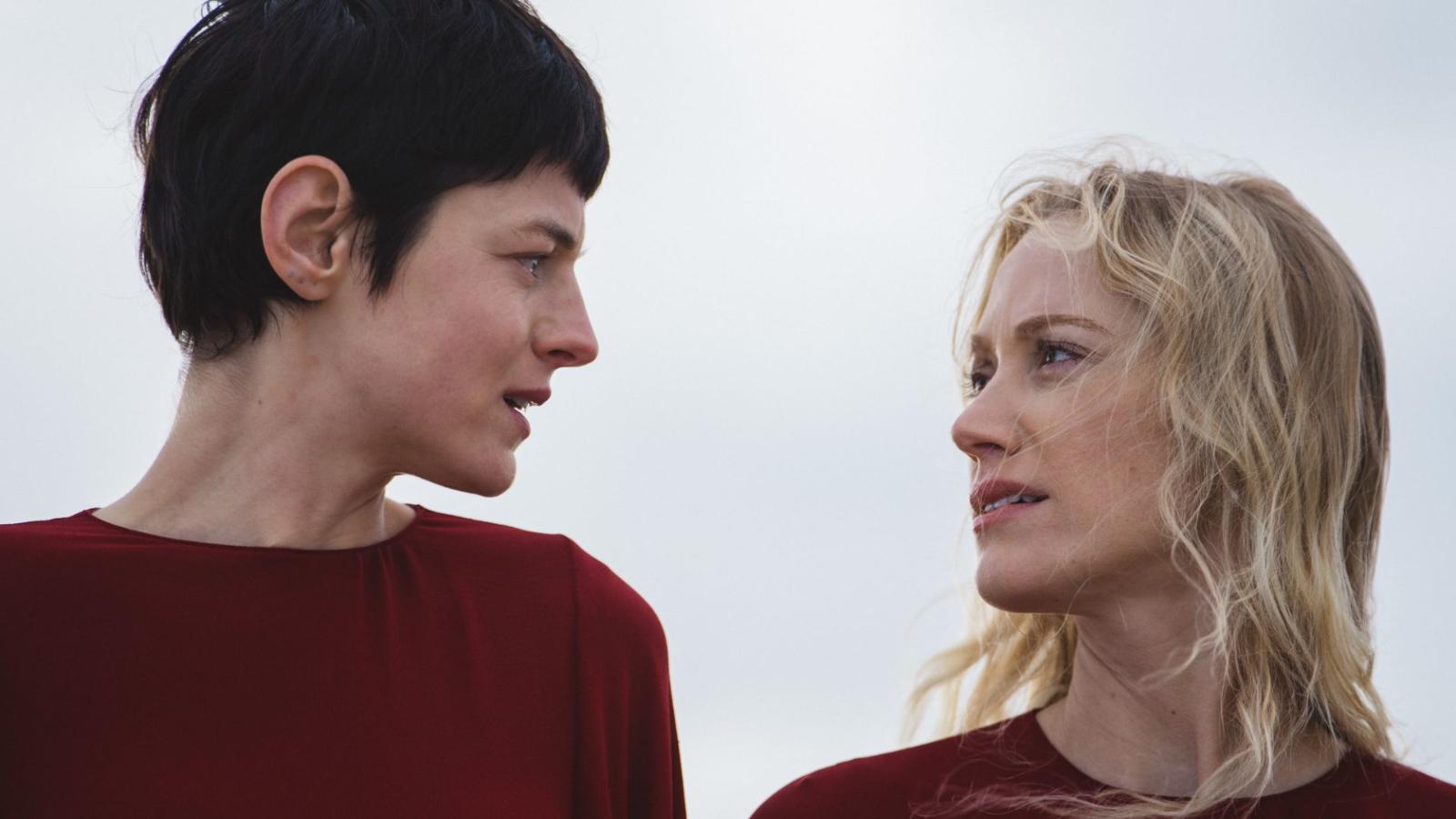
100 Nights of Hero is the reason why so many people want to destroy the arts. Storytelling, especially in the form of film and TV, is a way for us to step into the shoes of other people and their experiences. It humanizes, demystifies, and recontextualizes the fear-mongering we grew up with or are constantly bombarded with. That what 100 Nights of Hero did with the love story of Hero (Emma Corrin) and Cherry (Maika Monroe).
But before we dive into that, I want to address something.
Coming into this movie I wasn’t sure what to expect. But one things for sure. I expected Nicholas Galitzine, who plays Manfred, to have a bigger role. The conversation online surrounding this movie seemed to center on him. And I think at the end of the day, centering it around him (even if unintentionally) hurt 100 Nights of Hero. Because he’s a great actor, sure. But the queer community hungers for LGBTQ+ stories. Just look Galitzine’s own Red, White & Royal Blue.
After watching 100 Nights of Hero, I hunger for more stories like Hero and Cherry.
MORE: Lesbian Space Princess Review: A Colorful & Life-Affirming Coming-of-Age Story

Hero is Cherry’s maid in a world that feels like a reflection of our own but with a little twist (and some of the best costume design I’ve seen in years.) Everything from the rules oppressing women to the clothes feels familiar but from a far off place. That allows the viewer a degree of separation as Hero weaves this fairy tale for Cherry to keep Manfred’s affections away from her. In a way it reminds me of One Thousand and One Nights. But instead of Scheherazade and a king we have a maid as a part of a secret organization of storytellers centered around the often forgotten and disposed of stories of women.
In this world, who women are and what they should be is strictly controlled by men and their whims. You die if they get tired of you and don’t want to sleep with you. You are labelled a witch if you can read. And you are to be wed and bred as that is your only duty in life. Hero presents Cherry with something different in her stories. She gives Cherry a window into the life she could have, the woman she could be. And her tales recontextualize the stories that Cherry grew up with and that have demonized women.
But it isn’t just about Hero and Cherry.
MORE: Heated Rivalry Episode 5 is a Masterclass in Intimacy. Read more here.

In 100 Nights of Hero storytelling is used as a form of control and defines everyone’s lives. But Cherry isn’t the only one listening to these stories. The guards, the often forgotten spectators, are also listening to these stories. Guards who have homes, families, and lives outside of this rich and ravish lifestyle we find ourselves in 100 Nights of Hero. And that revolution that grew in Cherry’s head, that showed her the life and freedoms she can experience, it also revolutionized them, leading to rebellion and the collapse of this restrictive world.
Then there’s the sapphic of it all aka the driving force of this revolution.
While Hero is telling these stories to Cherry, and opening her eyes to what could be, they’re slowly falling in love. In this space that Hero has created, Cherry can ask for what she wants or needs. And Hero can unapologetically be the person she knows she is. Together they explore forbidden feelings, tender yet blazing touches, and become a part of the fairy tale that destroys the oppressive forces they live under while giving people, especially women, a chance to tell their own stories without fear of punishment.
But there is one thing about their story that I’m not so sure about… [MEGA SPOILERS AHEAD WARNINGGGGG]
MORE: Steal Away Review: A Film Not Too Far From Our Reality. Read more here.

Hero and Cherry die at the end of 100 Nights of Hero. They are given a choice: admit their sins and be forgiven or fall to their deaths. In front of the oppressive regime, and those who have been changed by their story and are demanding their freedom, they choose each other. Hero and Cherry don’t ask for forgiveness or regret their choices. They love each other and choose to end their lives on their terms. This moment sparks a furious revolution that burns the regime to the ground. But it’s bittersweet.
LGBTQ+ stories often don’t have a happy ending. And if film and TV are a reflection of our reality, these mediums are telling us that we don’t get happy endings. That’s why the ending of 100 Nights of Hero leaves me feeling conflicted. On one hand I understand that fairytales are more The Brothers Grimm than Disney. Often times the lesson we learn is bittersweet but with purpose. And Hero and Cherry stood true to their love and became the kind of legend that toppled kingdoms. But on another hand, I wanted them to live and see the fruits of the revolution they sparked.

The fact that we see Hero and Cherry welcomed to an afterlife by the Moon does ease some of my discomfort at them dying. It reminds me a lot of Lost and how controversial that ending was. The most important part of Jack’s life was the time he spent with the cast of characters on Lost. So maybe I need to reframe Hero and Cherry’s ending in that manner.
The moments they spent together were the most important part of their lives. That’s why they ended up in an afterlife together. Hero needed Cherry. And Cherry needed Hero. To remember. To let go. But also to spark the kind of legend that brings hope to people like them and reshapes the world in a way where their love isn’t forbidden. It’s the norm.
100 Nights of Hero is available on digital.
What did you think of 100 Nights of Hero? Let us know in the comments below!
Queerly Not Straight posts Saturdays on Fangirlish with opinion pieces, listicals, reviews, and more focused on the LGBT community. Posts are ONLY published on Fangirlish.
