
If you watch vertical dramas, I bet you can remember your very first one. Mine doesn’t really matter. I was sick, doom-scrolling to pass the time, when I stopped on one of those ridiculous little ads. And somehow, against all logic and better judgment, I downloaded an app. Then another. And that went on for a while.
That was the beginning of my relationship with verticals — a relationship that has since cost me over a lot of room on her credit card and so far has watched more than 400 verticals.
In that time I’ve learned a lot about the space. Budgets are usually low, scripts can be wildly repetitive, and somehow — no matter the plot — there is almost always a kidnapping somewhere in the mix.
And honestly? I say all of that with love.
Because despite the chaos, the over-the-top twists, and the fact that some of these stories feel like they were written at 2 a.m. on caffeine, boredom, and emotional damage, I genuinely love this genre.
I love how addictive it is.
I love how unapologetically dramatic it can be.
Vertical dramas understand entertainment in a way many larger productions have forgotten — they understand fandom. They lean into what pulls people in: drama, chaos, and emotional stakes. And at the same time, they’re clearly evolving, because fandom itself is always evolving.
And fans of vertical dramas want more.
That’s where Super Punchy Studios comes in — founded by screenwriter and director Salvador Paskowitz and business partner Timothy “Timo” Nelligan. The studio aims to reshape the medium, and in its first major vertical, they brought in Nicole Mattox, Seth Edeen, Molly Anderson, and Haley Lohrli. Anderson and Lohrli are strong in their own right, but Step by Step is ultimately carried by Mattox and Edeen — their chemistry and emotional weight are what land the story.
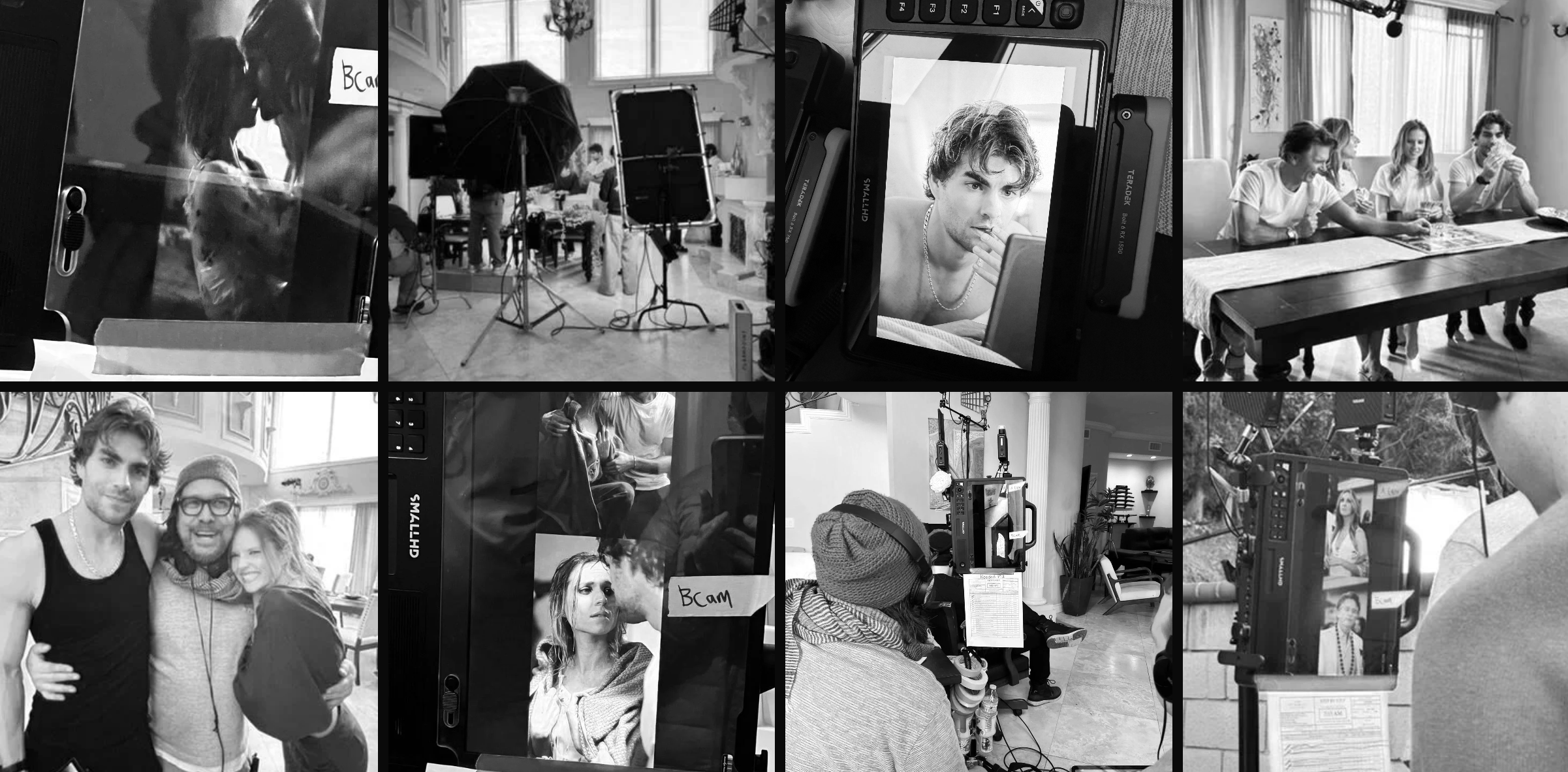
From the beginning, Step by Step feels like something different. It doesn’t feel like a cheaply made vertical designed for quick shock value. It feels intentional. Cinematic. The kind of project that makes you stop passively watching and actually engage with what’s on screen.
The production value is genuinely impressive. Every shot feels purposeful, like a Hollywood-style production adapted for a vertical frame rather than constrained by it. Lighting, costuming, and color grading all feel carefully designed to shape emotion in every scene.
And I loved that.
I loved that the direction trusts its audience. I loved the camera choices and scene composition. Most of all, I loved that it avoids the usual vertical formula of dramatic extremes — no constant kidnappings, no random slap-for-drama moments, no exaggerated chaos for its own sake. Instead, it leans into something harder: realism. It shows how people actually respond to emotionally complicated situations. Every scene becomes another step — literally and emotionally — in the evolution of a family, and of two people shedding who they were in an effort to figure out who they might become and who they have settled for being.
That’s what makes it stand out. It feels like a vertical actively trying to evolve the genre rather than recycle it.
Then there’s Nicole Mattox and Seth Edeen. To me, they’re already A-list vertical actors. I’ve seen enough of their work to know their range, but too often the format boxes performers into similar roles. This didn’t. This felt like both of them finally being given space to stretch. It showcased their talents, rather than confined them.
It feels like I’m watching a movie because I am watching a movie. Though verticals are short and digestible moments, Step by Step is cinematic and these two are its A-list talent.
Their chemistry is undeniable. This isn’t their first collaboration, but it’s the first time they feel fully realized as a pair on screen. In Step by Step, they aren’t repeating familiar dynamics — they’re playing characters who feel new, specific, emotionally flawed, and deeply lived-in.
The story leans into the “step-sibling” trope but doesn’t rely on it. What matters is them. They elevate it beyond cliché. You don’t sit there analyzing the setup because you don’t realize the trope, but instead you realize that you are watching talent that has such strong chemistry, you somewhat feel like they carry a doctorate in the science. Every glance, pause, and almost-moment carries weight on both the viewer and the actor. And more than anything, you’re rooting for their characters constantly, screaming when they make stupid choices, and scream at your phone – especially when they’re apart.

Piper (Mattox) is a disciplined political professional balancing control, expectation, and emotional restraint. She needs to learn to let go. Parker (Edeen) is still trying to figure out who he is and where his life is going. He needs to learn to hang on.
They begin with a one-night stand, only to discover their lives are about to collide in the most complicated way possible: their parents are engaged, and they’ll be living together for two weeks as their families prepare to become one big happy family.
As Piper navigates family pressure and responsibility, Parker becomes the unexpected emotional counterweight she didn’t know she needed. With declarations (what those are you’ll have to watch to find out) she becomes his. Neither feels complete alone, and that imbalance drives everything between them. Everything happens for a reason, and these two characters don’t just fall into each other; they reveal each other.
What stands out most is how much Mattox and Edeen elevate the material, owning not only the lines but carrying it across in their characters physicality, but also in the place where it really can make you forget its fiction. What is that? They carry the emotion that they are giving in their eyes. You believe in their happiness, sadness, and their love.
The vertical space often underestimates performances like theirs, but Step by Step makes their craft impossible to ignore. Mattox and Edeen‘s chemistry feels grounded, unforced, and emotionally precise.
Their performances feel like a statement. They aren’t just working in the genre — they’re shaping it. And while they already stand out, there’s a sense this is only the beginning. It can be said that these two, and performances like theirs – help redefine what the medium can be.
They don’t just feel like vertical actors here — they feel like what they are — movie stars.
But what makes it work is that the characters still feel human. They feel like people you know — the kind you want to yell at for their decisions while still understanding exactly why they’re making them. That balance is difficult, and they nail it.
Even the “step-sibling” trope — which can be divisive — is grounded in emotional complexity rather than scandal. The characters are flawed people navigating stigma, vulnerability, loneliness, desire, fear, and the possibility of happiness alongside the risk of pain.
That emotional realism is what lingers.
I didn’t love the ending (because I thought I knew what was coming but I was wrong) but I respected it. More importantly, the ending leaves space for a possible continuation, and for the idea that these characters are still becoming who they’re meant to be. I appreciated – while watching – that neither Parker or Piper fully realizes they’re improving — not for each other, but for themselves.
Vertical dramas are often chaotic, exaggerated, and not always kind to their characters or their audience. But this feels different. Grounded. Respectful. Emotionally aware. Beautifully shot. It shows that vertical storytelling doesn’t have to sacrifice depth for accessibility.
This feels like the direction the genre should be heading.
Because the medium works. Vertical dramas absolutely have potential. The future, though, belongs to stories like this. If more projects embraced that level of intention in writing, performance, and craft, the genre wouldn’t just grow — it would (as it should) be taken seriously.
