Interviews are strange. You open a zoom window, come face to face with someone you don’t know and ask questions. You hope that the questions aren’t intrusive and that you won’t let say something that you will regret. For me, I have intense brain fog and I was worried I wouldn’t be able to keep up with Salvador Paskowitz. He’s one of the founders of Super Punchy Studios – a new company creating movies in the vertical medium.
And yes, I said movies, because that is exactly what they are. If you are not familiar with verticals, you should be. If you’re on Tik Tok or Instagram these days, you can’t avoid them. These are short-form, serialized dramas (often 1–3 minutes per episode) filmed in a 9:16 aspect ratio, making them perfect to watch while holding your phone upright on apps like TikTok, Instagram Reels, or dedicated drama apps.
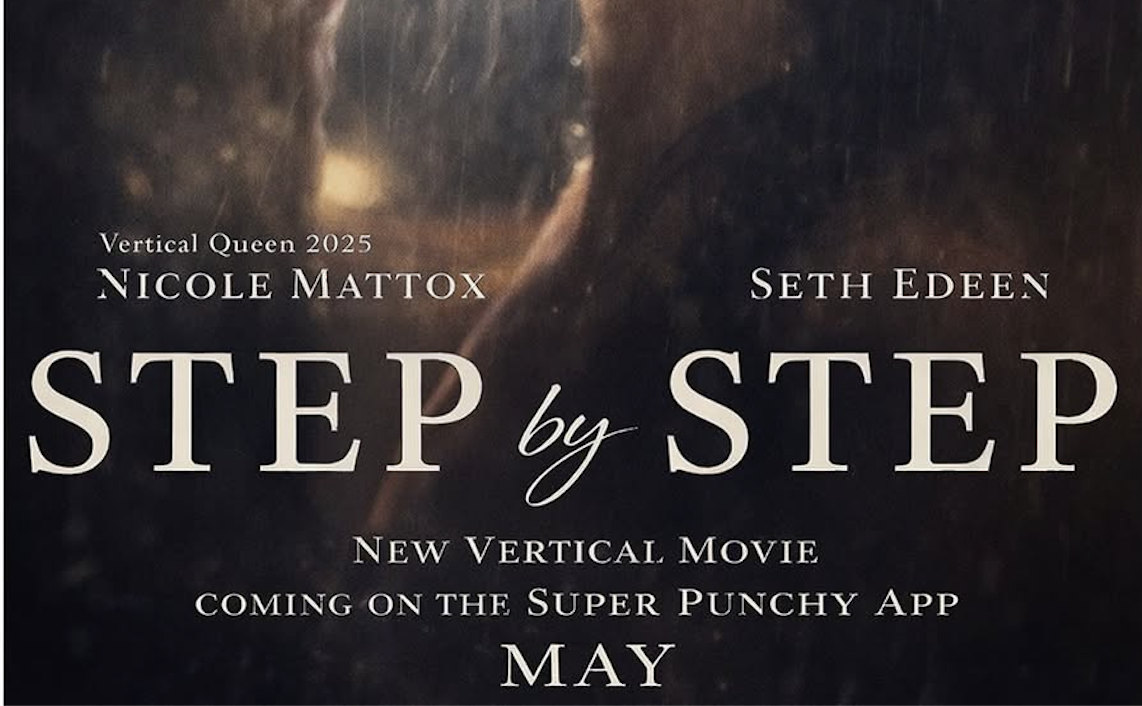
With the creation of Super Punchy, they decided to create their own app. Their first movie? It’s called Step by Step, and is directed by Paskowitz. He managed to cast some vertical drama heavy weights in the movie – Nicole Mattox, Seth Edeen, Haley Lohlri, and Molly Anderson. Along with his team, he created a vertical that felt cinematic.
LOGGING IN
Paskowitz was waiting as I logged into zoom. I had thought that PR rep was going to join us, but I was wrong. So we just started talking – with me finding myself telling him how much I loved the cinematic feel of Step by Step.
I couldn’t help but notice Paskowitz’s laid back attitude that was instantly putting me at ease. Maybe it’s that and maybe it’s the fact that we’re the same – our brains all over the place, but always having something to say.
He says, “I am such a sucker for, for cinema and for film and for drama and for melodrama. Who’s there? Who’s right outside there? And, and if we talk to that person and they see us talking, like it’s the end of our lives. To me, that’s so much more interesting than like, okay, well there’s this beam of light and it’s coming down on the city. All right. How big should the beam of light be? Well, let’s make it huge. Let’s make it five miles wide. I have an idea. What about 10 miles wide?”
GROWTH
At first I am confused, but I realize that we’re talking about what has made him want to challenge the formula of verticals, but also make them more cinematic. Challenging the status quo is important and the way we all look at it is different, but it can all be the same.
Things have to keep growing. Things have to keep changing.
“How about 50 miles wide? So it just doesn’t matter. And I think the problem is the, the secret sauce that we have is we just, from our very core, we just love movies and we just, just, there’s nothing to, there’s nothing to pull apart. Like what is Super Punchy doing that anyone else is doing? It’s like, well, you have to love movies to the extent that I, that I love movies.” he said.
I have a tendency to use the word “vertical” because that is what I learned when I started the medium.
Sal and I both give long answers – neither one of us overly succinct. I find that to be okay, because I had a highschool teacher that told me that not being succinct was a sign of a creative mind.
And if Sal and I can have one thing in common – we’re both creative beings. I mention the word vertical again and he says, “The underlying whole guide star, which is, forget this word vertical, just put this word vertical away. Put the word micro drama. What if you just made movies and you made them like this and you made them that they still felt like you say, like, like Aristotle says, there’s only so many and so many, many stories to write. But what if you just made some of these outlandish stories and stuff, but you made them as movies that are actually like a nightmare to them, to the degree that I’m a movie maker.”
MOVIE MAKING
He makes me laugh, because that’s what I do – I laugh in unexpected moments. I do believe that micro-dramas are movies. I have never understood people calling them series. It doesn’t matter to me that they are in small digestible chunks – they are made like movies.
Sal agrees and says, “My crew is all, my DP is a movie maker. My AD is a movie maker. Like everyone that’s involved. I mean, we, you know, it’s, it’s, it’s a little sideline, but it does, I’ve been accused before of being scatterbrained. I think I am. It is my brain. I don’t know what to say, but I do head down these, these passageways. It is a indicator of, of who we are because the way that these productions go, as far as I know, I I’ve heard, I’ve never been on one, but it’s really kind of run and gun and, and, you know, get the thing up and just shoot, you know, a, a, a section here and somebody walked in and it’s okay. And they’re wearing something that isn’t cleared. It’s okay. And from, from our barest bone, from our production, we really treat it as movies. Like we, we make sure that everyone basically has like union rule breaks.”
The reality is that Sal comes from a movie making background. The director wrote a movie that I think that a lot of us know – The Age of Adeline. He knows the movie business. He is a movie maker. His foray into the microdrama space is a natural progression.
BACKGROUND
“It really is the best of both worlds for me because I come from the traditional moviemaking side, which has really kind of been beat up a lot lately. Somehow you have all of these, all of these big companies, much more than much more money is flowing through the river, flowing through the system than ever. But somehow development is now small. It’s like, it’s like back when The Age of Adeline development was big but the income river wasn’t that big. Now the river is gigantic, but development is gone.” he says.
So the transition to verticals (sorry – micro-dramas), he says, allows me to take cinema and put it over here where it’s a ragtag team of tree fort making and it’s much more creatively inclusive” and that, “It’s like eating cotton candy. It’s like every day is fantastic. I love that. What an incredible surprise to have the actors be so amazingly kick ass.”
Some of the actors in micro-dramas are so talented but they aren’t given the opportunity for more or the recognition because of the medium. Super Punchy is advancing the medium in little ways right from the beginning. The production value is definitely leaps and bounds above alot of the verticals that are out there.
COLORING
Everything – down to the coloring. Everything is intentional and in my opinion it is that way to envoke emotion from those watching. It sets a mood, so I asked about it.
“I literally got to the color because the colorists were like, ‘we don’t know what you want. Can you just give us a guide?’,” he said, “So I went, okay, here’s every frame colorized. So they were like, this is amazing. It was just because it wasn’t work for me. It was like, I just really want this thing to feel intentional.”
Everything felt intentional. That is a part of what makes this vertical so different. Things were not done to shock the viewer, but rather to pull the viewer in. It really changed the way that the movie felt.
We understand that micro-dramas are a business and yes we’re aware that the object is to make money. However, it doesn’t have to feel like that. That may have something to do with Super Punchy’s philosophy.
She said, “Here at Super Punchy, our our philosophy is humans first. We see we may be wrong in that philosophy. It may it may yield. It may not be fruitful, but our notion is humans first, which is actors first stories first.”
