
Charlie Florek a man literally running from his emotions, but if we’re being honest, most of the people in Barry’s Bay are doing just that.
When we are young, everything is measured in summers. It’s not just a line from The Summer I Turned Pretty; it’s the reality that a lot of us live with. The way that when we look back, we are defined by the lessons that we learned during the summers.
We are defined through first loves and first heartbreaks. We’re defined through joy and pain. We’re defined through things that we’re supposed to matter so much, but obviously do not.
Percy is only 15 in the summer of 2013. It’s crazy to think about how being 15 changed everything.
ICE CREAM LICKING
Summer 2013 is the first time the show really starts acknowledging that Percy and Sam aren’t kids anymore. This is the summer when the two have begun to realize that they each have their own lives.
Their relationship has existed in this safe little bubble. They’re best friends who spend every summer together. Everyone can see how much they care about each other, but neither of them is particularly interested in acknowledging it or saying it out loud.
Everyone else, however, is very interested in saying it out loud.
Delilah spends the summer of 2013 – the entirety of this episode — treating Percy and Sam like a problem that needs solving. A romance that needs to begin. She’s convinced the attraction between them is obvious. Percy pushes back because, honestly, she’s terrified of ruining what they already have.
And that’s what makes this stage of their relationship feel so relatable. Percy isn’t worried that Sam doesn’t like her. She’s worried about crossing the line to the point where everything will change.
Because once you cross that line, there’s no going back.
The friendship that has defined their summers — suddenly has something at stake.
While the group is out getting ice cream, Delilah continues her campaign to convince Percy that it’s time to stop acting like Sam is just her friend. Percy keeps reminding her that Sam is standing ten feet away and can probably hear every word, but that does nothing to slow Delilah down.
What makes the scene work is that Percy slowly realizes that the people around her are starting to see her differently.
She’s growing up. Sam is growing up. And for the first time, everyone seems aware of it.
Surprisingly enough, even Percy.
The show has been building toward that realization for a while now. The summers are still magical, but there comes a point where they are no longer filled with innocence. There’s a new awareness between Percy and Sam that even they don’t realize that they have.
Which brings us to the ice cream scene.
Percy doesn’t realize her cone is dripping. Sam immediately notices and casually leans over to lick up all the melting ice cream before it spills everywhere.
It’s a tiny moment, but it’s exactly the kind of thing that makes their chemistry work.
Not because it’s some grand romantic gesture, but rather because it’s weirdly intimate.
The kind of familiarity that only exists when two people have spent years paying attention to each other. Sam knows Percy. Percy knows Sam. That’s always been the foundation of their relationship.
The attraction is there, sure. But what keeps making these flashbacks work is that the show never lets us forget they’re friends first.
WHAT HE ASKED FOR
I’m still annoyed we never got to see what happened in that motel room when Sam showed up at the end of the last episode.
The show ends with what could be a potential shift in their relationship, with Sam showing up at Percy’s door and then immediately skipping past the conversation. Not okay.
When we pick back up, Percy is at Sam and Charlie’s house working on Sue’s obituary.
It is interesting because Taylor was supposed to write it. Sam took a crack at it. Neither of them could find the words. Somehow, the responsibility ends up with Percy.
And honestly? It feels right. Not just because it is her job, but because she was Sue’s honorary daughter. Percy loved Sue. Not in the abstract way people talk about someone they knew years ago. She loved her deeply.
The problem is the lie that Percy tells herself. She keeps pretending she’s emotionally equipped to handle all of this. She’s trying to approach the obituary like it’s a job, but every second she’s in that house proves otherwise.
It’s done because she loves Sue.
She loves Charlie.
And most of all, she loves Sam.
You can still feel how strained everything is. The tension between Charlie and Sam hasn’t gone anywhere. If anything, it’s becoming more obvious the longer,
We also learn one of my favorite details about Sue. Apparently, she spent years telling people the jukebox in The Tavern was broken so nobody would touch it. The truth was that it worked perfectly fine. She just wanted to keep listening to Dolly Parton.
That’s such a specific kind of stubbornness that it instantly tells you who Sue was. Who her sons were.
The episode is filled with little reminders that she wasn’t just loved because she was someone’s mother. She was loved because she was uniquely herself.
Percy downplays what she does, a professional obit writer, almost automatically. It’s something she does a lot. She minimizes herself before anyone else gets the chance.
But Sam pushes back. What I like about the moment is that he isn’t complimenting her because he’s trying to flirt with her. He’s speaking from experience.
His mother just died. He understands exactly who a person was and the stories that are told mean to the people left behind. When he tells Percy her work matters, it feels genuine because he’s one of the few people in the world who can actually explain why.
That’s the thing about Sam and Percy. Even after ten years apart, they still instinctively understand where the other person’s pain lives. They don’t have to explain it. They just know.
Then Percy admits what has been obvious from the moment she arrived.
She loved Sue. Not loved. Loves.
And Sam’s response is almost unconscious – he reaches for her hand. It’s such a small gesture, but it is such a big one at the same time. His hand settles over hers. His thumb moves slightly against her skin. He’s comforting her before either of them has time to think about whether they should be doing that.
That’s what makes the scene feel so intimate.
Not the touch itself.
Rather, the instinct.
You can see it in the way they look at each other. The way conversations become quieter when everyone else leaves the room. The way neither of them seems entirely aware of how much they’re revealing.
That’s what makes the whole thing feel dangerous. The more time they spend together, the less it feels like two people reconnecting after a decade apart.
THE BROTHERS
After finishing the obituary draft, Percy finally leaves the house, which honestly feels like a missed opportunity for us as viewers. Every time Percy and Sam end up alone together, the show keeps cutting away just when things start getting interesting.
Meanwhile, Delilah and Jordie are out golfing, and for the first time, we get a clearer picture of what’s happening in her marriage. Apparently, the separation from Whit wasn’t some impulsive decision. They are spending the summer apart to figure out what they actually want.
Unfortunately, it sounds like Delilah has already figured it out.
They’re done.
Jordie spends most of the conversation being surprisingly supportive. At this point, he’s flirting with Delilah, hovering around everybody else’s business, and somehow always manages to be exactly where the drama is happening.
Sir, pick a lane.
Back at the house, Charlie returns from his run to find Sam buried in patient notes. The conversation that follows is short, but it says a lot about where these brothers are emotionally.
Charlie tries to talk. Sam immediately retreats behind work. That’s basically their relationship right now.
Every conversation feels like two people standing on opposite sides of a canyon, neither willing to take the first step across.
When Charlie asks about the obituary, Sam explains that Taylor worked on a draft, but it wasn’t what he needed. That’s why he asked Percy.
On the surface, it’s a practical decision. Percy is a professional writer. Charlie doesn’t seem entirely convinced that’s the only reason.
And honestly, neither am I.
Charlie admits that seeing Percy around again feels like walking into the past. It’s one of the first times someone says out loud what the entire episode has been building toward.
Because that’s what Percy’s return has done to everyone.
Not just Sam.
Everyone.
She’s become this living reminder of a version of life they all lost. Sam quickly points out that Percy is good at what she does, and that’s why she’s helping.
Which may be true, but something is interesting about how quickly he defends the decision.
The second Charlie questions it, Sam gets protective.
Not angry.
Protective.
Then Charlie delivers what feels like the real point of the conversation.
Some things are better left in the past.
It’s advice directed at Sam, but it almost feels like Charlie is trying to convince himself, too. The problem everyone is running into is that Percy and Sam don’t feel like they’re in the past. Every scene between them keeps suggesting the exact opposite.
And I think Charlie sees that before either of them is willing to admit it. He just feels guilty about it.
PASSPORT
I continue to love that Chantal somehow has her own completely separate crisis while all of Percy’s emotional devastation is unfolding. The two of them end up talking in the bathroom, and beneath all the jokes, there’s a real concern coming from Chantal.
She’s worried about leaving Percy alone.
Percy keeps insisting she’s fine. That she’s an adult. That she can handle herself. She isn’t. We’ve spent multiple episodes watching evidence to the contrary.
Percy says she’s okay the same way people say they’re okay when they absolutely are not okay.
Chantal clearly knows it too. She keeps offering to stay. She keeps giving Percy opportunities to admit she needs support. And Percy keeps refusing.
What stood out to me was when Chantal mentioned that Taylor was there.
As long as Taylor’s around, everything will be fine.
Percy doesn’t correct her, and this tells you everything.
Percy knows things aren’t fine. She knows she’s spiraling. She knows seeing Sam again has reopened wounds she spent ten years trying to ignore. She knows the situation with Taylor is a lot more complicated emotionally than she’s letting anyone see.
But she still won’t ask anyone to stay.
That’s become one of Percy’s defining traits. She’d rather carry something alone than admit she’s struggling under the weight of it.
Then, in true Chantal fashion, the conversation takes a hard left turn into a completely different disaster. She discovers her passport has expired.
Which is a nightmare, but also very funny considering how organized and competent Chantal normally is. The woman who has spent the entire trip managing everyone else’s problems is stuck dealing with one of her own.
Percy immediately starts researching solutions and suggests calling Charlie because, apparently, Charlie has quietly become the designated problem-solver for the entire town.
But Chantelle shuts that down. This is her mistake, and she’s going to fix it herself.
It’s a small moment, but I actually liked it because it mirrors what’s happening with Percy.
Both women are struggling and have people willing to help them. However, both women are determined to handle things on their own.
Chantal’s problem is an expired passport.
Percy’s problem is that she’s standing in the middle of a life and in a love she never really got over.

DELILAH IS A LIE-AH
Delilah is once again trying to convince Charlie that whatever is happening between them needs to end. Which would probably be a more convincing argument if she stopped looking at him like she wants the exact opposite.
At this point, they’re having the same fight over and over again. Delilah keeps trying to approach their relationship logically. She’s married, and she knows that her husband is a good guy.
Charlie keeps responding emotionally. However, Charlie finally lands a pretty devastating point.
He reminds her of the first time they slept together.
After years of circling each other, years of bad timing and missed opportunities, they finally got their chance. And according to Charlie, Delilah looked at him afterward and said she’d waited fifteen years for that moment. Now she’s trying to pull back from it.
Delilah insists she meant it at the time.
Charlie’s response is what really matters.
Because he points out that she wasn’t the only one waiting.
That’s the first moment when you really understand how differently they’re experiencing this situation.
Delilah is trying to figure out what comes next.
Charlie is still focused on finally getting something he wanted for most of his life.
Which is why neither of them seems capable of walking away.
Naturally, just as things are getting intense, Chantal walks in. She observes everything and immediately picks up on the weird energy in the room. She may not know exactly what’s happening, but she definitely knows she’s interrupting something.
Thankfully, her passport disaster gives everyone an excuse to stop talking before things get even messier.
Charlie reveals that he actually knows someone at the consulate who might be able to help – Violet.
Before Chantal can even process that information, Delilah volunteers Charlie to take her. Which immediately made me nervous.
Not because of the passport.
Because every time this show puts two emotionally unavailable people in a car together, somebody ends up having a life-changing conversation.
And Chantal and Charlie both feel overdue for one.
THE CAR RIDE
The drive to the consulate quickly becomes one of those conversations where two people accidentally start telling each other the truth.
It starts innocently enough.
Charlie asks about Chantal’s son and immediately realizes he’s stepped into dangerous territory. She looks offended that anyone would think she’s old enough to have a child, which honestly made me laugh.
The conversation eventually shifts to Drew, and Charlie seems genuinely baffled by some of the things Chantal does for her fiancé.
Including Postmating food to a grown man.
Which, to be fair, is a reaction I understood. I can’t understand if it’s a control thing or if she’s genuinely being taken advantage of. Charlie’s whole argument is essentially: Drew is an adult. He’ll survive.
He’s not entirely wrong.
What I found interesting is that the conversation turns into a discussion about ambition.
Charlie admits that part of his success comes from being selfish. Not cruel. Not uncaring. Selfish. He’s willing to prioritize what needs to get done and live with the consequences.
Chantal doesn’t entirely buy his philosophy, especially considering Charlie’s relationship history.
Taking life advice from a man currently having an affair with a married woman may not be the strongest strategy. Still, Charlie makes a point that lands. Both of them got where they are because they put work first.
Because they were selfish.
Then, naturally, everything falls apart.
The truck breaks down.
Immediately, both of their personalities come roaring to the surface. Chantal’s reaction is pure anxiety.
The consulate closes at five. It’s already after four. The timeline isn’t working.
The plan is falling apart.
She’s mentally moving straight to the worst-case scenario where she’s somehow stranded in Barry’s Bay forever.
Charlie, meanwhile, isn’t panicking about the passport. He’s panicking about the truck or what it represents.
His Mom/. And that’s where the scene becomes about grief.
Because suddenly this isn’t just a vehicle.
It’s Sue’s truck.
Season One Every Year After Reviews
- Every Year After Season 1, Episode 1 Review: Every Summer After
- Every Year After Season 1, Episode 2 Review: Young Blood
- Every Year After Season 1, Episode 3 Review: Playing With Fire
- Every Year After Season 1, Episode 4 Review: Anatomy of a Romance
- Every Year After Season 1, Episode 5 Review: I Choose You
- Every Year After Season 1, Episode 6 Review: Plan B
- Every Year After Season 1, Episode 7 Review: The Boathouse
- Every Year After Season 1, Episode 8 Review: Goodbye…
Charlie starts spiraling over all the times he told his mother to replace it. All the times she refused. All the things he wishes he’d pushed harder on.
It’s irrational, but grief usually is. That’s what the episode keeps showing us over and over. Nobody is actually upset about the thing they’re upset about.
Charlie isn’t really freaking out over a broken truck. He’s carrying grief around, and it keeps attaching itself to whatever happens to be in front of them.
The truck just happens to be Charlie’s version of that.
Which leaves him and Chantelle sitting on the side of the road, both convinced their current problem is the end of the world, when really they’re both wrestling with something much bigger.
Meanwhile, Charlie and Chantelle end up stranded after the truck breaks down, and honestly, it might be the best thing that could have happened to both of them.
For all of Charlie’s confidence, most of what drives him seems to come from old wounds. He keeps circling back to the idea that Sue loved Sam more, that Sam was always the favorite, that he somehow came second.
It’s easier for Charlie to believe that than to admit how much he misses his mother.
Grief has a way of turning pain into stories we tell ourselves.
That’s part of what makes this episode so effective. Everyone is grieving Sue, but nobody is grieving her in the same way. Sam disappears into responsibility. Charlie is selfish and lashes out. Percy gets pulled into memories.
None of them is finding a way to forgive themselves.
Or each other.
THAT ONE NIGHT
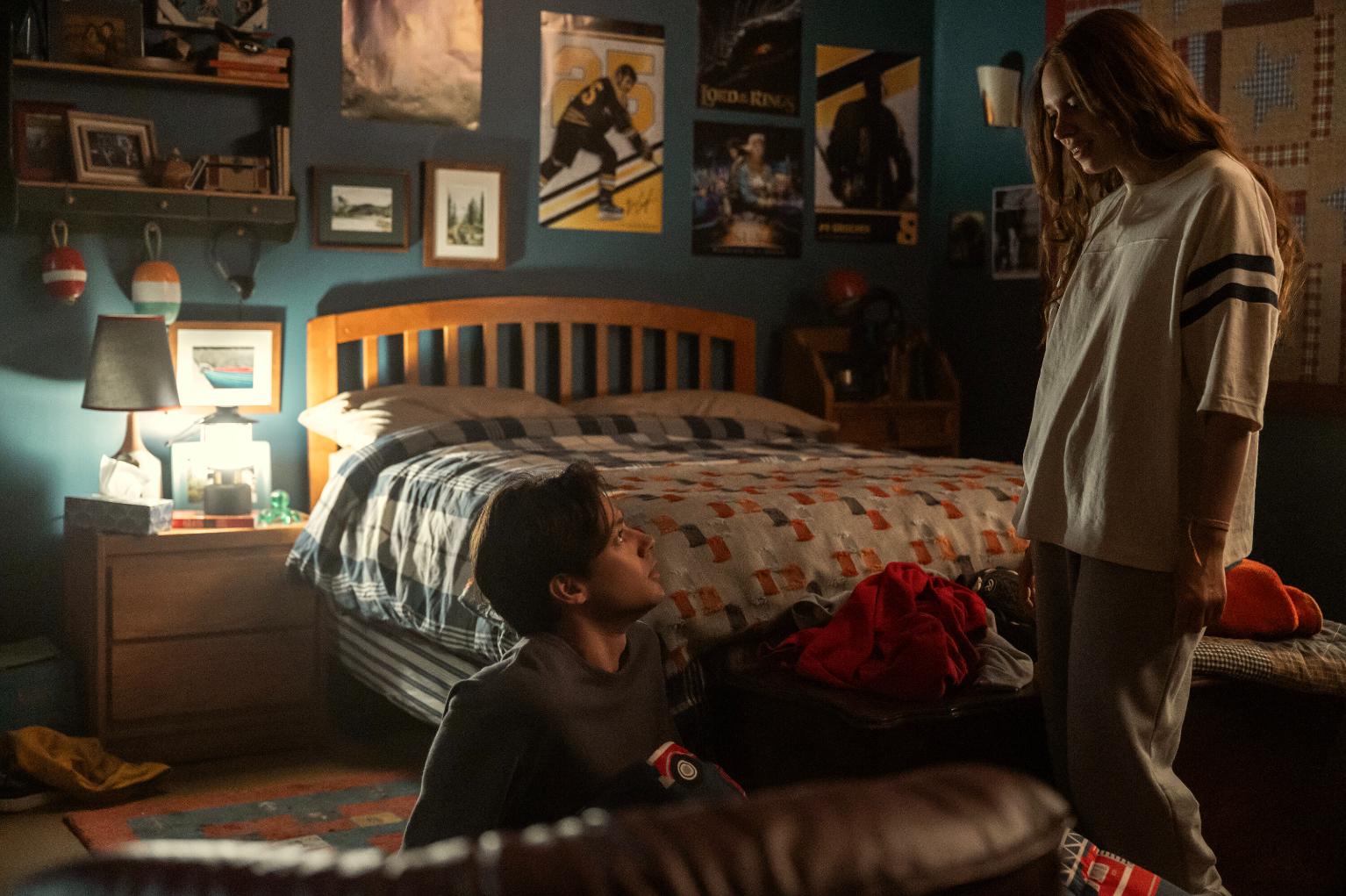
Percy sits down to write Sue’s obituary and immediately finds herself pulled back to the summer of 2013.
What stands out about those flashbacks isn’t that they’re romantic. It’s how safe they feel.
A storm rolls into Barry’s Bay while Percy’s parents are away, and she’s terrified. She ends up at Sue’s house looking for comfort more than anything else. Sam answers the door, lets her in without question, and somehow that becomes one of the most important memories of their relationship.
Because before they were a love story, they were each other’s safe space.
That’s what makes these flashbacks work so well. The series isn’t trying to convince us that Percy and Sam belonged together because they were destined soulmates. It’s showing us two teenagers who made each other feel safe no matter what happens.
That night, they end up sharing a bed, and the moment isn’t memorable because anything happens.
Nothing does.
The important thing about this scene and scenes like this are the things that aren’t said.
The awkwardness and hesitation. The way they’re both hyperaware of each other’s presence. The way Sam reaches toward her before stopping himself. The way Percy looks back to see if he’s still awake. It’s the idealistic part about young love: wanting something desperately and having absolutely no idea what to do about it.
The next morning, the two make it downstairs, and immediately Charlie assumes the worst. What lands isn’t Charlie’s teasing. It’s Sam’s response.
“It’s Percy.”
He means it innocently.
But Percy hears something else.
She hears that she’s been friend-zoned.
She hears a line being drawn.
Every Year After understands how devastating those moments can feel when you’re young. Sometimes heartbreak isn’t rejection; it’s realizing the person you want sees the relationship differently than you do.
The emotional math gets much harder.
Percy and Sam keep finding themselves falling into old rhythms. Finishing each other’s thoughts. Teasing each other. Reaching for each other without thinking.
The chemistry isn’t really the point anymore. The familiarity is, and that is what makes everything feel so dangerous.
They don’t act like two people reconnecting after ten years. They act like two people picking up a conversation that was interrupted.
Nobody knows how to move forward, but can find different ways to stand still.
THE RACE
Percy brings Sam the obituary, and he tells her she got it right. Not just accurate, but true in a way that actually sounds like Sue.
They hug, and it’s one of those moments that doesn’t fully land emotionally for either of them because there’s too much history sitting underneath it. It’s not awkward in a bad way—it’s the kind of pause where both people realize how much hasn’t been said in a decade. For the viewer, though, it lands.
It’s the moment where you see that Sam has fallen back in love with her.
Not that he ever stopped.
Percy tries to leave quickly after that, defaulting back to distance, but Sam stops her and suggests they go out to the raft. Like they used to.
It’s a simple invitation, but it carries a lot more weight than it should. Because nothing about “like we used to” is actually simple anymore.
That’s the part that lingers—not the logistics of the moment, but the realization that life has moved on and somehow – it’s now backsliding.
THE BONFIRE
Summer 2013 is the point where everything starts to shift.
Sam invites everyone to a bonfire, and Delilah tells Percy that it is more than casual. Percy tries to dismiss it as nothing, but Delilah reads the situation faster than Percy is willing to admit.
At the bonfire, the dynamic is already off. Percy and Sam are stuck in that frustrating in-between place where neither of them is honest, but both of them are acting like they are.
Sam introduces Percy to Jordie, and for a split second Percy misreads it as something personal. It lands as another reminder that she’s not actually the version of herself she thinks she is in his life.
Sam and Percy fall into their usual pattern: close enough to feel everything, but never close enough to actually say it. He says the wrong thing, she says it’s fine, and both of them pretend that “fine” means anything at all.
Percy ends up kissing someone else almost out of spite more than desire— more about forcing a reaction she can’t get from Sam. And she gets it. Just not in the way she wants. Sam sees it. And for the first time, the distance between them feels intentional instead of accidental.
Nothing resolves cleanly. They circle each other, almost admitting things, almost crossing lines, and then backing away again. Sam calls what they have “special,” which is exactly the problem—because special is not the same thing as chosen.
Sam and Percy are constantly teetering on the edge of becoming something, while actively refusing to become it.
PEROGIES
Sam invites her to come by later. It’s casual on the surface, but nothing between them ever really is. She agrees, though part of me thinks that she agrees to prove to herself that she can get closure. That she can be around Sam without having to admit what being around him actually does to her.
She shows up at the tavern dressed differently than she needs to be. Not overdressed exactly—just… almost like so he can see she’s grown. He says she looks good, and she brushes it off too quickly for it to be believable.
Everything between them has weight now, even the smallest gestures. Music plays in the background, and the whole thing feels charged in a way neither of them acknowledges out loud.
Sam almost kisses her.
And then Delilah walks in.
Delilah, always known to ruin a mood.
The moment breaks instantly. Not dramatically, just like something snapping back into place that was never supposed to stretch that far.
Percy leaves before anything else can happen, using Chantal as an excuse, because it’s easier than admitting she doesn’t trust herself in that room. Sam is left defending nothing and explaining less, which somehow says everything.
Delilah wants to know what he was thinking.
But he wasn’t.
He doesn’t think about Percy.
Calling Chantal, Percy tries to reset herself. She tells herself she almost did something stupid. That she can’t be the reason Sam’s life gets complicated again.
That leaving is the responsible choice, she thinks. But it doesn’t feel like responsibility.
It feels like an escape.
And as she turns the key in the door, it’s clear she’s not just walking into a room—she’s stepping away from the version of herself that almost stopped running. It is as if it is the beginning of everything she’s been trying not to face, finally catching up to her.
OTHER THOUGHTS
- Jordie and Delilah golfing feels weird
- Has Jordie had a forever crush on Delilah?
- Why is Chantal running away?
- If Drew doesn’t know how to do DoorDash, he needs to grow up
- Wait, what? Is Percy in Sue’s will?
- Why does Charlie always look guilty?
