
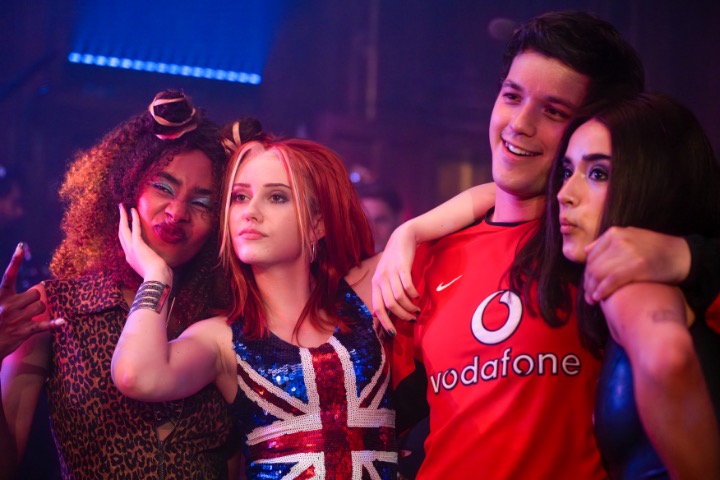
Your Fault: London was one of my most anticipated movies. Yes, I know it’s aimed at young adults. No, I do not care.
The story has me hooked.
It’s basically The Fast & the Furious meets the step-sibling trope with a generous helping of “what in the world is happening?” and somehow… it works.
Not to mention, the books are really good.
Prime Video also deserves credit because they know how to adapt a book. Their adaptations don’t just copy scenes—they make the story feel alive. Sometimes, like with Your Fault: London, you almost forget you’re watching something based on a novel because you’re so invested in what’s happening on screen.
A huge part of that is Matthew Broome and Asha Banks.
These two have ridiculous chemistry. Every glance, every argument, every longing stare—they sell every second of it. They’re helping bring back an era of yearning, messy romance, and unapologetic drama, and I’m here for it.

This movie is full of emotional chaos. You’ll roll your eyes, yell at your screen, and probably end up sending clips to your significant other with a “take notes” caption.
Should anyone actually want a relationship like Noah and Nick’s?
Absolutely not.
Their relationship is messy, toxic, and fueled by questionable decisions. But if you can separate fiction from reality—and remember this started as a book—it’s an entertaining ride.
The chemistry between Broome and Banks is easily the movie’s biggest strength, but it’s the mix of forbidden romance, family drama, and high-stakes emotions that keeps you watching. The first film pulled me in with the street racing. This one kept me invested because I genuinely wanted to know if Noah and Nick could survive everything life kept throwing at them.
I also have to give a nod to the original Spanish films. They leaned into the chaos in all the right ways, and this adaptation captures much of that same energy.
My only real complaint?
I wanted more racing.
Yes, there are a couple of race scenes, but for a franchise that originally grabbed my attention with fast cars and adrenaline, they felt surprisingly limited. This sequel leans much harder into the romance and drama than the action.
The drama absolutely delivers.
I just wouldn’t have complained if we’d gotten a few more cars flying around corners, too.
What hooked me in the first film wasn’t the racing—it was the romance. Sure, the fast cars were fun, but I was invested because I wanted to know if Nick and Noah could actually make it. The enemies-to-lovers dynamic mixed with the step-sibling trope made for an addictive story.
This sequel takes that romance a step further.

Nick and Noah have already admitted they love each other. Now they’re forced to answer a much harder question: can love survive when life is pulling two people in completely different directions?
That’s what makes this movie feel more grounded than the first.
As much as I enjoyed both films, I actually preferred the character growth here. It’s messy, frustrating, and surprisingly realistic. Nick and Noah constantly promise they’ll trust each other and insist no one else could come between them.
Then Bria shows up.
And suddenly all that confidence disappears.
Watching them unravel made me realize they aren’t actually ready to be together. They love each other, but love isn’t enough when communication keeps breaking down. Instead of talking, they let jealousy and insecurity do all the talking for them.
That’s where the sequel succeeds.
Yes, it still leans into the drama, misunderstandings, and forbidden romance that made the first movie so entertaining. But underneath all of that is a story about two people learning that relationships take more than chemistry.
They take trust.
One thing I found especially interesting was how the relationship started to feel unbalanced. Noah seemed like the one doing the emotional heavy lifting, constantly fighting for them, while Nick spent too much time making excuses.
He framed many of his decisions as “protecting” her, but protection without honesty starts to look a lot like control.

And Noah recognized that.
For her, that became a major red flag.
It’s one thing to want to keep someone safe. It’s another to make decisions for them while calling it love. That’s the line this movie explores, and I think it’s one of the strongest parts of the sequel.
One thing I really appreciated is that Your Fault: London doesn’t spend its runtime trying to recreate the magic of the first film. Instead, it stands on its own. It expands the story instead of repeating it, giving Nick and Noah new obstacles that feel more mature than simply “will they or won’t they?”
The emotional roller coaster never really stops, but it’s the ending that completely got me.
Those final few minutes?
Jaw. On. The. Floor.
Now I’m desperate to see what the third installment has in store.

Do I still think Nick and Noah belong together?
Absolutely.
Do I think getting there is going to be easy?
Not even a little.
If this sequel proved anything, it’s that love isn’t the hard part—staying together is.
And honestly, I can’t wait to see what comes next.
Bring on the:
- Drama.
- Intrigue.
- Chaos.
- Racing.
- And, of course… the love.
Because if the third movie delivers all of that, in an innovative way, I’ll be seated. I know many of us will be.
