
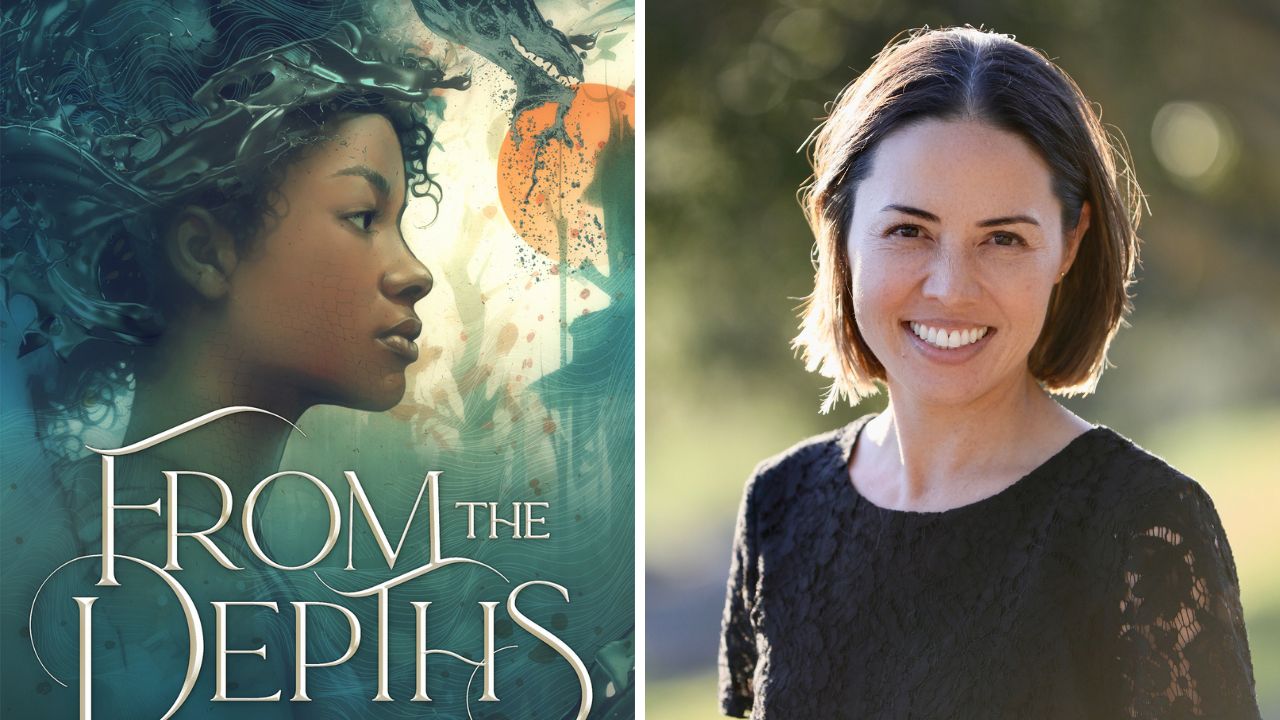
The following is a guest post from author Emily Renk Hawthorne, author of two fantasy books, Of Mountains and Seas and the upcoming From The Depths. She is a general dentist who works with underserved populations. Her latest book will be released on June 9, 2026. Get your copy here.
In the following guest posts, Emily Rank Hawthrone discusses how easy it is to fall into societal defaults while writing, and what to do about it.
After decades of saying I wanted to write a fantasy novel, I was so excited when my first draft was finally coming together. I just knew my book was going to be different from the fantasy books I’d grown up reading until I realized I’d automatically fallen into a certain societal default.
I grew up reading fantasy where male-dominated casts were the norm. It was so normal to me that I didn’t even think of those casts as male-dominated. They were just the norm. And so my cast was also male-dominated.
A hundred pages into my first draft, I suddenly took a second look at my cast. At the time, I was taking an online writing course full of new writers and a few seasoned ones. There was so much fun experimentation, but some writers were struggling with how to progress. One of my classmates commented that new writers may find it easier to write what they know first and then branch out from there. This got me thinking about what I was writing. I thought, wait a second. If I’m a new writer, a woman writing from her point of view, then why are all my main characters male?
There’s nothing wrong with having an all-male cast, but I started wondering why I, in particular, was unconsciously choosing to write this way. It shouldn’t have been surprising, based on my past, that this would be my first instinct. But I was surprised and unsettled. How much had I been influenced by society? Were my thoughts and writing as unique as I thought they were? Was I?
I went about slowly and painfully deconstructing myself and my story. Along with the novels I’d grown up reading, I also considered the media and authority figures of my youth, as well as my own people-pleasing tendencies. I flipped the genders of my characters so my cast became predominantly female. I examined the characteristics and personalities I had assigned and kept most of them unchanged even after switching genders. The setting would be in my home state of California. The characters would resemble the Chinese American family and social group I had grown up with. I was trying to shake up reader expectations as well as my own, but in a way, I was now truly writing what I knew.
After five years of figuring out how to tie together all my storylines (that’s a story for another article), I finally had a complete first draft. I sent it to my writing critique group and patiently waited for the initial feedback.
The first critiques that came back asked similar questions and made similar comments:
Why are there so many women?
This isn’t realistic because there are too many Asian people.
After everything I had already learned about my own assumptions and expectations, I probably should have expected responses like these, but I was still taken aback. I questioned my choices, but after letting things sit, I realized comments like these shouldn’t discourage me. If anything, they showed me how strongly many of us are trained to expect certain kinds of protagonists in fantasy stories.
Fast forward to a year after the publication of my debut novel Of Mountains and Seas, I still occasionally get questions about how realistic a mostly Asian and female cast is. I’ve perfected my answers, explaining how there is a large population of Chinese American people in California due to their recruitment for railroad construction and Gold Rush labor. I explain that just because the story is told from their points of view doesn’t mean there aren’t other people in their world, and if needed, I point out all the other diverse characters in my book from various backgrounds, whether they’re male, female, or non-binary. I don’t expect those assumptions to change overnight, but I hope I’m cracking open a door they’ll eventually venture through.
I’ve tried to take the lessons I’ve learned from writing my first novel and apply them moving forward. Sometimes I switch up a character’s appearance, gender, background, or personality after I’m well underway writing them, just to shake up what my mind was defaulting to. Sometimes I find myself searching online to question whether certain aspects of my story come from bias. Outside influence is inescapable, and it’s not always a bad thing, but I’m trying to be more intentional in how it appears in my writing.
Fantasy has always been about imagining worlds different from our own. For me, learning to write my first novel meant imagining a familiar world in a new medium—moving away from the books I’d read as a child and building a world that looked more like the communities I grew up in. If readers sometimes find a mostly Asian and female cast surprising, that only reminds me how many stories like this still haven’t been told—and how much room there is to expand what fantasy can be.
For more information on Emily Rank Hawtorne, you can visit her website.
