
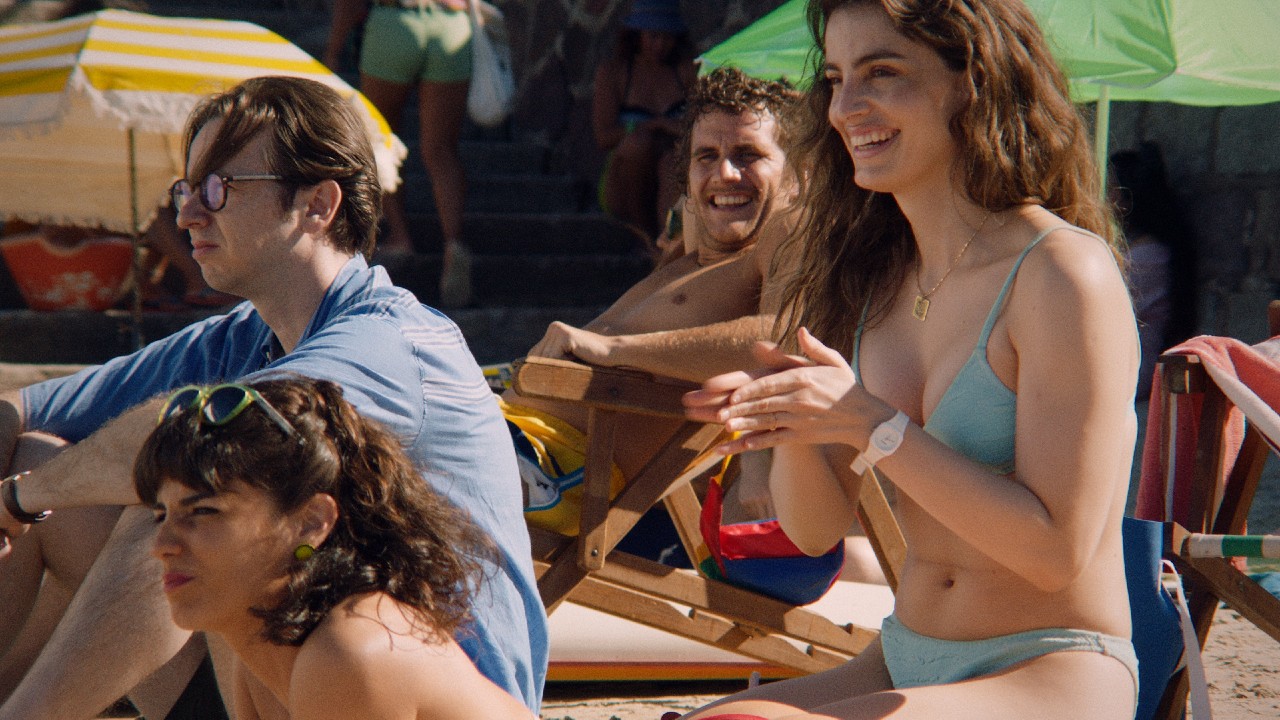
Adaptations are tricky things. And Summer War, an adaptation of one of my favorite books, Roberto Bolaño’s novel “The Third Reich,” is the kind of adaptation that is more concerned about vibes than setting. Ironically, that makes it a very good adaptation, because it’s in many ways harder to capture Bolaño’s playfulness and tension than it is to tell a very faithful story.
In the film, Alicia Scherson significantly alters the setting in order to give the movie a stronger political and thematic resonance. The book is originally set on the Spanish coast, but Scherson relocates it to Chile during 1989, the end of the Pinochet dictatorship.
We follow Udo, who returns to the country after many years, at a time when it seems like things are about to break and change forever. But Udo doesn’t really understand the political timing or the country he is now returning to, which in a way really helps the movie explain not just all the ways Udo is wrong but all that he’s missing. It’s a very interesting setup for the politics that even someone fairly familiar with the time period and the history didn’t know about.

But the movie doesn’t spoon-feed themes; it just presents information and uses Udo as a way to tell a story that is at times frustrating, intriguing and often just baffling in its realness. The arrogance he displays in believing he knows best is at times annoying, but more often than not, very understandable. We’ve seen so many people pretend things are better than they are because, on the surface, everything is working out for them.
There’s something bewildering about the way Scherson tells this tale that, in many ways, captures the experience of reading Bolaño. I read my first book by him, The Savage Detectives, when I was a teenager, and I clearly remember this deep sense of both confusion and wonder at trying to reconcile my probably-too-young brain with not just the message of the book, but the atmosphere it created. In many ways, Summer War embodies that perfectly. It’s engaging even when it’s befuddling—which it is a lot.

Perhaps one of the most interesting things about the movie is being able to judge Udo as he navigates a world that has changed without his permission or understanding. That, at least, feels like something we can relate to. Both the novel and the movie work as very clear metaphors for imperialism and interventionism, and the message works so much better in Chile.
Summer War isn’t an easy movie to watch. In fact, like the author whose book they’re adapting, there’s a certain pride to how different his is that I cannot help but respect. And though I think someone who loves Bolaño, like me, is likely to get something different out of it, there’s a magic to Summer War that can captivate even those who have no idea about the source material.
I’ll admit I watched the movie twice before I even attempted to put my thoughts in order, and I’m left with the sudden desire to watch it again. I’m sure I’ll discover something new. Perhaps I’ll understand it; perhaps I won’t. But I promise, I won’t want to look away.
Summer War premiered at the Tribeca Film Festival.
