
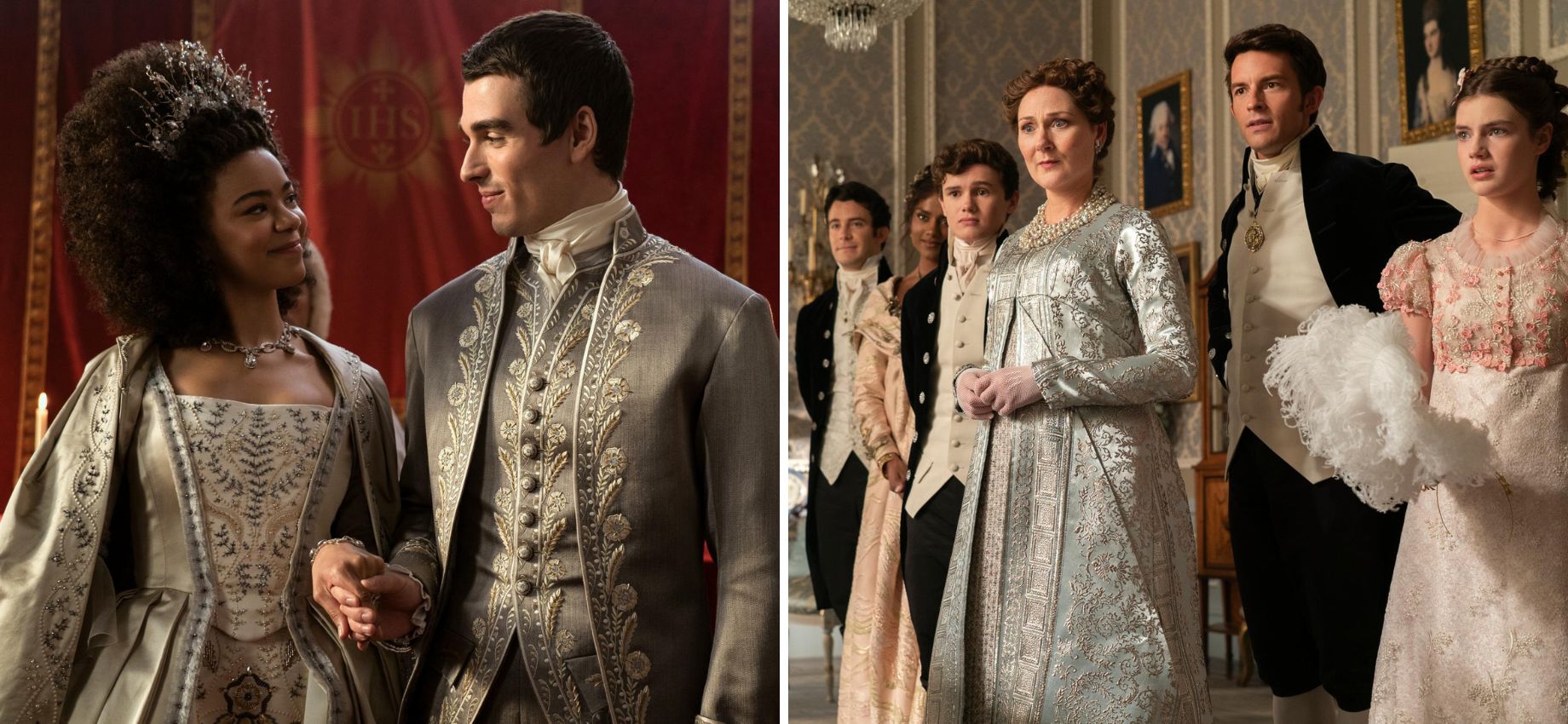
Dearest gentle readers, a new social season will be upon us before we know it. Now is an excellent time to examine how the ton’s past informs its present. More than a few narratives thread their way through Queen Charlotte: A Bridgerton Story to Bridgerton, but one of the more subtle ties is that spun by their title sequences. Both are visually stunning enough not to skip when Netflix suggests it, but, more importantly, they tell an engaging story that spans decades – much like the original show and its prequel series.
Queen Charlotte takes place 40 years before Bridgerton, chronicling the early days of the delicate yet devoted 57-year marriage of Queen Charlotte and King George. Over its six episodes, Charlotte and George test the larger society – and each other – with their love story that challenges the standards of the Georgian Era. Most notably and from the spinoff’s first episode, the House of Lords plans and implements the fictional “Great Experiment” to create an integrated nobility when King George’s mother, Princess Augusta, describes Charlotte as “very brown.”
Oprah Daily is one of many outlets that examined the research into how the real Queen Charlotte may have been the first mixed-race or Black British royal. Queen Charlotte: A Bridgerton Story’s executive producer and director Tom Verica said the show “wanted to take that in a different direction than what the history books have said happened — which was basically to bury that and not deal with it. We wanted to shine a light on that element.” That dedication is also evident in the title sequences bridging the Bridgerverse.


Before crossing that bridge, it’s best to analyze the animated story that leads up to it – Queen Charlotte: A Bridgerton Story’s title sequence created by Joe Dennis and Manddy Wyckens, commissioned through Studio AKA. “The original idea was to create a sequence that retraces the steps of Queen Charlotte in a similar fashion to the show, which has been done by weaving vignettes in such a way that we glimpse at the story and blur the lines between the Queen from the past and the one in the present,” Wyckens wrote.
The minute-long title sequence begins with Charlotte arriving at a palace where the light – artificial or otherwise – finds and follows her. That single shot outside of the storied building is the only one in which Charlotte is entirely and independently in the sun. From then, Brimsby is five paces behind, Lady Agatha Danbury accompanies her, or King George is by her side. Queen Charlotte’s events chronicle the pressures of embodying that guiding light, including its grander sociopolitical impacts on the titular character.
The darkness looming in every corridor and on every stairwell symbolizes the loneliness and secrecy clouding the earliest days of Charlotte’s marriage and her reign. Even in a crowded gallery, the spotlight shines on Charlotte by herself. With the severity of George’s illness similarly shrouded, Charlotte is isolated for most of the title sequence – until she shares the spotlight with George. The light they bask in is far bigger and brighter than that on the spectators around them. Their unity (and Charlotte and Agatha’s) is paramount.

That sentiment, illustrated through cleverly rendered details and sharply defined focus, comes full circle by Queen Charlotte: A Bridgerton Story 1×06, “Crown Jewels,” when George tells Charlotte, “This madness has been my secret my entire life. This darkness is my burden. You bring the light.” From the title sequence’s first shot to the last episode’s final frame, Charlotte brings light to the prequel series, George’s life, and the greater ton.
Whether carrying a lantern in a dark hallway or illuminating a room by opening a door, Charlotte creates lasting change with that light – with her love. Lady Danbury echoes as much to Simon Basset, the Duke of Hastings, in Bridgerton 1×04, “An Affair of Honor.” She tells him, “Look at our queen. Look at our king. Look at their marriage. Look at everything it is doing for us, allowing us to become. We were two separate societies divided by color until a king fell in love with one of us. Love, Your Grace, conquers all.”
Before making that very pivotal point, Lady Danbury tells Simon, “I understand that you believe that such subjects as love and devotion, affection and attachment, you find it all trife and frivolous. But have you any idea those very things are precisely what have allowed a new day to begin to dawn in this society?” That dawn is a product of the light Charlotte carries within herself and extends from herself, as depicted in Queen Charlotte’s title sequence. Without her, the Bridgerton family tree ceases to exist.


There would be no chance, however dwindling and no matter the circumstances, for Colin Bridgerton and Marina Thompson to even ponder engagement. Simon and Daphne Basset’s marriage, as well as that of Anthony and Kathani (Kate) Bridgerton, would not be accepted, let alone possible. Bridgerton’s title sequence featuring that family tree of beloved romantic heroes and heroines is only a reality because of Queen Charlotte: A Bridgerton Story‘s telling of the titular character’s experiences and love story.
Despite Queen Charlotte: A Bridgerton Story premiering four years after Bridgerton debuted, the spinoff series takes nuggets of backstory from the original series and expands them into critical world-building details with character-driven stakes. In turn, every love story, especially Charlotte in George’s in the 1800s, holds an even greater significance. It’s a testament to the creatives behind these shows that these themes are strongly represented in their one-minute title sequences.
Netflix allows viewers to skip those stylistic introductions to romantic dramas, but the dialogue between the shows is reason enough to reconsider. The details in Bridgerton’s, like the dance card for Daphne’s season or Edmund’s watch for Anthony’s, are lovely. However, they aren’t possible in a romantic context without Golda Rosheuvel and India Amarteifio‘s formidable Charlotte and the light she brings in Queen Charlotte: A Bridgerton Story’s title sequence and carries throughout two shows and many decades.
—
What is your favorite detail of either show’s title sequence? Let us know in the comments below!
Bridgerton and Queen Charlotte: A Bridgerton Story are streaming on Netflix now.
